

TL;DR
The best DIY pet Halloween costumes start with something your dog already wears without a fuss. Think collar tag, bandana, walking harness, or lightweight shirt, then add only enough detail to make the costume obvious. Keep the face clear, avoid loose pieces, watch your dog’s body language, and take the outfit off if their movement or behaviour changes. For most cats, a Halloween setup around them is a better choice than clothing.
Affiliate disclosure: This post includes Amazon.com product links. If an approved affiliate tag is added before publication, Family Haven Studio may earn from qualifying purchases at no extra cost to you.
You know that moment when you finish an adorable dog costume, put it on, and your dog immediately stands there like you’ve made a terrible mistake?
That’s the part most costume lists skip.
The goal of DIY pet Halloween costumes isn’t to cover your dog in as much fabric as possible. You want the idea to read quickly while your dog can still walk, sit, breathe, see, hear, and act like themselves.
That’s why this list starts small.
Some dogs are happy in a shirt. Others will tolerate exactly one bandana and would like everyone to respect the terms of that agreement.
Either dog can still have a great Halloween costume.
Start With the Least Costume Your Dog Already Accepts
A dog that happily wears a bandana does not need a full-body outfit just because you found extra felt.
Current AAHA guidance recommends choosing simple costumes, fitting them properly, keeping movement and breathing unrestricted, and skipping dress-up when the animal dislikes clothing. Their current pet costume safety advice also flags heat, small decorations, headwear, and poor fit as potential problems.
Use this quick ladder:
| Your dog normally accepts | Start here | Good options |
|---|---|---|
| Collar only | Soft collar tag | Heart tag |
| Bandana | Flat bandana design | Pumpkin, sheriff, skeleton |
| Walking harness | Small back piece | Bat, bee, ladybug, shark |
| Lightweight shirt | Soft fabric addition | Dinosaur, cactus |
| Short cape | Small cape design | Superhero, ghost, candy corn |
| Regular dress-up | More detailed back piece | Taco, sushi |
Tip: Always choose the lowest row that works. You don’t get bonus Halloween points for moving down the table.
Check the Fit Before You Add Anything Else
Put the base item on first.
Your dog should still be able to:
- walk with their usual stride
- sit and lie down
- turn their head freely
- see normally
- hear normally
- breathe and pant freely
- drink water
- use the leash connection
- keep their ID accessible
- go to the bathroom without fabric getting in the way
ASPCA’s Halloween pet safety guidance says costumes shouldn’t interfere with movement, sight, breathing, barking, or meowing, and warns against small or dangling pieces that can be chewed off.
Your Dog’s Reaction Matters More Than the Costume
A quiet dog is not automatically a happy dog.
PetMD lists stillness, lip licking, head turning, a tucked tail, trying to get away, growling, and barking among possible signs of discomfort or anxiety in dogs. Their pet stress signs are useful if you’re unsure whether your dog is posing or simply waiting for the outfit to disappear.
If your normally bouncy dog suddenly becomes a statue, take the costume off.
You can always choose something smaller.
A Quick DIY Dog Costume Chooser
If you already know what your dog tolerates, this gets you to an idea quickly.
| If your dog… | Try first | I’d skip |
|---|---|---|
| Hates clothes | Heart tag | Shirt or cape |
| Likes bandanas | Pumpkin, sheriff, skeleton | Side panels |
| Wears a walking harness daily | Bat, bee, shark, flower | New body straps |
| Is comfortable in shirts | Dinosaur, cactus | Heavy layers |
| Gets hot easily | Tag or bandana | Padded costumes |
| Chews additions | Plain bandana design | Dangling pieces |
| Needs a five-minute photo | Heart tag, shark fin | Detailed food costume |
| Already enjoys dress-up | Taco or sushi | Anything that changes their normal walk |
Now pick the idea that fits your dog, not the one that looks most impressive on somebody else’s.
A Few Supplies Can Cover Most of These Ideas
You do not need a cart full of Halloween supplies.
For most projects, gather:
- paper for making a pattern
- scissors
- soft felt
- lightweight cotton
- needle and thread
- fabric marker
- a collar, bandana, walking harness, or shirt your dog already wears
- sew-on fastener tape where a removable fabric connection makes sense
For larger wings and back pieces, the current Amazon.com USA soft felt sheet pack contains 28 sheets measuring 12 by 12 inches and about 1.4 mm thick, which is much more useful here than the tiny 4-inch felt squares linked in the older draft.
If you draw your patterns directly on dark felt, this Amazon.com USA tailor chalk marking set gives you ten triangular fabric chalk pieces for tracing before you cut.
Tip: Make a paper version first. It is much easier to shorten a paper bat wing than discover the finished felt wing reaches halfway across the sofa.
20 DIY Pet Halloween Costumes You Can Make at Home
1. Beanie Baby-Inspired Heart Tag
Best for: Dogs that dislike clothing
Difficulty: Very easy
Sewing: Optional
Time: About 10 to 20 minutes
This is the first costume I’d try for a dog that wants no part of a shirt, cape, or pair of wings.
Cut one oversized heart from red felt. Add your dog’s name, birthday, or a short funny description in white.
Keep the design inspired by the familiar plush-toy tag idea rather than copying branded artwork exactly.
How to Make It
Cut two matching heart shapes if your felt feels thin. Join them around the edges, then add a short fabric loop at the top.
Attach the loop high on your dog’s normal collar.
The tag should be large enough to show in a photo but short enough that your dog cannot easily reach it with a paw or mouth.
Why This One Works
There is almost no body coverage.
Your dog stays dog-shaped.
The heart does all the explaining.
Photo tip: Get down to your dog’s eye level and use a plain background. A bright red heart already gives the photo enough Halloween personality.
2. Pumpkin Bandana
Best for: Dogs that already wear bandanas
Difficulty: Easy
No-sew option: Yes
Time: About 15 minutes
A pumpkin bandana gives you Halloween without asking your dog to become an actual pumpkin.
Start with an orange bandana that already fits.
For the quickest version, draw a simple jack-o’-lantern face across the front with a suitable fabric marker.
For a quieter version, add three curved black lines for pumpkin ribs and one small green leaf near the edge.
Keep the back smooth against your dog.
Skip: bells, dangling leaves, beads, or anything else your dog can mouth.
3. Cowboy Sheriff Bandana
Best for: Dogs willing to wear one accessory
Difficulty: Easy
Time: 10 to 20 minutes
Take a tan, red, or denim-look bandana.
Add one broad yellow sheriff star in the middle.
You can write your dog’s name across it or simply use SHERIFF.
That’s enough.
Do not put the cowboy hat on the dog unless they already wear headgear without stress.
You wear the hat.
Your dog gets promoted.
4. Skeleton Bandana
Best for: Last-minute Halloween
Difficulty: Easy
No-sew: Yes
A black bandana plus white bones gives you a recognizable Halloween idea in minutes.
Use a fabric marker or flat white felt to make broad rib shapes across the front.
You do not need an anatomy textbook beside you.
Three or four white curved lines and a center spine shape will get the message across.
This works especially well for fluffy dogs because the design stays visible on the chest instead of disappearing into the coat.
5. Soft Bat Wings
Best for: Dogs that already wear a walking harness
Difficulty: Easy to moderate
Time: About 30 to 45 minutes
Bat wings give you a strong silhouette without touching the dog’s head or legs.
Draw one short rounded wing on paper, fold the paper, and cut both sides together so they match.
Then copy the shape onto black felt.
Keep the Wings Short
Mount the middle section over the top of the dog’s normal walking gear. Do not cover buckles or the leash connection.
Have your dog turn left and right indoors.
If the wings hit furniture every time they change direction, shorten them.
A little bat is still a bat.
Your dog does not need the wingspan of a coffee table.
6. Bumblebee Back Piece
Best for: Dogs comfortable in their walking gear
Difficulty: Easy
Time: About 20 to 30 minutes
Yellow, black, and two pale wings tell this story quickly.
Cut one yellow oval sized to your dog’s upper back. Add two or three broad black stripes and two short soft wings.
Connect the finished piece to the fabric portion of familiar walking gear without blocking clips, rings, or straps that need to work normally.
Skip the antennae.
The colour combination already says bee.
7. Little Ladybug Back Piece
Best for: Small and medium dogs
Difficulty: Easy
Cut one red oval.
Add large black felt spots and one black center strip.
That is the ladybug.
You do not need wire wings, head elastic, pipe-cleaner antennae, or a tutu.
Some older DIY versions use those additions, but simpler is the better direction here. Current veterinary guidance specifically favors straightforward outfits with fewer extra pieces.
Your dog is going trick-or-treating, not defending a dissertation on insect anatomy.
8. Butterfly Wings
Best for: Dogs comfortable with a light back piece
Difficulty: Moderate
Make the wings small enough that they stay close to the shoulders.
Choose two or three colours instead of every colour in the felt pack.
Good combinations include:
- orange, black, and cream
- lavender, blue, and white
- teal, navy, and pale yellow
- burgundy, dusty pink, and cream
Use large flat colour blocks.
Skip loose glitter, beads, gems, and dangling trim.
Scale the Wings to Your Dog
A broad dog can wear a wider shape.
For a small dog, two compact rounded wings may look better than a large set that extends past the body.
Your dog should still turn, sit, and lie down normally.
9. Soft Shark Fin
Best for: Dogs that dislike side coverage
Difficulty: Easy
Time: About 20 minutes
Cut two matching fin shapes from gray felt.
Join the edges and leave the base flat.
You do not need a hard insert.
Doubled felt usually gives enough structure for the fin to show in a photo while staying soft if your dog lies down.
Connect the base to the upper back.
That’s it.
One fin can turn an ordinary hallway into shark territory with very little effort.
10. Flower Garden Back Piece
Best for: Dogs that like their usual walking gear
Difficulty: Easy to moderate
Cut broad green leaves and simple flowers from felt.
Keep the flowers flat or use only two soft layers.
Choose a small palette:
- forest green, rust, and cream
- sage, dusty pink, and burgundy
- olive, mustard, and ivory
Attach the flowers across a removable fabric panel that sits on the upper back.
Keep everything short.
A flower does not need to be the size of your dog’s head to show up in a picture.
11. Rainbow Cloud
Best for: Easy photos
Difficulty: Easy
Cut one white cloud from doubled felt.
Add three to six short coloured strips beneath it.
Rather than letting the strips hang loosely, attach most of their length to the backing so they cannot swing near your dog’s legs.
For a smaller dog, three or four broad colour bands will often read better than six tiny ones.
Cloud.
Rainbow.
Done.
12. Soft Spider Back Piece
Best for: Dogs that tolerate light additions
Difficulty: Moderate
Cut one black oval for the spider body.
Make the legs from short doubled-felt strips.
No wire.
No pipe cleaners.
No long legs swinging beside your dog’s feet.
Arrange four short legs on each side of the oval, then attach the piece high on the back.
Test It Before Halloween
Have your dog walk past furniture, turn, sit, and lie down.
If a leg folds harmlessly with movement, good.
If it pokes your dog or catches on something, shorten it.
13. Dinosaur Spikes
Best for: Dogs that already wear a shirt
Difficulty: Moderate
Start with a lightweight dog shirt your dog already knows.
Cut rounded triangles from felt. Use the largest near the shoulders, then make them smaller as they move down the back.
You can use doubled felt instead of filling each spike.
That keeps the row softer and lighter.
Sew each spike to the shirt rather than putting new straps around your dog’s body.
A familiar shirt plus one new detail is easier to assess than introducing a completely new outfit all at once.
14. Cactus Back Piece
Best for: Shirt or walking-gear wearers
Difficulty: Easy
Cut one green upper-back piece.
Add short pale stitched lines or fabric-marker strokes for the cactus texture.
Finish with one or two flat pink flowers.
Skip the large stuffed cactus arms.
They add width and more chances to bump into furniture.
The green body and pink flowers already make the idea clear.
15. Tiny Superhero Cape
Best for: Dogs that already accept a short cape or shirt
Difficulty: Easy
Cut a small cape from lightweight cotton.
Round the lower corners and keep the hem well above the back legs.
Add one large flat emblem in the centre.
Connect the cape to a shirt or walking gear rather than tying cords tightly around the neck.
No dog mask needed.
If this picture needs a masked hero, congratulations, that role belongs to you.
16. Face-Free Ghost Cape
Best for: Dogs that tolerate light upper-back fabric
Difficulty: Easy
Forget the sheet over the head.
Your dog does not need eye holes cut into fabric to look like a ghost.
Cut a short white cape and put two oversized black ghost eyes on the back.
The dog’s real face stays completely clear.
Why I Prefer This Version
Current AAHA and ASPCA advice emphasizes keeping sight, breathing, and normal movement unrestricted. A back-facing ghost design keeps the joke while removing fabric from the dog’s face.
You get the ghost.
Your dog keeps their head.
Everybody wins.
17. Candy Corn Capelet
Best for: Dogs that tolerate short upper-back pieces
Difficulty: Easy
Cut a small rounded triangle.
Divide it into three horizontal bands:
- cream
- orange
- yellow
Keep the piece high on the back and well away from the legs.
A small dog does not need to become a life-size piece of candy corn.
The colour pattern makes the idea obvious.
18. Starry Wizard Cape
Best for: Cape-tolerant dogs
Difficulty: Easy
Use dark navy or purple lightweight fabric.
Add a few flat cream, yellow, or pale silver stars and one moon.
Attach the short cape to familiar gear.
Skip the pointed hat.
The stars already tell the story.
Your dog’s ears do not need another responsibility tonight.
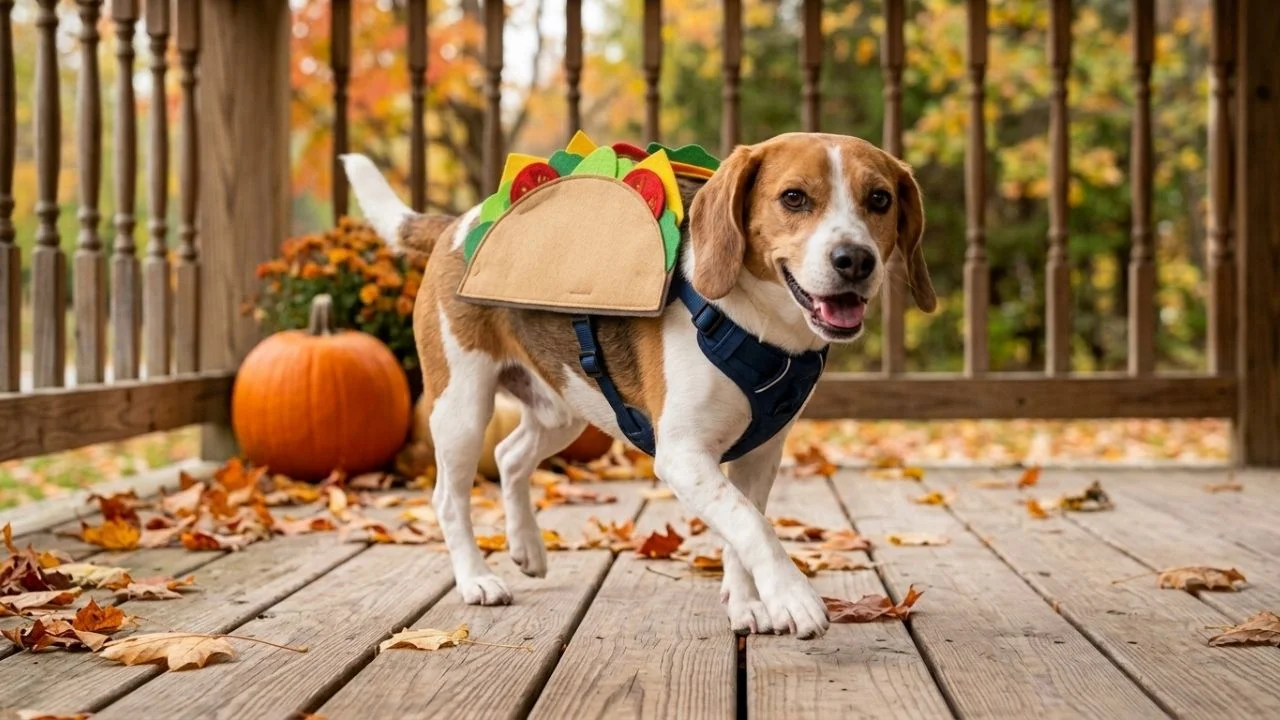
19. Flat Taco Costume
Best for: Dogs already used to a back piece
Difficulty: Moderate
The taco does not need two stiff shells hanging down your dog’s sides.
Build the idea on top instead.
Cut a curved tan backing, then add broad green lettuce, red tomato, and yellow cheese shapes near the top.
Keep every ingredient soft and flat.
The dog becomes the filling by suggestion.
No sandwiching required.
Skip this idea if your dog gets hot quickly or keeps turning around to inspect anything placed on the back.
20. Small Sushi Roll
Best for: Dogs that already tolerate more detailed costumes
Difficulty: Moderate
Build one compact sushi piece that sits on top of familiar walking gear.
Use a white felt rectangle for rice. Add a flat pink or orange piece for fish, then wrap a black strip around the sushi piece, not around your dog.
That last part matters.
The costume should sit on the dog.
The dog should not be wrapped into the costume.
If your dog spends the first minute turning around to investigate dinner, switch to something smaller.
Which DIY Pet Halloween Costumes Are Easiest to Make?
If time is disappearing and Halloween is getting closer, start with the low-effort options.
| Costume | Approx. project time | Sewing needed? | Body coverage |
|---|---|---|---|
| Heart tag | 10–20 min | Optional | Minimal |
| Pumpkin bandana | 10–15 min | No | Minimal |
| Sheriff bandana | 10–20 min | Optional | Minimal |
| Skeleton bandana | 10–20 min | No | Minimal |
| Shark fin | 20–30 min | Helpful | Low |
| Bee back piece | 20–30 min | Helpful | Low |
| Superhero cape | 20–30 min | Helpful | Low |
| Ghost cape | 20–30 min | Helpful | Low |
| Taco | 30–45 min | Helpful | Medium |
| Sushi | 30–45 min | Helpful | Medium |
These are estimates for the simple versions described here, not universal project times.
Your dog’s size and how much detail you add will change them.
Want More Homemade Dog Costume Ideas?
You do not need another 100 ideas before choosing one, but it can help to compare a few established pet and lifestyle sites if none of these feels right.
Pretty Fluffy’s current easy no-sew costumes article focuses on bandanas, familiar clothing, and uncomplicated homemade ideas. It was updated in August 2026.
Dogster’s 2026 homemade dog costume ideas roundup gives you 18 different DIY directions with materials and difficulty information.
HGTV’s larger DIY dog costume gallery is useful for broader inspiration, though I would simplify some of the more elaborate ideas before putting them on a dog.
Use those for more ideas.
Use your dog to decide which idea survives.
What About DIY Halloween Costumes for Cats?
For most cats, I would skip the wearable outfit.
Cats Protection advises against dressing cats for entertainment because clothing can interfere with movement, grooming, temperature control, and normal behaviour. Their Halloween guidance also notes that freezing or becoming unusually still does not necessarily mean a cat accepts what is happening. (cats.org.uk)
Their current cat Halloween advice recommends creating the seasonal moment without forcing clothing onto the cat.
Try this instead:
- place a pumpkin safely in the background
- use an orange or black blanket the cat already likes
- decorate a cardboard box
- add a seasonal cat-safe toy
- photograph the cat beside the dressed-up human
- use a simple Halloween backdrop
- add costume details digitally after the photo
The cat still gets to be in the Halloween picture.
The cat simply does not need to become a taco.
Get the Photo Without Turning It Into a Photo Shoot
For plenty of people, the photo is the whole reason for making DIY pet Halloween costumes.
So prepare the picture before you put anything on your dog.
Blue Cross recommends keeping pet photo sessions short, working with willing animals, and photographing natural behaviour instead of forcing a pose. Their pet photography tips are a useful follow-up if you want a better photo without asking more from your dog.
Set Up First
Before the costume goes on:
- open the camera
- check your lighting
- clear distracting objects
- choose the background
- place any pumpkins or seasonal props
- decide where you want your dog
Then dress your dog.
Not the other way around.
Get Down to Dog Level
Standing-height photos can make a small dog disappear into the floor.
Lower yourself.
A heart tag, shark fin, or pair of bat wings becomes much easier to see.
Use One Strong Background Detail
Try:
- one pumpkin
- a plain front door
- fallen leaves
- a dark blanket
- an orange cushion
- a quiet patch of lawn
If you’re using your porch or entry as the setting, these fall entryway decor ideas can help you keep the background seasonal without making it compete with your dog.
Photograph What Your Dog Already Does
If your dog likes sitting, take the sitting photo.
If they stand and stare at you because dinner is seven minutes late, use that.
If they lie down while wearing the shark fin, you now have a resting shark.
Work with the dog you have.
Stop Early
AKC’s dog costume advice recommends keeping costumed photo sessions brief and removing the outfit when the dog looks uncomfortable.
You need one good picture.
Not photo 147 after everybody has reconsidered Halloween.
If Your Dog Hates Costumes, Skip the Costume
Your dog can be part of Halloween without wearing a costume.
Try:
- a normal seasonal bandana they already accept
- an orange leash
- a Halloween ID tag
- a seasonal toy beside them
- one pumpkin in the background
- an autumn blanket
- a porch photo
- a family costume where only the humans dress up
AAHA recommends switching to a less intrusive option or skipping the costume when a pet does not enjoy clothing.
That is not a failed photo.
It is you paying attention to your dog.
Pet Halloween Costume Safety in One Minute
You do not need a veterinary textbook beside the sewing basket.
Keep these rules close:
Keep the face clear. Anything that interferes with normal breathing, sight, or hearing needs to change.
Avoid loose little pieces. Buttons, bells, gems, ties, and other easily chewed additions can become choking or swallowing risks.
Watch the temperature. A dog already has fur. Extra fabric can add heat, so keep weather and activity level in mind.
Keep normal gear usable. Do not cover the leash connection or ID.
Stay with your dog. A costumed dog should not be left unsupervised.
Believe behaviour. If your dog stops moving normally, scratches at the outfit, bites at it, keeps trying to escape, or shows another clear behaviour change, remove it.
DIY Pet Halloween Costumes FAQ
What Is the Easiest DIY Pet Halloween Costume?
A large felt heart attached to a normal collar is one of the easiest DIY pet Halloween costumes because it needs little material and almost no body coverage.
For a dog that already wears bandanas, pumpkin, sheriff, or skeleton designs are also quick.
What DIY Dog Costume Can I Make Without Sewing?
Start with a bandana and a suitable fabric marker.
You can make:
- a pumpkin
- sheriff
- skeleton
- simple Halloween face
- colour-based costume
A soft felt collar tag can also work with little or no sewing if you have a secure fabric loop.
What Can I Make at the Last Minute?
Use something already in the house.
A bandana becomes a pumpkin.
A familiar walking harness becomes a shark or bat.
A dog shirt becomes a dinosaur with a short row of soft felt spikes.
Using an item your dog already wears saves time and gives you one less fit problem to solve.
How Should a Dog Halloween Costume Fit?
Your dog should still walk, sit, lie down, breathe, see, hear, and go to the bathroom normally.
The outfit should not twist around the body or create pieces the dog can easily chew. AAHA also advises against costumes that are too tight or loose enough to create snagging and tripping problems.
How Long Can a Dog Wear a Halloween Costume?
There is no single safe number that applies to every dog and every costume.
Consider:
- your dog’s response
- the temperature
- body coverage
- activity
- fit
- whether the dog merely tolerates the outfit or actually behaves normally in it
For a dog that only accepts dress-up briefly, a quick supervised photo may be enough.
Why Does My Dog Freeze in a Costume?
Freezing can be a sign of discomfort or anxiety.
PetMD includes stillness among the behaviour changes that can signal a dog is uncomfortable. Remove the costume and see whether normal behaviour returns.
Do not assume “not fighting it” means “enjoying it.”
Can I Use Hot Glue on a Dog Costume?
Build and glue pieces away from the dog, then allow everything to cool and fully set before fitting the costume.
Do not place hot adhesive near the animal.
For pieces close to the body or parts that need to bend repeatedly, stitching is often a better option because it avoids hard dried glue spots.
Can My Dog Wear a Costume While Trick-or-Treating?
Only if your dog already handles both the outfit and the Halloween environment comfortably.
Costumes are only one part of the problem. Halloween also brings unfamiliar people, doorbells, children, masks, darkness, noise, and frequent opening of doors.
AKC notes that all of that activity can stress dogs, and ASPCA recommends keeping pets secure when door traffic increases.
For some dogs, the best Halloween plan is staying home.
Should Cats Wear Halloween Costumes?
For most cats, I would choose a costume-free setup.
Cats Protection advises against recreational clothing for most cats because it can interfere with normal behaviour and cause stress.
Use the background, blanket, box, toy, or your own costume to create the Halloween theme instead.
Make the Costume Clear, Then Stop
The best DIY pet Halloween costumes are not always the ones with the most pieces.
Start with what your dog already wears.
Add one detail that makes the idea obvious.
Check the fit.
Have your phone ready.
Get the photo while your dog is still behaving normally.
Then take the costume off.
You are not trying to win a costume-construction contest. You are trying to make a fun Halloween memory with the animal standing right in front of you.
If the smallest version makes you laugh and barely bothers your dog, you picked well.