

TL;DR
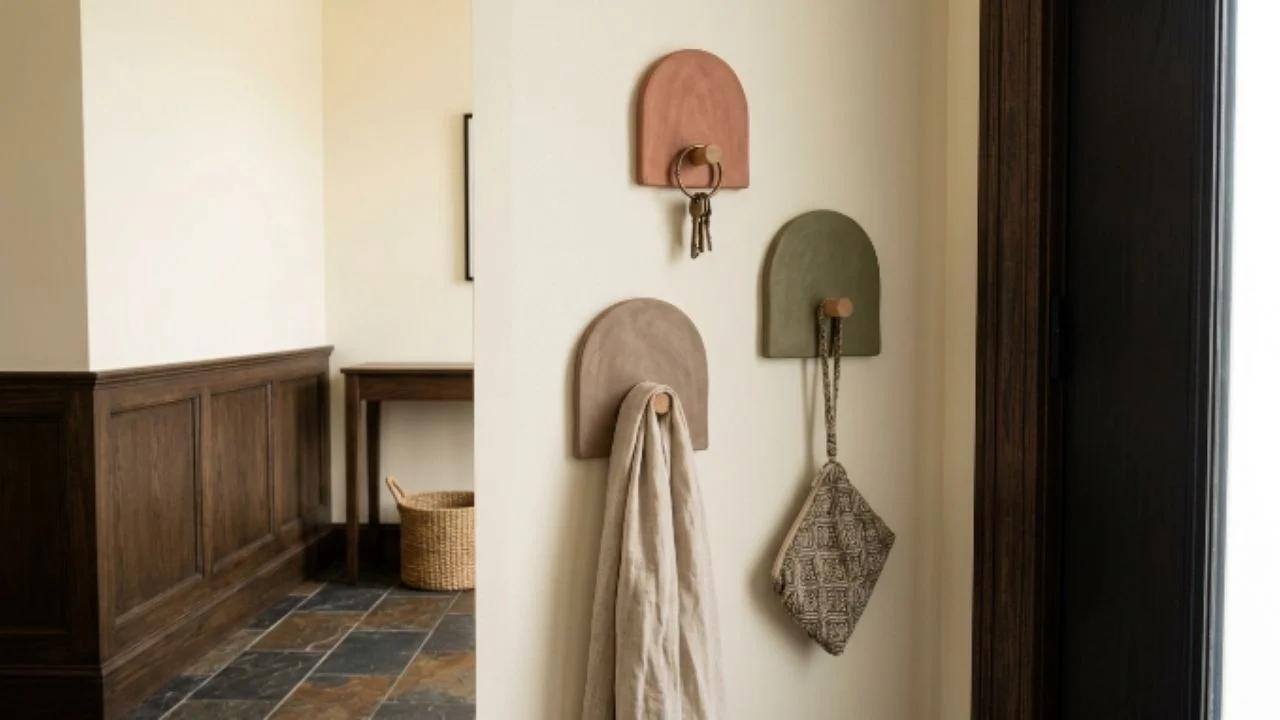
- The best air dry clay wall hook ideas use clay for the decorative shape and proper hardware for the part that actually holds an item.
- Start with a broad, simple form such as an arch, pebble, circle, leaf, or house. Thin points and narrow projections are easier to damage.
- A small wall rarely needs a dozen hooks. Two or three coordinated pieces can give you useful storage without making the space feel crowded.
- Let the room guide the finish. Soft stone shades suit calmer spaces, while checkerboards, rainbows, suns, and mushrooms add more personality.
- Keep your clay thickness, drying method, and finishing products consistent with the directions for the clay you bought. Brands differ.
- Before making the whole set, finish one hook completely. You will catch color, scale, hardware, and placement mistakes before repeating them.
A narrow wall can be annoyingly awkward.
It is too small for another cabinet, too useful to leave empty, and somehow every basic hook you find looks as though it belongs behind a utility-room door.
That is why air dry clay wall hook ideas make so much sense in a small space. You get something useful on the wall, but the useful part can also look like a tiny piece of handmade decor.
The trick is knowing where to stop asking the clay to do all the work.
A broad clay backplate can carry the color, texture, shape, and personality. A suitable wooden peg, metal hook, screw, or other wall hardware handles the hanging job.
Once you separate those two jobs, you can have far more fun with the design.
How to Choose the Best Air Dry Clay Wall Hook Ideas for Your Space
Before choosing a mushroom because it is adorable or a checkerboard because it caught your eye, look at the wall.
What is missing there?
A place for a necklace beside your dresser needs a different hook from a landing spot for keys near the door. A child’s room can handle more playful color than a quiet neutral hallway.
Start with what you need to hang
Use the finished hook for a sensible job.
| What you want to hang | A useful direction | Think about |
|---|---|---|
| Necklace or bracelet | Pebble, moon, button | Small peg and easy reach |
| Hair accessories | Rainbow, pocket, house | Grouping 2 or 3 |
| Lightweight scarf | Arch, leaf, sunburst | Peg length and placement |
| Cap | Arch or house | Secure wall fixing |
| Small empty fabric pouch | Pebble or button | Keep the load light |
| Keys | Compact shape | Use suitable hook hardware |
| Heavy coat | Skip decorative clay as the main support | Choose hardware made for the load |
| Loaded backpack | Skip this project for that job | Use a proper structural wall hook |
Quick rule: Clay creates the look. Hardware does the hanging.
Crayola notes that pieces made with its Air-Dry Clay can crack when they are too thin, when too much water is worked into the clay, or when the clay constricts around a rigid support during drying. Follow the instructions for the exact product in your hands rather than treating one online measurement as universal.
If this is your first time working with the material, this air dry clay guide walks through basic rolling, storing, smoothing, drying, and finishing in plain language.
A few useful supplies
You do not need a giant tool kit.
| Supply | Why it helps |
|---|---|
| Air-dry clay | Decorative backplates and shapes |
| Smooth roller | More even slabs |
| Craft knife | Cutting templates and silhouettes |
| Fine sandpaper | Tidying dry edges |
| Acrylic paint | Adding the finished palette |
| Small wooden or metal hooks | Functional hanging point |
| Suitable wall hardware | Securing the finished piece |
| Compatible sealer | Optional surface protection |
For a ready-made clay option, DAS air dry clay is an Amazon.com USA listing I verified for DAS white air-hardening clay. A warm neutral such as FolkArt mushroom acrylic paint also suits several ideas below, and Mod Podge matte sealer is one possible matte finishing product if it suits your clay and paint system.
Do not assume a sealer makes air-dry clay suitable for wet environments or heavy use. Air-dry clay remains different from kiln-fired ceramic.
Why These Air Dry Clay Wall Hook Ideas Work in Small Spaces
A small wall rewards restraint.
You can use height instead of floor area, turn an awkward strip beside a door into useful storage, or fill a spot above a nightstand without adding another piece of furniture.
The wall hook also becomes part of the decoration, so you are not solving storage and then trying to hide the solution.
That is the real advantage.
1. Mini Arch Wall Hook
If you want the safest place to begin visually, make an arch.
The shape is simple enough for a beginner, but it still has an architectural quality that looks good in a grown-up room.
Aim for a compact backplate rather than a large statement piece. The original draft used roughly 7 to 9 cm tall by 5 to 6 cm wide as a starting scale, which suits a small wall well.
Make the shape feel intentional
Cut a rectangle first, then soften the top into a broad arch.
Avoid pinching the top into a narrow peak. The broader curve looks calmer and leaves fewer delicate edges.
For color, try:
- warm cream
- dusty terracotta
- olive
- mushroom
- charcoal
- muted clay pink
Best place for it
A narrow entryway, dressing corner, bedside wall, or desk area.
One arch is useful. Three placed vertically at slightly different heights can make an awkward strip of wall feel planned rather than forgotten.
Tip: Keep the peg finish consistent across the set. Three different clay colors can still look connected when each uses the same wood or metal.
2. Organic Pebble Wall Hook
This is the one I would choose for someone who thinks, “Mine is never going to come out perfectly symmetrical.”
Good.
It is not supposed to.
A pebble-shaped backplate looks better when the edges are slightly irregular. You can make two or three pieces that feel related without tracing the same template every time.
The supplied draft already used this approach, pairing an uneven clay plaque with a wooden peg so the finished piece reads more like a small wall object than ordinary storage hardware.
Give it a stone-like finish
Try:
- warm grey
- putty
- sand
- muted sage
- mushroom
- creamy beige
A slightly lighter dry-brushed finish over the raised areas can bring out the handmade texture.
Do not over-sand every tiny mark away. A little unevenness can make the surface feel more like hand-finished pottery.
Best place for it
Beside a bed, along a narrow hallway, or close to a vanity.
A necklace, fabric hair tie, or other light accessory gives the hook a job without covering the entire pebble shape.
If you like useful clay pieces that do more than sit on a shelf, the site’s functional clay glasses holder is another project built around the same idea of combining decoration with everyday use.
3. Crescent Moon Wall Hook
A moon can become childish quickly when every surface around it also has stars, clouds, glitter, and bright yellow paint.
Give the shape some breathing room and it changes completely.
Use a broad crescent with substantial tips. Keep carved texture shallow and position the functional peg toward the lower part of the form.
Skip the obvious color
A moon does not have to be yellow.
Try:
- chalky white
- dusty ochre
- muted blue-grey
- deep navy
- pale clay pink
In a reading nook, deep navy against a warm wall can feel calm and graphic. In a child’s room, cream or muted blue gives you the celestial idea without turning the wall into a theme park.
A useful pairing
One moon plus two small decorative stars.
The stars do not need to become hooks. Let the moon do the useful job and the smaller pieces finish the composition.
That gives the wall a story without making every inch functional.
4. Terracotta Leaf Hook
Leaves already come with an easy design lesson: nature does not need perfect symmetry to look good.
Choose a broad leaf shape with a simple outline. Skip a leaf filled with skinny points unless you are prepared to make those points much thicker.
Press a shallow center vein and a few smaller lines into the surface.
The original version kept the leaf flat and placed the peg toward the lower part of the shape, which keeps the visual idea clear and the functional part simple.
Why terracotta works
Terracotta is forgiving.
Tiny tonal changes and handmade marks suit the color rather than fighting it. A darker wash sitting lightly in the leaf veins can create enough depth that you do not need elaborate painted detail.
Best place for it
Try this in:
- a small entry
- a botanical bedroom
- a reading corner
- a warm neutral hallway
One leaf beside a mirror can be enough.
You do not need to turn the entire wall into a garden.
5. Muted Rainbow Hook
A rainbow can work in a child’s room without looking like it came straight from a preschool supply cupboard.
The secret is the palette.
Use three or four broad color bands instead of seven narrow ones.
Try dusty coral, soft ochre, sage, muted blue, or clay pink. Keep the shape substantial and the edges rounded.
The original project used a flat rainbow form with a separate peg handling the hanging function, which is the better direction for this type of design.
Make it playful, not busy
If you add clouds, keep them chunky.
If you paint four rainbow bands, do not add dots, stars, names, stripes, and another border.
Let one idea win.
Best place for it
A child’s bedroom, creative corner, or playful little reading space.
It is also a sweet way to hold lightweight hair accessories where a child can actually reach them.
6. Speckled Button Hook
This is one of the easiest designs to make look like something you bought from a small interiors shop.
Cut a clean circle, add two shallow decorative button holes, and place the real peg lower down.
The button holes are just visual.
The supplied draft used that exact distinction, which is worth preserving because it stops the decorative idea from interfering with the useful part.
Give it a ceramic-like finish
Start with:
- warm white
- oatmeal
- greige
- stone
- mushroom
Then add tiny irregular speckles.
Do not space them evenly.
You want something closer to a handmade glaze effect than polka dots.
For a more polished paint finish, this air dry clay painting guide explains sanding, painting, and finishing dry clay in an approachable way.
Best place for it
Beside a vanity, narrow desk, or closet.
Try two or three circles at staggered heights and keep the hardware the same.
7. Wavy Checkerboard Wall Hook
This is for the room that needs a bit more personality.
Start with a soft rectangular slab, then cut shallow waves into the edges.
The smart move is not covering the entire thing in checks.
Paint a small checkerboard section on one side and leave the rest of the backplate quiet. The original draft used a partial checkerboard, and that restraint makes the design far easier to live with.
Pick two or three colors
Try:
- cream + terracotta
- oatmeal + olive
- pale pink + brown
- warm white + charcoal
That is enough.
Best place for it
A bedroom, desk wall, studio corner, or other small space that can handle a playful pattern.
Tip: If the hook has a pattern, keep what hangs from it simple. A busy pouch hanging from a busy checkerboard can make a tiny wall feel crowded fast.
8. Little House-Shaped Hook
A house gives you a recognizable silhouette without asking for advanced sculpting.
Keep it simple.
Broad walls, a sturdy roof line, a shallow door, and one or two windows are enough.
The original draft wisely skipped thin chimneys and fussy roof details because those little projections become easy weak spots.
Make a tiny neighborhood
If you have a slightly wider wall, make three houses with different proportions:
- one tall and narrow
- one short and wide
- one simple gabled house
Repeat the same peg finish and use colors from one palette.
Now the variation looks intentional.
Best place for it
A child’s room, entryway, family landing spot, or small hallway.
A light cap or fabric accessory makes sense here. A heavy winter coat does not.
9. Clay Sunburst Hook
A sunburst can become the focal point of a narrow blank wall.
That also means it does not need much company.
Make the rays broad and rounded, with a shallow circular detail in the center.
The original version used warm mustard or ochre and suggested giving the design enough wall space around it rather than packing several together.
That is good advice.
Give this one room
Place it:
- beside a narrow mirror
- above the edge of a small console
- near a reading chair
- on a short hallway wall
One strong sun can do more visually than five little suns lined up in a row.
Color idea
Ochre center, pale clay rays, small oak peg.
Simple.
10. Half-Moon Pocket Hook
This one solves two tiny problems at once.
The hook hangs something light. The shallow pocket catches one or two tiny things that otherwise end up drifting across a bedside table or vanity.
Keep the pocket shallow.
The source draft used roughly 1 to 2 cm as a small decorative depth and specifically warned against treating it as a bowl for keys.
That distinction matters.
What belongs in the pocket?
Think:
- one hair tie
- a small paper note
- a tiny decorative tag
- a lightweight ring, if the shape is secure and appropriate
Not:
- a fistful of coins
- several keys
- heavy jewelry
- anything that puts meaningful force on the clay
Watch the join
If your pocket uses two joined clay pieces, follow the joining directions for the exact clay you bought and inspect the dried seam carefully before finishing.
11. Terrazzo-Style Clay Hook
This is the one to make when you have little scraps left from the other ideas.
Press small irregular clay chips into a fresh slab, then cut a simple round or oval backplate.
The simple silhouette matters because the surface already has movement.
Keep the colors related
Try:
- cream + rust + olive
- white + clay pink + brown
- sand + terracotta + charcoal
Do not add ten unrelated colors because you have ten scraps.
The goal is a terrazzo reference, not a leftovers competition.
Finish gently
Light sanding can expose the pattern and tidy the edges.
If you plan to seal the piece, test the chosen finish with your clay and paint first. Air-dry clay is porous, and finishing products can change sheen or color.
12. Tiny Mushroom Wall Hook
The mushroom gives you plenty of personality with almost no extra decoration.
Use a broad cap and sturdy stem silhouette. Add a few shallow cap markings if you like, then let proper hook hardware do the useful work.
The original idea kept the mushroom primarily flat, which is a sensible way to avoid expecting a little clay stem to act like a real hook.
Keep it grown-up
Try:
- rusty terracotta cap
- cream stem
- dark brown detail
- muted forest green wall nearby
You do not need bright red unless that genuinely suits the room.
Make a woodland trio
Pair:
- mushroom
- leaf
- pebble
Now the connection is visible without giving you three copies of the same shape.
If you enjoy working at this smaller scale, the site’s tiny clay garden figures has more small-form ideas using mushrooms, plants, animals, and other simple shapes.
How to Make a Set Look Intentional
This is where a good idea can go sideways.
You make one arch, then a mushroom, then a rainbow, then a checkerboard, then a house, and suddenly the wall looks as though five unrelated projects met there by accident.
You need one repeating element.
Keep one thing consistent
| Repeat this | Change this |
|---|---|
| Peg finish | Clay shape |
| Color family | Shape |
| Backplate size | Pattern |
| Matte finish | Color |
| Shape | Shade |
| Hardware | Decorative details |
A mushroom, leaf, and pebble can all use warm clay tones.
Three arches can use three colors.
Two buttons can share the same speckle pattern but change size.
Use height on a narrow wall
A vertical arrangement is useful beside:
- a door frame
- a desk
- a dresser
- a narrow console
- a closet
- a bedside table
Leave enough room between pieces that each shape can still be read.
Small-space styling often improves when you use fewer objects with clearer spacing rather than filling every available inch.
How to Make Air Dry Clay Look Less Like a School Project
There is nothing wrong with a handmade finish.
The problem starts when unfinished edges, random colors, and too much decoration all appear on the same small piece.
A few changes make a noticeable difference.
Sand the edges after drying
Use fine sandpaper only after the clay is fully dry according to its instructions.
You are not trying to erase every handmade mark. Focus on jagged cuts, sharp edges, and obvious bumps that distract from the shape.
Use a limited palette
Pick two to four colors before you start painting.
For this article, useful combinations include:
- cream + terracotta + olive
- oatmeal + charcoal + mushroom
- clay pink + brown + warm white
- muted blue + ochre + cream
Leave some clay plain
Every square inch does not need paint.
A natural clay color paired with one painted detail often feels calmer than covering the whole piece in pattern.
Let texture do something
Speckles, shallow carved lines, terrazzo chips, or a dry-brushed surface can make a plain shape interesting.
Choose one texture treatment.
Finish only when it helps
Air-dry clay can be painted once fully dry, and compatible sealers may help protect a painted surface. The exact finish depends on your clay and the product used. Crayola confirms that thoroughly dried pieces made with its clay can be painted with acrylic, tempera, or watercolor.
For another plain-language finishing reference, air dry clay tips covers sanding, painting, drying, and sealing air-dry clay.
How to Reduce Cracking and Warping
A tiny crack is annoying.
A whole backplate curling away from the wall is worse.
The good news is that several common problems can be reduced before you ever reach the paint stage.
Do not roll the piece paper-thin
Different clays have different instructions, so start with the manufacturer.
Crayola recommends at least 1/4 inch for its Air-Dry Clay and warns that thin pieces can crack.
Use water sparingly
A little moisture may help with smoothing or joining depending on the clay.
Too much can cause problems. Crayola specifically lists excess added water as one cause of cracking in its product.
Dry flat pieces evenly
Crayola says warping can happen when edges dry faster than the inside. For flat pieces, the company recommends periodically turning them or drying them on a rack so air can reach underneath.
Repair before painting
If you spot a crack after drying, fix it before moving to color.
Crayola suggests using a small amount of water or fresh wet clay for some cracks, although success depends on the damage.
You can also read this fix air dry cracks tutorial for another straightforward explanation of crack repair and even drying.
Which Ideas Work Best in Each Room?
You do not need to guess.
| Room | Best starting ideas | Why |
|---|---|---|
| Entryway | Arch, pebble, leaf, house | Compact and easy to group |
| Bedroom | Moon, pebble, button | Calm shapes suit small accessories |
| Kids’ room | Rainbow, house, moon | Playful without needing large wall art |
| Dressing area | Button, pebble, pocket | Useful for jewelry and hair accessories |
| Desk wall | Checkerboard, button, arch | Adds useful storage without floor furniture |
| Reading nook | Moon, mushroom, leaf | Decorative shapes can stand alone |
| Narrow hallway | Arch, button, pebble | Easy to arrange vertically |
If you want another project that explores small scenes and shape building, the site’s clay diorama project ideas offers more practice with layering, miniature forms, and visual grouping.
Common Mistakes to Avoid
Making every hook different
Variation is useful.
Randomness is not.
Repeat one color, finish, material, or shape so the group has a reason to belong together.
Using too much detail
Tiny windows, skinny moon tips, narrow mushroom stems, thin sun rays, and delicate leaf points can make a simple project harder than it needs to be.
Broaden the silhouette.
Choosing the paint before the room
A Pinterest-worthy color palette can still look wrong in your actual home.
Look at the wall, nearby wood tones, furniture, textiles, and existing colors first.
Then choose the hook palette.
Treating adhesive as a universal wall solution
Your wall surface matters.
Drywall, masonry, tile, painted wood, and rental walls may need different fixing methods. Follow the instructions for the hardware you are using and any restrictions that apply to the space.
Hanging too much from a decorative hook
If the item is genuinely heavy, use a wall hook designed and rated for that job.
A decorative clay backplate is not a reason to ignore what the hardware and wall can handle.
Making the first batch before testing one
Finish one.
Dry it.
Sand it.
Paint it.
Attach the hardware.
Hold it against the wall.
Then decide if you still want five more.
That one extra step can save you from repeating a color or proportion you do not actually like.
Frequently Asked Questions
Can air-dry clay really be used for wall hooks?
Yes, but think of the clay primarily as the decorative portion of the design.
Use suitable hardware for the part that holds the item and suitable wall fixings for the surface.
Which air dry clay wall hook ideas are easiest for beginners?
Pebbles, circles, broad arches, and simple houses are good starting shapes.
They rely on clean silhouettes instead of thin projections or complicated joins.
How thick should an air-dry clay backplate be?
Follow your clay manufacturer’s directions.
For Crayola Air-Dry Clay specifically, the company recommends a minimum thickness of 1/4 inch to help reduce cracking. Another product may give different instructions.
Do I have to seal air-dry clay?
Not every decorative piece needs the same finish.
Sealing can help protect paint and change the surface appearance, but air-dry clay is not the same as waterproof fired ceramic. Choose a finish compatible with the exact clay and paint you used.
How long should air-dry clay dry?
There is no single answer for every product, thickness, room temperature, and humidity level.
Follow the package directions and do not paint or assemble the piece simply because the outside feels dry.
Can I use these in a rental?
Possibly.
The clay design is not the main issue. The wall-mounting method is.
Use a fixing method permitted for your wall and rental agreement, and match it to the item you plan to hang.
What if my clay hook starts to crack?
Small cracks may sometimes be repaired with fresh compatible clay or a little moisture before refinishing, depending on the product and damage.
If the crack is around the hardware or the piece no longer feels secure, do not hang items from it until you have fixed or replaced the damaged part.
Can I make homemade clay instead?
You can use a homemade recipe for decorative projects if you understand that its behavior may differ from commercial air-dry clay.
The site already has its own homemade clay recipe guide if you want to compare that route before starting.
Start With the Wall, Not the Clay
The most successful air dry clay wall hook ideas are not necessarily the most elaborate ones.
They work because the shape suits the room, the scale suits the wall, the hardware suits the job, and the finish looks connected to everything around it.
So start small.
Pick one wall.
Pick one job the hook needs to do.
Choose one shape you would still like even if it were not trending.
Then make one finished piece before committing to the set.
You may discover that the tiny strip of wall you kept ignoring did not need another piece of furniture at all.
It just needed something useful enough to stay and good-looking enough that you are glad it did.