

TL;DR
- If your rustic room looks beautiful during the day but flat at night, change the lighting before changing the furniture.
- Use more than one kind of light. A ceiling fixture alone rarely gives a room that warm, settled feeling you see in inspiration photos.
- Do not make every fixture wood and black metal. Glass, ceramic, linen, aged brass, and woven shades keep rustic rooms from looking themed.
- Choose fixture size from the room, not the product photo. A gorgeous chandelier can still look wrong if it is too small or too heavy for the space.
- You do not need Edison bulbs everywhere. Warm white bulbs behind linen, glass, or woven shades can feel softer and much less predictable.
- Before buying anything expensive, ask one question: what feels wrong in this room after dark?
Affiliate disclosure: This post contains Amazon.com links. Family Haven Studio may earn a commission from qualifying purchases at no added cost to you.
As an Amazon Associate I earn from qualifying purchases.
Have you ever loved a room all afternoon, then switched the lights on after sunset and wondered where all the coziness went?
The wood suddenly looks dull. The stone fireplace disappears into the wall. One ceiling light makes the center of the room bright while every corner feels forgotten.
That is the problem I want these rustic lighting ideas to solve.
Not “Which chandelier looks the most rustic?”
More like: What does this room need at night, and what kind of light would actually make it feel better?
Because you can have beautiful oak floors, a chunky dining table, linen curtains, old pottery, and a stone fireplace, and still end up with a room that feels cold once the daylight is gone.
You also do not need to fill the house with wagon wheels, distressed boards, mason jars, black cages, and exposed filament bulbs to prove you like rustic interiors.
Some rooms need one strong chandelier.
Some need a lamp beside the chair.
Some need nothing new overhead at all.
The rule I would use through the whole house is simple:
Light what people actually do first. Then choose the material, size, and shape that make that light feel like it belongs in your home.
Which Rustic Lighting Ideas Make a Room Feel Warm Instead of Dated?
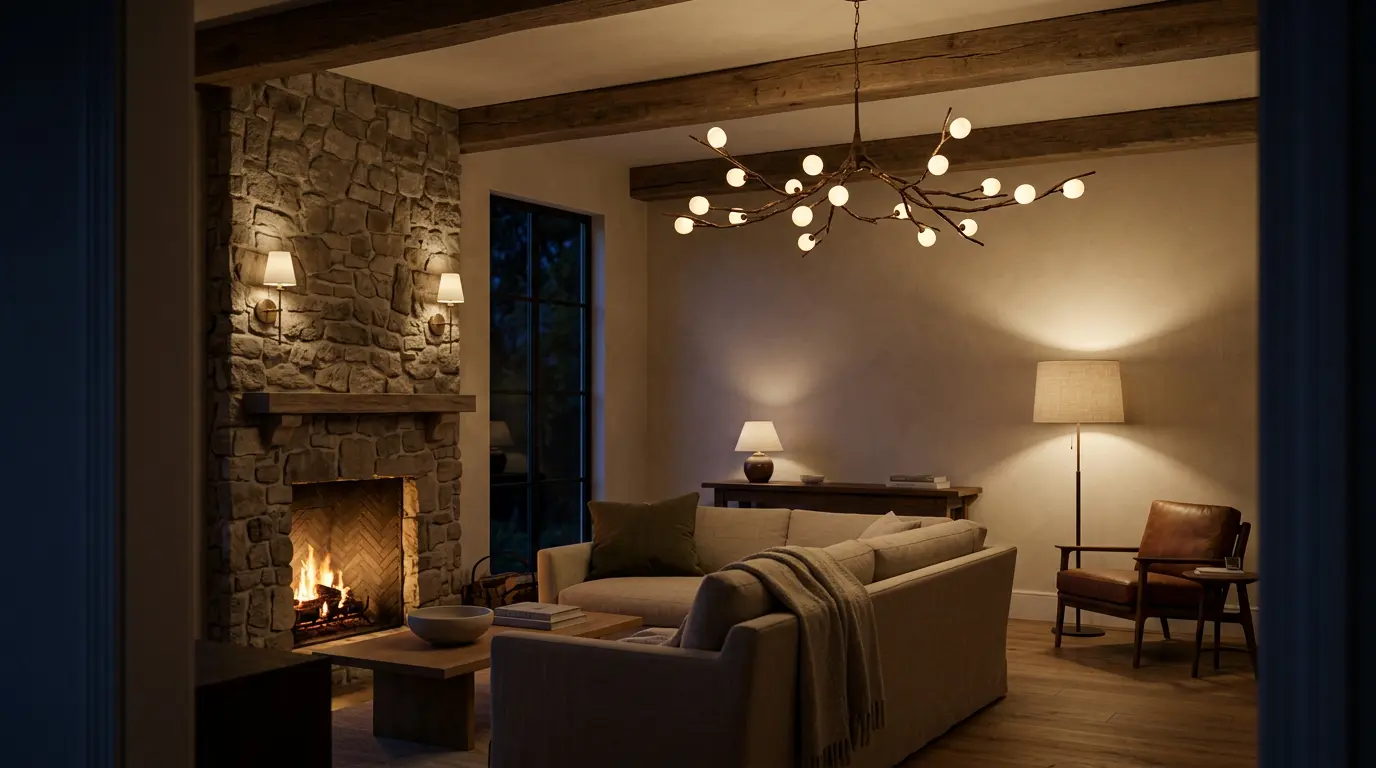
The rooms that feel warm usually have light coming from more than one height. The ceiling might give the room its general brightness, but a lamp beside the sofa, a sconce beside the fireplace, or a small light on a shelf is what makes the room feel settled.
The Lutron layered lighting guide breaks lighting into ambient, task, and accent layers. That sounds more technical than it needs to be.
Think of it this way.
One light helps you see the room.
One helps you do something.
One makes something beautiful worth looking at.
That is enough to start.
Do Not Make Every Light Look Rustic
This is where rustic homes can go wrong quickly.
You find a wood-and-black-metal pendant you love, so you buy another version for the hallway, another for the bedroom, another for the kitchen, then a matching floor lamp.
Individually, each one might look fine.
Together, the house starts to feel like a showroom collection.
I would rather repeat a feeling than repeat the exact fixture.
Maybe the dining room gets black iron.
The living room gets a ceramic lamp.
The hallway gets opal glass.
The bedroom gets linen shades.
The finishes still belong together, but your home does not look as though every light arrived in the same delivery truck.
Use Warm White Light, but Do Not Make the Room Orange
If your wood furniture looks gray and your cream walls suddenly look cold at night, I would look at the bulb before blaming the decorating.
A softer warm-white bulb often makes oak, walnut, stone, linen, brick, and warmer paint colors look more like they did in daylight.
If you are checking the box, the ENERGY STAR color guide places roughly 2700K to 3000K on the warmer side of white light.
That number is not the point.
The point is that the room should feel warm and still be easy to use.
You should not have to choose between cozy and being able to find your glasses.
Choose the Fixture for Your Actual Ceiling
Product photos can lie to your eyes.
A chandelier photographed close-up can look enormous online, then arrive and look like a bracelet hanging from your 15-foot ceiling.
The opposite happens in small rooms.
That dramatic pendant you saved on Pinterest can suddenly feel like it is sitting on your head once it is hanging over a little dining table.
Before buying, I would mark the approximate width with painter’s tape or a piece of cardboard.
Stand in the doorway.
Sit on the sofa.
Look from the kitchen.
That five-minute check can save you from spending hundreds of dollars on a fixture that is technically beautiful and completely wrong for the room.
27 Rustic Lighting Ideas Worth Trying
1. Use a Wagon-Wheel Chandelier When the Ceiling Needs Something Wide
A wagon-wheel chandelier can look stunning in the right room.
The problem is that people sometimes buy one because “wagon wheel equals rustic” instead of asking whether the room has enough space for it.
I would use one in a vaulted living room, a large dining area, or a room with broad beams and a substantial fireplace.
I would skip it in a small dining room with an eight-foot ceiling.
This black wagon wheel chandelier (paid link) is the kind of restrained version I would look for.
Notice what I would not add around it.
No rope chandelier beside it.
No wagon-wheel wall art.
No faux barn signs.
Let the chandelier be the rustic statement.
2. Match a Long Table With a Long Light
If your dining table or kitchen island is long and rectangular, a tiny round light in the middle can feel disconnected.
The table is pulling your eye one way while the light is doing something completely different.
This is where I like a linear fixture.
A wood metal farmhouse chandelier (paid link) can follow the length of the table and visually connect the ceiling to the furniture underneath.
Do not get stuck trying to match the wood stain perfectly.
If your table is warm oak, the fixture does not need to be the exact same warm oak.
Close enough in warmth usually looks more natural than an obvious attempt at matching.
3. Try Lantern Pendants When the Room Already Feels Heavy
Imagine a kitchen with a dark island, wood cabinets, stone counters, bar stools, and a big range hood.
Then imagine hanging three solid black metal pendants over the island.
That may be one dark object too many.
This is where clear glass helps.
A black lantern pendant light (paid link) gives you the black outline people often want in rustic kitchens, but you can still see through it.
I would choose this over an opaque fixture when the room already has strong furniture or darker finishes.
You still get structure overhead without making the ceiling feel crowded.
4. Light the Fireplace From the Side
If you spent money on stone, brick, or a beautiful mantel, it should not disappear at night.
A ceiling fixture tends to light the floor better than the face of a fireplace.
That is why I like sconces here.
These rustic wood wall sconces (paid link) are the type of lower wall light that can keep a fireplace area present after sunset.
I would keep the fixture simple if the stone already has a lot of movement.
The wall does not need another star.
The light just needs to help you see the one that is already there.
5. Put a Linen Floor Lamp Beside the Chair People Actually Use
This sounds obvious until you look at how people place lamps.
The reading chair is on one side of the room.
The lamp is across the room because “it looked good in that corner.”
Then somebody sits down with a book and turns on the ceiling light.
I would put the lamp where the person needs it.
A linen shade floor lamp (paid link) brings soft fabric into rooms that may already have wood, leather, stone, and metal.
That fabric shade matters visually too.
If everything in the room is hard, a little softness goes a long way.
6. Use a Ceramic Lamp When the Room Has Enough Wood Already
If I walked into a room with wood flooring, an oak console, a timber coffee table, exposed beams, and wood picture frames, I would not immediately add another wood lamp.
I would break the pattern.
A textured ceramic table lamp (paid link) is a better fit when you want something earthy without adding more timber.
Look for clay, cream, stone, taupe, muted green, charcoal, or a slightly uneven glaze.
That little change in material can make the whole room feel more considered.
Rustic does not have to mean wooden.
7. Use Aged Brass When Black Metal Is Starting to Take Over
Black fixtures are easy to use.
Maybe too easy.
Once you have black window frames, black cabinet pulls, black chair legs, and a black chandelier, adding another black sconce can make the room feel harder than you intended.
This is where I would bring in aged brass.
An antique brass wall sconce (paid link) gives you warmth without turning glamorous or shiny.
Aged brass beside oak or walnut can be beautiful because the metal catches light while the wood stays grounded.
You do not have to change every metal in the room.
One or two brass moments are enough.
8. Try Seeded Glass When the Room Already Feels Full
If your room has a chunky wood table, dark chairs, beams, patterned curtains, and a rug with a lot going on, I would be careful about hanging another heavy object overhead.
This is where seeded glass earns its place.
You still get that slightly imperfect, old-house look, but you can see through the fixture.
A seeded glass pendant light (paid link) is the kind of fixture I would consider for a breakfast nook, small kitchen, or narrow entry.
I would choose this before an opaque metal pendant if the room already feels visually busy.
“Cozy” and “crowded” can be surprisingly close cousins.
9. Use a Woven Pendant to Soften Stone and Wood
Some rustic rooms have plenty of texture, but all of it feels hard.
Stone.
Wood.
Metal.
Leather.
This is where a woven shade can change the mood.
A natural rattan pendant light (paid link) brings fiber overhead without another heavy metal frame.
I especially like this in a dining nook, sunroom, bedroom, or relaxed kitchen.
Before buying, look at the weave.
A loose weave may throw noticeable patterns across the walls and ceiling.
If that would annoy you every night, choose something tighter.
10. Use a Branch Shape Instead of Literal Antlers
You can bring nature into a rustic room without hanging antlers from the ceiling.
A branch-inspired fixture gives you movement and an organic shape without making the room feel like a themed lodge.
This branch style chandelier light (paid link) is the type of fixture I would consider in a cleaner modern-rustic space.
I would pair it with simple walls, restrained furniture, and natural materials.
The more unusual the chandelier, the less decorating you need around it.
Let one thing be interesting.
11. Use Schoolhouse Glass When the Ceiling Is Low
Low ceilings are where Pinterest can get dangerous.
You save a room with a beautiful hanging pendant, then forget the photographed room has a 12-foot ceiling and yours does not.
You do not need to give up character.
You need a flatter fixture.
An opal schoolhouse ceiling light (paid link) gives you that older glass shape without a long drop.
I would use this in a hallway, small kitchen, bedroom, mudroom, pantry, or entry.
The personality comes from the shape and glass, not from hanging three feet into the room.
12. Use Black Dome Pendants When a Pale Kitchen Needs Contrast
Some pale kitchens are lovely but a little sleepy.
White cabinets.
Light oak.
Cream stone.
Beige walls.
Everything is playing the same note.
A black pendant can give the room one stronger line.
This black dome pendant light (paid link) is the kind of straightforward shape I mean.
Before buying three of them, though, check how the shade directs light.
A kitchen island needs to look good, but somebody still has to cut vegetables underneath it.
Pretty light that leaves your hands in shadow is not a win.
13. Keep a Candle Chandelier, but Modernize Everything Around It
If you already own a candle-style chandelier you like, I would not replace it just because the internet decided something else is newer.
Change what surrounds it first.
A distressed candle style chandelier (paid link) can still work in a room with a plain oak table, simple chairs, contemporary artwork, and cleaner walls.
That mix is often more interesting than making every object equally old-looking.
One traditional fixture can feel collected.
A whole room of them can feel staged.
14. Use Rope as an Accent, Not a Decorating Policy
Rope can look great in rustic and coastal-rustic rooms.
But it announces itself quickly.
A woven rope pendant light (paid link) is enough texture for one breakfast nook or casual dining corner.
If you use rope overhead, I would skip rope mirrors, rope handles, rope baskets hanging from hooks, and rope wrapped around every decorative object.
One confident choice usually looks better than five reminders.
15. If You Love Mason Jars, Make Them the One Joke
Mason-jar lighting is not forbidden.
It just became overused.
If you genuinely love the glass shape, use it with restraint.
A three jar ceiling light (paid link) could work in a pantry, mudroom, breakfast corner, or casual kitchen.
I would keep the hardware simple and leave the jars clear.
Then stop.
No mason-jar soap dispenser.
No mason-jar utensil holder.
No mason-jar wall sign.
The light already said what it needed to say.
16. Light the Artwork Instead of Buying Another Ceiling Fixture
Sometimes a room feels unfinished at night because the walls go dead.
The ceiling may be bright enough.
The missing piece is lower down.
A rechargeable brass picture light (paid link) can bring a landscape, family photograph, plaster wall, or small gallery area back into the room.
This is where I would spend a little before installing more overhead lighting.
Try lighting what you already love.
You may discover the room did not need another chandelier at all.
17. Use Swing-Arm Sconces When the Nightstand Is Doing Too Much
Small bedroom?
Tiny nightstand?
Phone, water, glasses, book, charger, tissues, and somehow three receipts sitting on it already?
You probably do not need a table lamp taking up half the surface.
These black swing arm sconces (paid link) move the light onto the wall and let you aim it where you need it.
I would use them beside a bed, reading nook, desk, or built-in bench.
Put the switch where you can actually reach it.
A beautiful bedside light loses some charm when you have to get out of bed to turn it off.
18. Put a Little Lamp in the Kitchen After Dinner
This is one of my favorite ideas because it changes the mood without changing the kitchen.
During dinner prep, you need the bright lights.
After dinner, maybe you do not.
A pair of brown cordless table lamps (paid link) can give a dry corner of the counter or shelf a softer glow once the work is finished.
Keep the lamp away from water, steam, and the cooktop.
This is not a chopping light.
It is the “the kitchen is closed” light.
19. Put a Small Chandelier in the Bedroom
A bedroom chandelier does not need to be huge or formal.
Sometimes a small ceiling fixture is enough to make the bed feel like the center of the room.
A small wood bead chandelier (paid link) can bring a little texture overhead without the weight of a large iron frame.
I would still keep lamps or sconces beside the bed.
The ceiling fixture can make the room feel finished.
The bedside light does the work.
Those are different jobs.
20. Bring the Dining Light Closer to the Table
A dining pendant that sits too high can feel as though it belongs to the ceiling instead of the table.
Lowering it visually connects the two.
A walnut linear pendant light (paid link) suits a long rectangular table because the shape follows the furniture below.
Do not obsess over one universal hanging measurement.
Sit down.
Look across the table.
Can you see the person opposite you comfortably?
Good.
That matters more than copying a number from a diagram.
21. Choose the Outdoor Light for the Door First
Exterior lighting is another place where people sometimes choose the look before the job.
That black barn light looks lovely in the product photo.
But will it light the steps?
Can you see the lock?
Does it shine into a bedroom window?
A black gooseneck barn light (paid link) gives you the farmhouse shape, but placement is what determines whether it actually helps.
I would stand outside after dark before deciding where the fixture goes.
Your front door will tell you what needs light.
22. Use a Tall Stairwell for Something You Could Not Use Anywhere Else
A double-height stairwell is one of the few places where a long cluster can make sense.
Use the height.
A five light cluster pendant (paid link) can create a vertical line that follows the stairs instead of leaving one little pendant floating near the ceiling.
Check the view from downstairs and upstairs.
Then ask the less glamorous question.
How will you clean it?
If the answer requires a circus ladder and a prayer, rethink the height.
23. Light the Beams You Paid to See
If exposed beams are one of the best things about the room, it is strange to let them disappear every evening.
You do not necessarily need another decorative fixture.
You may need directional light.
These black adjustable track heads (paid link) can be aimed toward timber, stone, or textured walls.
I would use a soft pass across the material rather than blasting each beam individually.
The goal is for someone to notice the wood.
Not the spotlight.
24. Hide the Kitchen Light That Actually Does the Work
A rustic kitchen does not need every light source to look rustic.
The light that helps you chop onions can stay out of sight.
These warm under cabinet lights (paid link) put light closer to the countertop, which can help when your body blocks the ceiling fixture behind you.
Let the pendants handle the decorating.
Let the under-cabinet lights handle dinner.
That division makes the kitchen look better and work better.
25. Test a Dark Corner With a Cordless Lamp Before Calling an Electrician
Before paying to add wiring to a shelf, alcove, or corner, I would test the idea with a portable light.
Live with it for a couple of weeks.
Move it around.
See whether you actually turn it on.
These cordless wood table lamps (paid link) can help you try the idea without committing to a permanent fixture.
This is also one of the easier rustic lighting ideas on a budget.
Sometimes the cheapest experiment gives you the clearest answer.
26. Put the Lights on Separate Controls
A room that feels cozy while you are watching television may feel frustrating when you are looking for a dropped earring.
That is why I would rather have control than permanent dimness.
A Lutron Diva LED dimmer (paid link) can help with compatible dimmable lighting.
The ceiling light can be brighter when you need it.
The sconces can sit lower.
The reading lamp can stay strong beside the chair.
That is what makes a room flexible.
Not one magic “cozy” setting.
27. Mix One Vintage-Looking Light With Cleaner Fixtures
If you want your rustic home to feel collected rather than themed, stop trying to match every light.
Pick one fixture with some character.
Then let the others calm down.
A green glass brass pendant (paid link) could be the older-looking piece over a table while the nearby sconces and ceiling lights stay simple.
This is the rule I would carry through the entire house:
Coordinate, do not clone.
Your fixtures should know each other.
They do not need to be twins.
How to Choose Rustic Lighting by Room
If you are still unsure what your room needs, start with what people do there after dark.
| Room | Start Here | Then Add |
|---|---|---|
| Living room | Ceiling light or chandelier | Floor lamp, table lamp, fireplace or art light |
| Kitchen | General ceiling light | Pendants and under-cabinet task light |
| Dining room | Chandelier or pendant | Sconces or a small buffet lamp |
| Bedroom | Soft ceiling fixture | Bedside lamps or wall sconces |
| Bathroom | Suitable ceiling light | Strong vanity lighting |
| Entryway | Pendant, lantern, or flush light | Console lamp or art light |
| Outdoor | Properly rated wall light | Path, step, or architectural light |
Living Room
Look at where people sit.
If the sofa is where everyone ends up at night, that area needs more attention than the empty corner across the room.
A chandelier may make the ceiling beautiful, but a lamp beside the sofa may make the room feel better.
Kitchen
I would solve food prep before decorating.
If the countertop is dark when you stand in front of it, fix that first.
Then choose the pendants.
Once dinner is finished, a little lamp or dimmed general light can change the room completely.
Dining Room
The table is the clue.
Long table, think longer fixture.
Round table, a round fixture often feels natural.
Then check the sightline while seated.
Nobody should have to talk around the chandelier.
Bedroom
Bedrooms usually need less hard-looking lighting than people think.
Ceramic, linen, opal glass, woven shades, and smaller chandeliers often feel more restful than a large industrial fixture.
Put good light beside the bed.
That is the light you will actually use.
Bathroom
Do not let the rustic theme interfere with useful mirror lighting.
A pretty ceiling fixture will not make shaving, skincare, or makeup easier if your face is in shadow.
Let the vanity lighting do its job.
Add the character elsewhere.
Entryway
An entry fixture can be a little bolder because you are not sitting beneath it for hours.
Check ceiling height and door swing before falling in love with anything hanging.
The front door should open without introducing itself to the chandelier.
Outdoor
Choose the light based on where you need to see.
Door.
Steps.
Path.
House number.
Then choose the rustic shape.
That order saves you from installing a beautiful fixture that lights the siding and nothing else.
Five Rustic Lighting Mistakes I Would Avoid
Using Edison Bulbs Everywhere
You do not need to prove the house is rustic through the bulb.
Use exposed filament bulbs where the fixture genuinely suits them.
Elsewhere, opal glass, linen shades, woven shades, and concealed LEDs may feel softer.
Making Every Fixture Wood and Black Metal
One wood-and-black fixture can be gorgeous.
Eight of them can make the house feel copied and pasted.
Mix in ceramic, aged brass, linen, glass, or woven fiber.
Depending on One Ceiling Light
If the room feels flat at night, this is one of the first things I would check.
Add light closer to where people sit or work before replacing the main fixture.
Buying a Fixture That Is Too Small
Large rustic rooms can swallow small lights.
If you have broad beams, tall ceilings, or a large stone fireplace, your fixture may need more visual width than you expect.
Tape the size out before buying.
Buying a Decorative Light That Cannot Do the Job
A kitchen pendant still needs to help light the island.
A bedside sconce needs to help you read.
A hallway light needs to help you see where you are walking.
If it cannot do the job, add a second quieter source rather than pretending appearance is enough.
Rustic Lighting FAQs
What Color Light Looks Best With Rustic Decor?
I would start with a softer warm white, especially if your room has oak, walnut, cream, beige, brick, bronze, or warm stone.
If you are reading the bulb packaging, that often means somewhere around 2700K to 3000K.
Do not choose from the number alone.
Look at how the bulb treats your actual walls, wood, and fabrics.
Can Rustic Lighting Work in a Modern Home?
Absolutely.
In fact, I often think it looks better when the entire home is not rustic.
One aged-brass pendant, ceramic lamp, wood chandelier, or woven shade can bring warmth into a cleaner modern room.
Contrast keeps it interesting.
Do Rustic Fixtures Have to Be Wood?
No.
Rustic character can come from aged brass, dark iron, ceramic, seeded glass, linen, rattan, rope, stone-like finishes, or warmer glass.
If the room already has plenty of wood, I would choose another material.
How Do I Make a Rustic Room Feel Cozy Without Making It Dark?
Do not dim everything.
Put light at different heights.
Keep good task light where you read, cook, or work, then lower the surrounding lamps, sconces, or ceiling lights when you want a softer evening feeling.
Cozy is not the absence of light.
It is better control of it.
Can I Mix Different Rustic Light Fixtures?
Yes.
I would rather see a house where the lights coordinate than one where every fixture matches.
Repeat a finish, glass type, wood tone, or general shape once or twice.
That is enough connection.
How Do I Mix Wood and Metal Lighting?
Look at whether the materials feel warm or cool before worrying about an exact match.
Warm oak usually sits comfortably beside aged brass, bronze, or softer black metal.
Do not try to match the wood on the fixture perfectly to the table.
A slight difference often looks more natural.
What Rustic Lighting Works With Low Ceilings?
Look for flush mounts, semi-flush lights, schoolhouse glass, compact lantern shapes, and fixtures that sit closer to the ceiling.
You can still have character.
You just do not need a long chain hanging into the room.
What Rustic Lighting Works With High Ceilings?
This is where wider chandeliers, long linear lights, tiered lanterns, and vertical pendant groups make sense.
Use the extra space.
Just make sure the fixture can still be cleaned and maintained without turning bulb replacement into a home-improvement event.
Can Rustic Rooms Look Good Without Edison Bulbs?
Yes.
Linen shades, opal glass, seeded glass, ceramic lamps, rattan pendants, ordinary warm-white bulbs, and concealed LEDs can all work beautifully.
Rustic style comes from the whole room, not one bulb.
What Makes Wood and Stone Look Warmer at Night?
Start by changing where the light comes from.
A sconce can wash stone from the side.
A picture light can bring warmth to a textured wall.
Directional light can skim across beams instead of leaving them dark.
Then look at the bulb color.
What Are the Easiest Rustic Lighting Ideas on a Budget?
I would start with movable light.
A table lamp.
A cordless lamp.
A plug-in wall light.
A floor lamp beside the sofa.
Those changes can tell you where the room actually needs light before you spend money changing wiring.
How Many Lights Does a Cozy Room Need?
There is no magic number.
Ask how many jobs need light.
Can you move through the room?
Can you read or work where you normally sit?
Is there a fireplace, artwork, shelving, or texture you want to see after dark?
Answer those questions and the number of fixtures becomes much easier to work out.
Make the Room Feel Like Home After Dark
The best rustic lighting ideas are not the ones that look the most rustic in a product photo.
They are the ones that make you like your home just as much at 9 p.m. as you did when the afternoon sun was coming through the windows.
Maybe your room needs a chandelier.
Maybe it needs a lamp beside the sofa.
Maybe the expensive ceiling fixture is perfectly fine and the real problem is that every bulb is too cold.
Maybe the kitchen simply needs a little warm lamp after dinner.
Start with the room you use most after sunset.
Turn on the lights you have now and look around.
What disappears? What feels harsh? Where are you actually sitting or working?
Fix that first.
Then choose the rustic fixture that belongs there.