


POPULAR AT FAMILY HAVEN
POPULAR AT FAMILY HAVEN
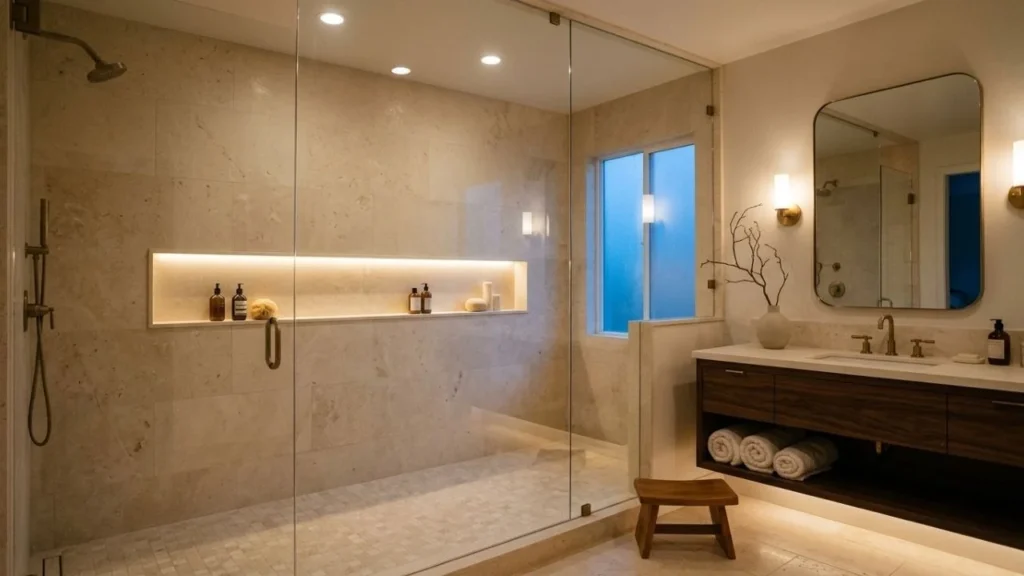
Shower lighting ideas start with useful visibility and the layout of the space before you add softer mood lighting.
A shower can have beautiful tile, clear glass, a rainfall head, and the shampoo you save for days when life has been doing a bit too much.
Then you switch on one harsh ceiling light and the whole room suddenly feels less relaxing bathroom and more changing room five minutes before closing.
Good shower lighting ideas have to solve both sides of that problem.
You need enough light to see the floor, controls, bottles, razor, and edges of the enclosure. At night, you probably do not want the bathroom glowing at the same intensity you use when getting ready at 7 a.m.
The answer is not to make the shower dark.
Give each light a job.
Start with the correct fixture and sensible placement inside the shower. Then use dimming, warmer light, vanity lighting, niche lighting, or low lighting elsewhere in the bathroom to change how the room feels.
One safety detail comes before the pretty stuff: a fixture in the bathtub or shower area needs to suit its installation location. NEC-based guidance distinguishes damp-location fixtures from fixtures subject to shower spray, which need to be marked suitable for wet locations.
It helps to stop thinking of the bathroom as one lighting problem.
The shower light helps you see inside the shower.
The vanity light helps you see your face.
A dimmer lets the brightness change with the time of day.
A niche light can add a warm accent.
A low night light can make a 2 a.m. bathroom trip far less rude.
Once each light has a clear purpose, the room becomes easier to plan.
| If you want… | Start with… | Add after… |
|---|---|---|
| A brighter everyday shower | One suitable recessed shower light | A compatible dimmer |
| A large walk-in shower | Two well-positioned ceiling lights | A lit niche |
| A softer evening shower | Dimmable warm shower lighting | Low bathroom night light |
| Dark tile that still feels warm | Diffused ceiling light | Warm niche lighting |
| A rental-friendly change | Leave shower wiring alone | Dry-zone lighting |
| A quieter spa-style look | Simple ceiling fixture | One concealed linear accent |
A standard shower stall does not automatically need a ceiling full of fixtures.
One recessed light in the right place may give you all the visibility you need while keeping the ceiling visually clean.
The fixture choice comes first.
Where the planned position is subject to shower spray, choose equipment marked suitable for wet locations and follow the manufacturer’s installation instructions. Do not rely on “bathroom light” written in a product title.
A Juno RetroBasics downlight is one example for compatible recessed housings. Juno currently lists the RetroBasics family for wet locations and offers 5/6-inch versions with selectable white settings.
Do not judge the fixture position while staring at an empty floor plan.
Stand where you will actually stand.
Where is the light in relation to your head and shoulders?
Does it reach the floor?
Does your body block most of it?
Does your face disappear into shadow?
Those questions tell you more than whether the fixture sits perfectly in the mathematical center of the shower.
In a smaller stall, one well-positioned light can look cleaner than three ceiling spots squeezed into a few feet.
A bigger shower creates a different lighting problem.
One bright fixture may leave the back wall, bench, or second shower area noticeably darker. Your own body can block some of the overhead light too.
Two suitable ceiling lights can spread illumination more evenly across a longer enclosure.
A HALO wet-location retrofit is one option for compatible recessed installations.
Do not choose the number of fixtures from the size of the ceiling alone.
Look at the shower dimensions, ceiling height, tile color, glass, fixture output, bench placement, and where somebody will stand.
A large walk-in shower may need two.
That does not automatically mean it needs six.
Centering a shower light sounds sensible until the center puts the fixture directly above or slightly behind your head.
Your own body then blocks part of the light trying to reach the front of you.
If you are planning new wiring, ask the electrician to consider the standing position rather than automatically using the center point of the enclosure.
A recessed fixture with a softer, regressed light source can also reduce the harsh feeling you can get from a more exposed lamp.
Stand in the shower footprint while the fixture location can still be changed.
Look at where your head, shoulders, and shower head will sit.
A small adjustment during rough-in is much easier than spending the next decade wondering why one side of the shower always looks dull.
Warm white light can work especially well with beige, cream, warmer marble, bronze, brown, wood-look porcelain, and stone with warmer undertones.
A shower does not need cold blue-white light to be useful.
Around 2700K to 3000K is a sensible starting range when you want the bathroom to feel softer after dark.
A HALO 2700K retrofit is one example for compatible recessed housings.
Do not make the shower fixture responsible for detailed grooming too.
If you shave, apply makeup, style your hair, or need stronger face lighting, solve that at the vanity.
The shower needs to illuminate the shower.
The mirror needs to illuminate you.
That separation gives you more freedom to make the shower warmer without making the entire bathroom difficult to use in the morning.
Tile can look surprisingly different once it leaves the showroom.
The same white tile might lean creamy under 2700K, balanced under 3000K, and stark under 5000K.
Grout changes it.
Paint changes it.
Metal finishes change it.
Daylight changes it again.
A fixture with selectable white settings gives you room to compare temperatures in the finished bathroom instead of making the entire decision from a sample board.
The Juno RetroBasics downlight is sold in switchable-white versions, which is useful when the final bathroom finishes need to make the decision with you.
Test your choices after the tile, grout, vanity, paint, and main metal finishes are in place whenever the installation allows it.
The light in a store aisle is not the light in your bathroom.
Bright light can be useful at 7 a.m.
At 10:30 p.m., the same brightness can feel as though the bathroom would like you to explain where you were last night.
A compatible dimmer lets the same lighting setup behave differently at different times of day.
The Lutron Diva LED+ dimmer is rated for up to 150W of dimmable LED load in the DVCL-153P version. Lutron also includes low-end adjustment to help with LED dimming performance.
Check the light and dimmer before combining them.
LED fixtures and controls are not universally compatible. The wrong combination can flicker, refuse to dim low enough, or behave inconsistently.
The whole point of dimming is for the room to become calmer.
The lights should not start arguing with you first.
A lit niche can turn an ordinary tiled recess into one of the nicest details in the shower.
The cleanest position is often along the upper inside edge, where the light can wash down the back tile and across the bottles without sitting directly in your line of sight.
A BTF waterproof LED strip is sold in warm-white water-resistant versions and can form one part of a planned niche-lighting setup.
One part.
That distinction matters.
An IP rating on the LED strip does not settle the suitability of the driver, cable, connectors, electrical connections, channel, or the finished installation.
Treat a niche light as a complete electrical setup rather than a strip you happen to stick behind the tile.
For the electrical side, use components intended for the location and follow the applicable requirements and manufacturer instructions.
This is not where the spare roll of bedroom LEDs gets a surprise promotion.
A visible row of individual LEDs can make expensive tile look unfinished surprisingly quickly.
A diffuser spreads the light so you see a continuous glow rather than a row of bright dots.
A Muzata LED diffuser channel uses an aluminum profile with a milky cover and is one option for creating that softer line.
The diffuser solves an appearance problem.
It does not solve the electrical requirements of the shower.
A nice channel cannot make the wrong strip, driver, connector, or wiring method suitable for the location.
A niche often sits around chest or eye level.
That means poor strip placement can put a surprisingly bright source directly in front of you.
Hide the light along the top inner edge or another position where the niche itself blocks a straight view of the LEDs.
Then check the result from both sides of the glass.
Stand inside the shower.
Step outside.
You should notice the illuminated niche, not a row of bright dots staring back at you.
The source can stay quiet.
The tile gets to be the thing you look at.
Some bathrooms do not need a new lighting layout.
The recessed housing is already there. The old lens, trim, or lamp simply looks tired.
If the existing housing is suitable and compatible with the new retrofit, replacing the trim may be simpler than opening the ceiling.
The Juno RetroBasics retrofit includes options designed for common recessed applications.
Measure before ordering.
A retrofit can be advertised for a 5- or 6-inch housing and still use a mounting arrangement that does not suit the old can already in your ceiling.
Check two things:
the listing for the planned location
and the physical compatibility with the existing housing.
Getting one right does not fix the other.
Charcoal tile, deep green, brown-black, dark stone, and darker ceilings can make a shower feel warm and enclosed.
A bright white ceiling ring may stand out more than you expected.
Where the listed fixture family offers suitable finish options, black or another dark trim can disappear more easily into the surrounding surface.
Juno’s RetroBasics range, for example, is available in multiple trim colors, including darker finishes.
Choose the fixture for its suitability first.
Choose the pretty ring after that.
The reverse works in lighter bathrooms.
Against white, cream, pale gray, or soft stone, a white recessed trim can nearly disappear.
A HALO shower retrofit is one example of the simple white recessed look.
This can work especially well when the shower already has a strong visual feature: veined tile, a statement niche, a large rain head, or patterned stone.
The ceiling does not need to compete with all of it.
Sometimes the best fixture is the one you stop noticing.
A glass shower does not exist visually on its own.
It shares light with the bathroom around it.
That means better general and vanity lighting can make the enclosure feel brighter without adding another fixture inside a small shower.
Keep the suitable shower light where you need it.
Then look at what is happening outside the glass.
Could the vanity light be better?
Is the room ceiling light poorly positioned?
Could compatible general lighting be dimmed in the evening instead of keeping everything at one brightness?
Clear glass lets those lighting layers work together.
In a small bathroom, that can look much cleaner than squeezing extra ceiling spots into the shower.
Sometimes the shower is not the reason the bathroom feels dark.
The mirror is.
Stand where you normally get ready.
If your face is poorly lit, another ceiling light over the shower may solve absolutely nothing about the part of the bathroom that bothers you.
Give the wet area its appropriate fixture.
Give the mirror its own useful lighting.
Then control compatible room lights separately if you want the bathroom softer after the morning rush.
It sounds obvious once somebody says it.
Yet a surprising number of bathrooms ask one ceiling light to be the shower light, vanity light, room light, makeup light, and midnight light.
No wonder it looks tired.
A late-night bathroom trip rarely needs every ceiling fixture at full brightness.
A small warm motion light in a suitable dry receptacle can illuminate the route into the room without waking you up more than necessary.
A LOHAS motion night light is one indoor option designed for spaces such as bathrooms, bedrooms, and hallways.
Keep plug-in products like this outside the wet shower area.
They are room lights, not shower fixtures.
Placed sensibly, a low night light can do more for the after-dark feeling of the bathroom than another decorative product inside the enclosure.
Bathroom atmosphere does not have to come from something installed beside running water.
A low warm light outside the shower can soften the room when you are getting ready for bed, drying off, or walking in during the night.
The GE motion night light is another indoor plug-in option for an appropriate dry location.
Keep the proper shower light available while somebody is actually showering.
The low light belongs to the room around it.
That is the difference between creating a softer evening bathroom and simply making the shower harder to see.
You do not need two bathrooms.
You may not even need two sets of fixtures.
You need lighting that can respond to two different moments.
In the morning, use the shower and vanity lights at the brightness needed for getting ready.
At night, lower compatible room lighting while keeping the shower bright enough to see the floor, controls, bottles, ledges, and enclosure edges.
A dimmer can make that change far easier when the selected LED fixtures are compatible with the control.
The darker, calmer version of the bathroom should still work as a bathroom.
That is where some “moody bathroom” inspiration goes wrong.
The photograph looks lovely.
Then you imagine dropping the shampoo cap and having to find it.
Decorative sconces, amber lamps, lantern-style fixtures, color-changing lights, and other unusual pieces have far more freedom outside the shower enclosure.
Use that freedom.
Inside the shower, a simpler setup is often the sensible choice: suitable equipment, good placement, enough visibility, and installation details that make sense around water.
Outside the enclosure, let the room have more personality.
A LOHAS warm night light is one dry-zone option for adding a softer glow after dark.
Inspiration photos can still help.
Use them to decide how you want the bathroom to feel.
Do not let them decide which electrical product belongs beside the shower head.
Damp and wet locations are not the same thing.
NEC-based guidance for bathtub and shower areas says permitted luminaires within the defined zone must be marked for damp locations, or for wet locations where they are subject to shower spray.
That is more precise than assuming every fixture anywhere near a bathroom needs exactly the same rating.
For a shower project, check:
Do not make the decision from “bathroom light” in the listing title.
Read the specification.
Not by itself.
An IP rating describes protection against defined levels of dust and water exposure.
It does not answer every electrical question about the finished installation.
A shower-niche setup can involve an LED strip, driver, cable, connectors, electrical connections, channel, diffuser, and sealing details. Those parts do not automatically share the same rating because one component has an impressive number printed on its packaging.
Consider the complete setup.
The strip is only one piece of it.
For a softer bathroom, 2700K to 3000K is a sensible starting point.
Warm white tends to work nicely with:
Around 3000K to 3500K can work well with crisp whites, chrome, cooler gray, and bathrooms where stronger task lighting matters.
Do not choose by Kelvin number alone.
If the fixture gives you selectable white settings, compare them after the major finishes are installed.
Tile gets a vote.
Grout gets one too.
Yes, a shower niche can have lighting.
That does not mean an ordinary indoor LED strip belongs there.
Plan the niche as a system.
Think about the strip, cable, driver, electrical connections, sealing, diffuser, channel, and where each component will sit.
The finished result can look wonderfully simple.
The hidden work behind it should be planned with considerably more care.
Keep enough practical light inside the enclosure to see what you are doing.
Then soften the bathroom around it.
That might mean:
The goal is not darkness.
It is contrast.
The shower stays usable while the rest of the room stops feeling like it is permanently set to Monday morning.
Do not assume any recessed light sold for bathrooms belongs wherever you want to put it.
Check the exact listing and installation location.
The LED strip is not the only electrical component involved.
Look at the driver, cable, connectors, connections, channel, sealing, and planned location too.
You still need to see where you are stepping.
Create the softer feeling with dimming and the lighting around the enclosure instead of sacrificing useful visibility.
Placement matters as much as brightness.
A good fixture in an awkward position can still create glare and heavy shadows.
Shower lighting, vanity lighting, room lighting, and nighttime lighting solve different problems.
Let them.
It depends on the exact position and exposure.
NEC-based guidance says luminaires in the defined bathtub or shower area must be marked for damp locations, or for wet locations where they are subject to shower spray.
Check the fixture listing, manufacturer instructions, planned location, and the electrical requirements adopted where you live.
Do not assume a standard recessed fixture is suitable simply because it physically fits.
Use equipment listed for the conditions at the planned location and make sure any retrofit is compatible with the existing housing.
Yes.
Wet-location recessed LED products with dimming capability are available.
The fixture and dimmer still need to work correctly together. Manufacturers such as Juno publish dimmer-compatibility information for their LED products, and Lutron publishes load and compatibility information for its controls.
Yes.
Around 2700K to 3000K can make a bathroom feel softer while still giving useful light when the fixture output suits the space.
Yes.
Plan the complete installation for the wet environment rather than choosing the LED strip in isolation.
If you already have a suitable compatible recessed housing, a listed LED retrofit may be simpler than changing the full ceiling arrangement.
Measure the housing and check the mounting method before buying.
Leave shower wiring and permanent fixtures alone unless the property owner approves a proper electrical change.
You can still soften the bathroom with an appropriate warm night light or another suitable light in the dry part of the room.
The best shower lighting ideas are not the ones with the most fixtures.
They are the ones that still make sense when somebody actually steps into the shower.
Start with lighting that lets you see the floor, controls, bottles, ledges, and edges clearly. Make sure the equipment suits the location where it will be installed.
Then decide what would make the room feel better when the day is winding down.
Maybe that is warmer white.
Maybe it is a dimmer.
Maybe it is a softly lit niche.
Maybe the answer is nothing inside the shower at all, just a lower light in the room outside it.
A bathroom can be bright enough for a rushed morning and still feel calm later that night.
You do not need a light show over the shower head.
You need useful light where water is involved, then enough softness around it to make staying under the warm water for another five minutes feel entirely reasonable.
Explore original printables, find another story or save your next creative project.



[…] the shower is also dark, these safe shower lighting ideas can help you think through visibility and light placement before choosing an even deeper […]
[…] better shower lighting ideas explain how shower, vanity and general lighting can do separate jobs instead of asking one ceiling […]
[…] that hallway leads toward the bathroom, you may also like these shower lighting ideas for the room at the end of the […]