
POPULAR AT FAMILY HAVEN
POPULAR AT FAMILY HAVEN
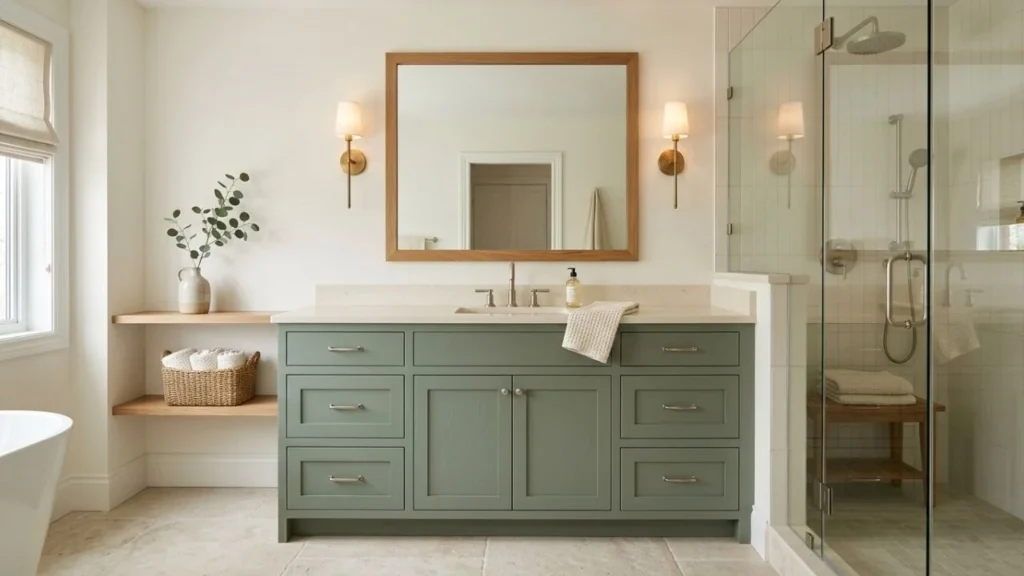
The best green bathroom ideas start with the bathroom you already have, not the shade that looked good in somebody else’s photo.
You can save thirty sage bathrooms and still have no idea which sage belongs beside your actual tile.
That is the real problem behind green bathroom ideas. Green itself is not the difficult part. The decision is which green, where should it go, and how much do you want to live with?
A soft sage can look calm on your phone and turn gray beside a cool floor. Olive can look rich on a paint card and muddy under warm bulbs. Emerald can begin as one dramatic vanity idea and suddenly have you wondering if every faucet in the house now needs replacing.
It does not.
Green is broad enough to work with white, cream, chrome, brass, black, warm wood, stone and other colors. The useful part is figuring out which combination fits the room you already have.
If you want to compare finished rooms before deciding, these designer green bathroom examples show green used through paint, shower tile, stone and deeper all-over schemes.
Start with what is staying.
If you are not replacing the floor, shower tile, countertop, tub, toilet or vanity top, those surfaces already have a say in the new color.
A white tile can lean blue. Beige can lean pink or yellow. Marble may carry gray, cream, green or brown through its veining.
Your green has to live beside those finishes every day.
| Green family | Usually feels | Try it beside | Check carefully with |
|---|---|---|---|
| Sage | Soft, muted | Cream, oak, warm white | Cool gray tile |
| Seafoam | Airy, cooler | White, pale wood, nickel | Yellow-beige finishes |
| Olive | Earthy, warm | Walnut, travertine, terracotta | Dark floors with weak light |
| Moss | Deep, organic | Stone, warm metal, dark wood | Rooms already dark throughout |
| Emerald | Rich, stronger | Marble, cream, walnut | Several other saturated colors |
| Gray-green | Quiet, contemporary | Sand, pale stone, white | Yellow artificial light |
If you want more pairing inspiration before committing, these current bathroom color ideas show softer green sitting beside stone, warm neutrals and timber rather than relying only on cool white and gray.
Take the paint sample to the tile.
Do not make the tile audition for paint you already bought.
If the bathroom has white tile or white walls and you are unsure which direction the white leans, these colors for white walls can help you compare warmer and cooler combinations before choosing the green.
I would test:
Two cool gray-leaning surfaces can flatten each other. That is why a sage that looked gentle in the store may suddenly look dull at home.
Tape up a large sample and look at it:
Bathrooms bounce light from tile, glass, mirrors and metal. The same paint can look more yellow, blue, gray or brown at different times.
Before you paint: Leave the sample up for a full day. The ten minutes you spend checking it at night may save you a second paint job.
You do not get extra points for using more color.
| Commitment level | Put green here | Good starting point for |
|---|---|---|
| Low | Vanity, trim, art, textiles | First green room or rental |
| Medium | Half wall, wallpaper, shower zone | Clear color without an all-over scheme |
| High | Full walls, ceiling, tile drench | Green defining the room |
Once you know your comfort level, the next decision gets much easier.
If all those saved sage green bathroom photos appeal to you but four green walls feel like too much, start with the vanity.
This works especially well when the bathroom already has white tile, cream walls or pale stone. The vanity becomes the color point while the rest of the room stays quieter.
Try it with:
I would keep the counter fairly clear. A painted vanity already has enough visual weight.
Look at the doors and drawer fronts first.
If the surface is swollen, peeling or badly damaged, paint will not fix the underlying problem. If the cabinet is sound, test the sage beside the countertop before buying the full amount.
Olive is one of the most flexible green bathroom ideas when sage feels too pale and emerald feels too strong.
An olive green bathroom works naturally with:
I like olive best when the room has at least one lighter surface around it. If the floor, vanity and walls are all dark, the room can start feeling heavier than you intended.
Worth knowing: Olive can lean more yellow or more brown depending on the light. Test it beside the wood tone you already own.
A powder room does not have to pretend it is large.
Maybe “bigger” is not the goal.
Maybe you want small, moody and memorable.
Moss or forest green can work beautifully with:
A compact room can handle deeper color when the lighting, mirror and surrounding finishes support it. This small bathroom color example shows exactly how a darker green can make a little room feel intentional rather than apologetic about its size.
Small-room tip: If the walls are dark, I would keep at least one large plane lighter, such as the ceiling, vanity top or floor.
Emerald does not need every wall.
Let the shower carry it.
Try:
Then keep the outer bathroom quieter with cream, pale stone or warm white.
This gives you a strong green tile bathroom moment without making the entire room intense.
Do not choose grout from a tiny paper swatch.
Lay a few tiles together and compare:
The grout is part of the final color decision.
Idea 4 contains the green.
This one commits to it.
If you genuinely love the tile, carrying one green tile across more than one surface can make the room feel calmer than mixing four unrelated materials.
This bathroom tile design guide includes green tile, softer checkerboard patterns and more expressive tile layouts that go beyond one small backsplash.
If you tile-drench:
A glossy tile may bounce more light. A matte or textured tile may feel quieter but can have different cleaning needs. Check the care instructions for the exact tile you choose.
Green and terracotta work because one brings a cooler botanical note and the other brings warmth.
Try:
sage + terracotta + cream + warm wood
A sage shower wall beside a warmer terracotta floor can feel much more balanced than sage beside another cool gray surface.
If the wall tile is long and narrow, consider a squarer floor tile. Different shapes help the surfaces feel related without looking copied.
Quick tip: If both tile colors are strong, keep the paint simple. You do not need a third dramatic surface.
A green bathroom wallpaper can give you pattern and color in one decision.
Instead of covering the whole room, try:
This works especially well in powder rooms and on walls away from constant splashing.
If you are considering paper in a bathroom with a shower or tub, this bathroom wallpaper planning guide explains why ventilation, material and placement need thought before installation.
Pick one quieter green already inside the wallpaper and repeat it on:
That is much easier than buying paint first and then spending a weekend trying to find wallpaper willing to agree with it.
If a full green bathroom feels like too much, stop halfway.
Use green below and cream, warm white or wallpaper above.
Natural dividing lines include:
This works especially well in a narrow bathroom because it adds color without turning every wall into one large field of green.
If you already have white tile halfway up the wall, the room may have done half the planning for you.
Walls are not the only painted surface.
A muted green ceiling can work beautifully with warm white walls, especially when you want the color to feel more intentional without bringing more objects into the room.
You can also reverse it:
Tape a painted sample close to the ceiling.
The same shade can look darker above your head because it receives light differently.
I would never choose a ceiling color from a sample held at waist height.
Flat paint is not your only option.
A textured decorative finish can give sage, olive or gray-green more movement, especially in:
The changing surface can make a muted green feel richer without adding another pattern.
Choose a finish intended for the actual wall and bathroom conditions. I would not assume a decorative wall finish belongs inside a shower simply because it looks beautiful in a photo.
If you choose dramatic green stone, let it be the thing people notice.
Use it on:
Then calm the surrounding finishes.
Try:
The stone, wallpaper, patterned floor and five decorative trays do not all need a group project.
Worth knowing: Natural stone can have specific sealing and cleaning requirements. Follow the care guidance for the exact stone rather than assuming every material is treated the same way.
Checkerboard does not have to mean sharp black and white.
Try:
Current tile examples are also using checkerboard in softer green-and-neutral palettes rather than only hard black-and-white contrast.
Use it on:
Then let the rest of the room settle down.
Pattern needs some quiet around it.
Green and pink can feel grown-up when neither shade is sugary.
Try:
Pick one color to lead.
If the vanity is green, use pink through:
You do not need to split the bathroom fifty-fifty like the colors are negotiating a treaty.
If your chrome faucet works perfectly and you like it, I would not replace plumbing just because every saved green bathroom seems to have brass.
Keep the chrome.
Then add warmth through:
Mixed metals can look intentional when each one repeats or clearly belongs to a certain part of the room. Current bathroom design is also moving away from perfectly matched metal everywhere.
That is fine.
Sage, seafoam and gray-green can look clean with chrome or brushed nickel.
Green does not come with a mandatory brass subscription.
This is one of the smallest choices in the renovation and one of the easiest to underestimate.
Take the exact same sage square tile.
Change the grout and the whole wall reads differently.
White grout: stronger grid.
Cream or beige grout: softer pattern.
Close green grout: more continuous color.
Before installation, look at several tiles with the grout sample between them.
Do not wait until somebody asks for the grout color while you are standing in a dusty room trying to remember what you chose three months ago.
Ask what you want people to notice.
If you love the tile layout, contrast can show it.
If you love the green itself, a closer grout color can make the surface calmer.
A small green bathroom does not have to look bigger.
That idea alone can remove a lot of pressure.
If you want a dark green bathroom with deep moss, olive or forest walls, support the color with:
Artificial light becomes part of the paint decision.
Test the green under the bathroom lights before committing.
If the shower is also dark, these safe shower lighting ideas can help you think through visibility and light placement before choosing an even deeper color.
Do not confuse “moody” with “hard to see.”
Those are different problems.
You can build a green bathroom without touching the walls.
Try:
Pick one green family.
For example:
olive + cream + warm brown
Not sage towels, an emerald mat, mint storage and a neon green bin because every piece of green bathroom decor was bought on a different weekend.
A rental can still look thought-through.
If you are still stuck, start with the fixed surface you dislike least.
| Existing finish | Green to test first | What I would watch |
|---|---|---|
| Cool gray tile | Warmer sage, olive, gray-green | Blue-green may look flatter |
| Beige tile | Olive, moss, muted sage | Yellow-heavy green may look muddy |
| White subway tile | Most green families | Bright white sharpens deep green |
| Warm marble | Olive, moss, muted sage | Cool mint may feel detached |
| Black floor | Sage, emerald feature, lighter olive | Too many dark surfaces |
| Oak vanity | Sage, moss, olive | Match warmth, not exact color |
| Walnut vanity | Olive, emerald, moss | Keep one larger surface lighter |
| Chrome fixtures | Sage, seafoam, gray-green | Do not replace chrome automatically |
Before you buy anything: Put the sample beside the surface that is staying. That surface is your real starting point.
You do not need a contractor-style national price chart to decide which changes are small and which ones belong to a renovation.
Bathroom size, material, labor and location can change the cost too much for one generic number to be genuinely useful.
| Project level | Start with | Leave for later |
|---|---|---|
| No-reno change | Samples, towels, art, bath mat | Plumbing and tile |
| Weekend project | Vanity paint, trim, one wall | Full shower redo |
| Mid-level update | Wallpaper, mirror, lighting, partial tile | Stone slab work |
| Renovation | Shower tile, full vanity, stone, tile drench | Small accessories until finishes are chosen |
The smartest green bathroom ideas solve the surface that bothers you most before they start buying accessories.
A new towel rarely fixes a tile problem.
The finished photo is one day.
You still have to live with the room afterward.
Before calling the plan finished, ask:
Those questions are not glamorous.
They are the ones that can stop a bathroom you loved for three weeks from becoming a room that quietly irritates you for three years.
The floor and shower tile have more power than the paint card.
Bring the sample to them.
Sage can start looking lifeless when every neighboring surface is another cool gray.
Warm wood, cream or stone can help.
You can use more than one green.
Keep them related.
A room should not look as though five separate people were each allowed one green purchase.
You do not need one finish on every faucet, mirror, light and handle.
A bathroom can feel connected through color, shape and material without matching every metal.
A color chosen entirely in daylight may surprise you after sunset.
Check it under the lighting you actually use.
One should lead.
If the shower is full emerald tile, quieter walls may make the tile look better.
Ask what feeling you want.
Airy and intimate are both valid.
Tile does not finish the tile decision.
Grout changes the pattern.
There is no single winner.
Sage and seafoam work well when you want a softer room. Olive pairs naturally with warm wood and stone. Moss and forest green suit deeper rooms. Emerald makes sense when you want the green to become a clear feature.
Start with the finishes that are staying.
If you want a lighter look, test sage, seafoam or a softer gray-green.
If you want a more intimate room, moss, olive or forest green can work too.
Small does not force you into pale paint.
Try:
Test the pairing beside your existing tile before finalizing it.
Yes.
I would pair it with useful artificial light and at least one lighter surface, such as the counter, ceiling or floor.
Yes.
Olive, moss and emerald sit comfortably with warmer metal.
Sage can work with brass too, but brass is not required.
Absolutely.
Seafoam, sage and gray-green can look clean with chrome or brushed nickel.
Keep chrome if it suits the room and still works.
That depends on the effect you want.
White creates more contrast.
Cream or beige softens the grid.
A closer green makes the surface look more continuous.
Yes, but the room conditions matter.
Powder rooms are easier. Bathrooms with showers and tubs need more thought around ventilation, wallcovering type and placement.
It can.
Matching walls and ceiling gives you a more wrapped-in feeling. A lighter ceiling creates more contrast.
Test the shade overhead before committing.
Green itself covers a huge range of shades and styles.
What tends to feel old faster is a room tied too tightly to one short-lived combination of tile, metal, pattern and accessories.
If the most permanent surface is green, keep some surrounding choices easier to change.
The strongest green bathroom ideas become easier once you stop choosing color in isolation.
Do not begin with the towel.
Do not begin with the brass faucet from somebody else’s bathroom.
Begin with the floor, tile, vanity top or another surface that is staying.
Take two or three green samples into the room.
Look at them during the day.
Check them again at night.
One may suddenly look dull.
One may lean too blue.
And one may make the bathroom you already have start making sense.
Choose the green in the room, not on the paint card.
Explore original printables, find another story or save your next creative project.