
POPULAR AT FAMILY HAVEN
POPULAR AT FAMILY HAVEN
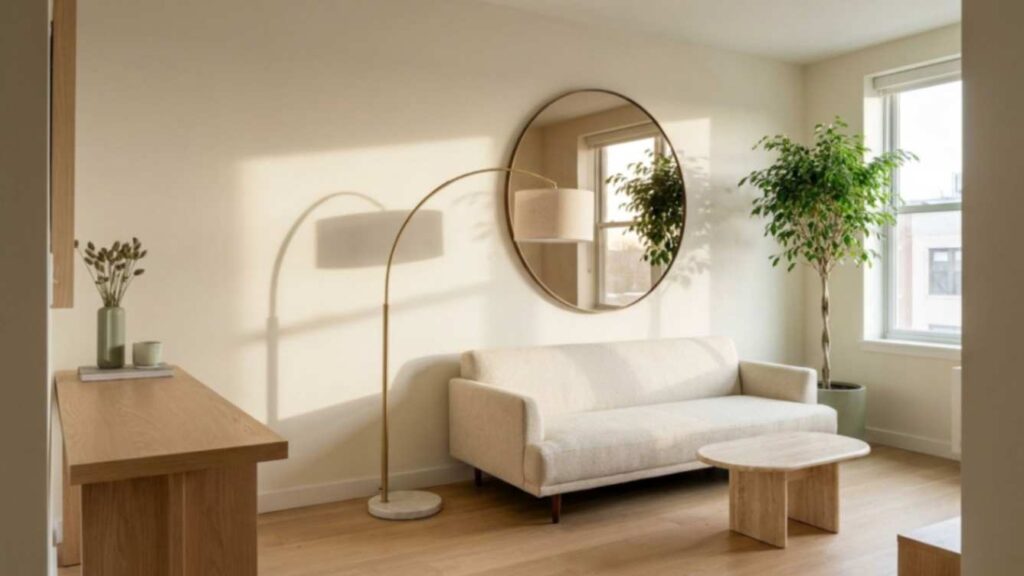
You have the sofa. The coffee table is there. There is a rug, a TV, maybe a plant in the corner and a couple of pillows you actually like.
So why does the room still feel a little… cold?
That is the question behind the best cozy apartment living room ideas. You usually do not need to replace half the room. You need to figure out which layer is missing.
Sometimes it is the lighting. Sometimes the rug is too small to connect the furniture. Sometimes every surface is smooth, gray, and hard. Sometimes the room is simply trying to hold too much.
Let’s figure out what your living room needs before you buy another cute little object that ends up wandering from shelf to shelf because nobody knows where it belongs.
If your living room feels:
| The room feels… | Look here first |
|---|---|
| Flat after dark | Lighting |
| Cold | Color and texture |
| Disconnected | Rug and furniture placement |
| Crowded | Furniture scale and walking space |
| Boxy | Curves and height |
| Messy | Visible storage |
| Generic | Personal pieces |
| Unfinished | Art and a clear focal point |
The best cozy apartment living room ideas are not about squeezing all 17 suggestions into one room.
Start with the problem that sounds most familiar.
Fix that layer.
Then look at the room again.
You may discover you need far less than you thought.
A cozy room usually has a few layers working together.
First, something grounds the space. That is often the sofa and rug.
Then comes light. A room that looks lovely at noon can feel completely different once the sun goes down.
Next comes softness through fabric, wood, rugs, curtains, upholstery, and other surfaces that break up all the hard lines.
Height matters too. If everything stops at sofa level, the room can feel squat and unfinished.
Then comes the part no shopping list can choose for you: personality.
One photograph you love can do more than five decorative objects you bought because an empty shelf made you nervous.
That is the formula we are going to work with.
If your apartment feels comfortable during the day but disappointing at night, start here.
Before blaming the sofa, the paint, or the rug, turn off the ceiling light and see what happens.
One bright fixture in the middle of the ceiling can light the room perfectly well while making it feel about as relaxing as a waiting room.
Spread the light around instead.
Try a floor lamp near the sofa, a smaller lamp across the room, and one softer source near a shelf or TV area.
You are not trying to make every corner equally bright. You are creating brighter and softer areas so the room has depth.
Homes & Gardens also recommends using layers of ambient, task, and decorative lighting in compact living rooms rather than asking one source to do every job. Their guide to layered living room lighting explains the idea in more detail.
If you want more ideas for choosing lamps and placing light around a room, these warm living room lighting ideas can help.
Turn off the overhead light.
Switch on every lamp you already own.
Now look for the darkest part of the room.
That is probably a better clue about your next lighting decision than another hour of browsing lamps online.
If all your light comes from above, the room can feel flat.
Mix heights.
A floor lamp can throw light above sofa level.
A table lamp creates a lower glow.
A small lamp or soft light near the TV can make that side of the room feel less like a large black rectangle floating against the wall.
Architectural Digest notes that lighting sources at different heights can draw your eye around a small room and make the space feel more interesting.
Keep the TV area subtle, though.
A soft glow? Lovely.
A rainbow of lights pulsing behind the screen like mission control? Maybe not the cozy evening you had in mind.
If that wall needs more than lighting, these living room TV wall ideas go further into layouts and styling.
Once the lighting feels better, look down.
Your rug and furniture need to look as though they belong to the same room rather than meeting for the first time.
Here is an easy mistake to make.
You find a rug you love.
You order it.
It arrives.
And suddenly it looks like a postage stamp sitting underneath the coffee table.
A living room rug should relate to the seating area, not only the table.
Crate & Barrel’s current living room rug sizing guide recommends choosing a rug large enough for at least the front legs of the sofa and primary chairs to sit on it.
Your exact room still gets the final vote.
Use painter’s tape to mark the rug dimensions on the floor.
Then:
You will know quickly whether the rug is connecting the furniture or floating alone in the middle.
Already own a charcoal, gray, navy, or brown sofa?
Good.
Do not immediately decide the sofa is the reason your room does not feel cozy.
Dark upholstery can give the room visual weight. What surrounds it decides whether that weight feels grounded or heavy.
Try warming it with cream, oatmeal, taupe, wood, muted rust, olive, brass, or softer lighting.
The sofa does not need to disappear.
It needs better company.
If you prefer a quieter palette, these neutral living room ideas can help you layer softer shades without making the room look flat.
This is where cozy apartment living room ideas can go wrong.
People hear “small apartment” and start shrinking everything.
Tiny sofa.
Tiny table.
Tiny chair.
Tiny lamp.
Then the room contains a collection of small pieces fighting for attention instead of one arrangement that works.
A properly scaled sofa or sectional can sometimes make more sense than a loveseat plus two chairs and extra tables.
Architectural Digest’s 2026 guide to sectionals for small spaces includes designers making exactly that point: one correctly sized sectional can sometimes reduce the clutter created by several smaller seating pieces.
The real questions are simpler:
Can you walk through the room comfortably?
Can the doors open?
Can you reach the window?
Does the sofa give you the seating you actually need?
Does the coffee table still fit without turning the room into an obstacle course?
If yes, the sofa may be perfectly fine.
Cozy does not mean beige from floor to ceiling.
You can use charcoal. Brown. Olive. Navy. Rust. Burgundy. Deep green.
The room feels warm when the colors, light, and materials support each other.
Gray often gets blamed for making a room feel cold.
Gray itself is not necessarily the problem.
A gray sofa surrounded by cool white walls, a cool gray rug, silver decor, and blue-white lighting can feel chilly because everything around it is pulling in the same direction.
Change the relationships instead.
| If your sofa is… | Try around it |
|---|---|
| Charcoal | Cream, taupe, pale wood, rust |
| Mid-gray | Oatmeal, mushroom, olive, walnut |
| Navy | Warm white, camel, medium wood |
| Brown | Cream, muted green, brass, oatmeal |
You are not trying to disguise the sofa.
You are changing the company it keeps.
If you are thinking about paint too, these cozy living room colors can help you compare warmer wall directions.
Look around.
Smooth wall.
Smooth sofa.
Smooth coffee table.
Smooth television.
Smooth flooring.
If every major surface has roughly the same visual feel, the room can look harder than you want.
Texture changes that.
Try contrast through:
Apartment Therapy’s designer-backed guide to cozy apartment decorating also points to color and texture as useful ways to make a small apartment living room feel warmer.
You do not need an army of cushions.
If your sofa is smooth and dark, two lighter textured pillows may create all the contrast you need.
Then sit down.
If you have to move five pillows before your body can actually touch the sofa, the pillows have started winning.
Your blanket does not need to be folded into a perfect rectangle with military precision.
Drape it over the sofa arm.
Let part of it fall across the chaise.
Fold it loosely over the back.
A throw can break up a large block of upholstery, introduce another color, and make the sofa look softer.
But please make sure it is comfortable.
A cozy living room should survive actual people sitting in it.
The blanket is allowed to have a job.
Apartments have no shortage of rectangles.
The TV.
Doors.
Windows.
Cabinets.
Frames.
Sofa.
Rug.
Coffee table.
Once you notice it, you cannot unsee it.
A round mirror introduces a completely different shape without needing floor space.
But where you put it matters more than people sometimes admit.
Before hanging one, stand where the mirror will go and think about what it will reflect.
A window?
Nice.
A lamp?
Good.
A plant or artwork?
Great.
The laundry pile you have been meaning to fold since Tuesday?
Perhaps another wall.
A mirror does not automatically fix a small room.
Use it to reflect something worth seeing.
Architectural Digest also includes reflective surfaces and mirrors among its small-room tools, especially when they work with light rather than becoming decoration for decoration’s sake.
Once you introduce one curve, repeat that softer shape somewhere else.
Maybe you have:
Or:
You do not need a room full of circles.
The idea is repetition.
One rounded object can feel random.
A few connected shapes begin to feel like they belong together.
Now look at height.
Where does most of your furniture stop?
Probably somewhere around the back of the sofa.
A tall plant, floor lamp, vase of branches, or vertical artwork gives your eye somewhere else to travel.
That extra height can soften an empty corner without filling it with a pile of small decorations.
You do not need seven plants to prove you like plants.
One strong shape may be enough.
Cozy and cramped are not the same thing.
A room can feel full without being difficult to move through.
This is where furniture footprint matters.
Your coffee table should not require evasive maneuvers every time you walk from the sofa to the kitchen.
Round and oval tables can work well in tight arrangements because they remove projecting corners.
Nesting tables can be useful when you want extra surface space sometimes but not all day.
A storage ottoman can combine a table-like surface, footrest, and storage.
But do not assume “round” means “small.”
A giant circular table is still a giant table.
Measure the whole footprint.
Then test the walkway.
Your knees and shins will thank you later.
Apartment furniture has to work.
A media console that also hides cords, remotes, controllers, and chargers is doing more than an open table full of little objects.
A storage ottoman earns its space twice.
Nesting tables can disappear into one footprint when you do not need the second surface.
Architectural Digest’s current small-living-room guidance also stresses furniture that serves more than one purpose and storage that keeps compact rooms from becoming visually overloaded.
Some things look better when you cannot see them.
Remote controls.
Charging cables.
Game controllers.
Batteries.
Paperwork.
The mystery wire nobody remembers buying but everyone is afraid to throw away.
You do not need to hide every book and object you own.
Just separate the things worth displaying from the things that are simply waiting to be used.
When floor space runs out, look up.
You may have more room than you think.
Before adding another floor-standing piece, ask whether the wall can solve the problem.
A slim picture ledge can hold art without taking floor space.
A small floating shelf can create one useful display area.
Wall-mounted lighting can free a side table.
Keep the arrangement edited.
Two frames, one object, maybe one light.
Then stop.
You do not have to fill the last twelve inches of shelf because the shelf had the audacity to leave them empty.
If you want more low-cost ways to work with what you already own, these budget DIY living room ideas may help.
A small room does not require tiny artwork.
One larger piece can give a wall a clear focal point with less visual noise than a collection of little frames scattered everywhere.
A pair can work too.
Or a small group of three.
Look at the wall from across the room rather than standing six inches away while hanging everything.
The art should feel connected to the furniture below it.
If it looks as though it is floating near the ceiling, bring it back into the conversation.
Empty wall space is not failed decorating.
Sometimes that quiet area is exactly what lets the art matter.
Most living rooms actually use the television.
We can stop pretending otherwise.
The television is often one of the largest dark shapes in an apartment living room.
Instead of surrounding it with ten small decorations, make the whole zone feel calmer.
Try:
Keep the light soft enough that it does not glare across the screen.
If the TV wall needs a larger rethink, these TV wall styling ideas can help you work through the whole arrangement.
The goal is not to disguise the TV.
It is to stop that side of the room from looking abandoned once the screen turns off.
This is the part that no formula can finish for you.
The last layer should not be another generic vase simply because the coffee table has an empty corner.
Add something that means something.
Maybe it is:
a framed photograph
a piece of art you saved for months
a ceramic object
a favorite book
something collected on a trip
a vintage lamp
a family piece
something handmade
The room becomes more personal when there is something inside it that could not have come from somebody else’s shopping list.
If you want to explore that side of decorating further, these apartment living room aesthetic ideas focus more on personality, expressive styling, and making an apartment feel like yours.
And then comes the surprisingly difficult part:
Stop.
Do not fill every remaining gap because the gap exists.
You do not need to remember all 17 cozy apartment living room ideas at once.
Stand in your room and decide which problem sounds most familiar.
Start with:
Start with:
Look at:
Add something with a story.
Not another coordinated accessory set.
Something that reminds you of a person, place, interest, memory, or version of yourself you actually like.
Stop shopping for a minute.
Move something.
Remove something.
Turn off the overhead light.
Tape a larger rug size onto the floor.
Restyle the TV console.
Move the lamp.
Live with those changes for a few days.
Then decide what is truly missing.
That pause can save you from spending your whole decorating budget solving the wrong problem.
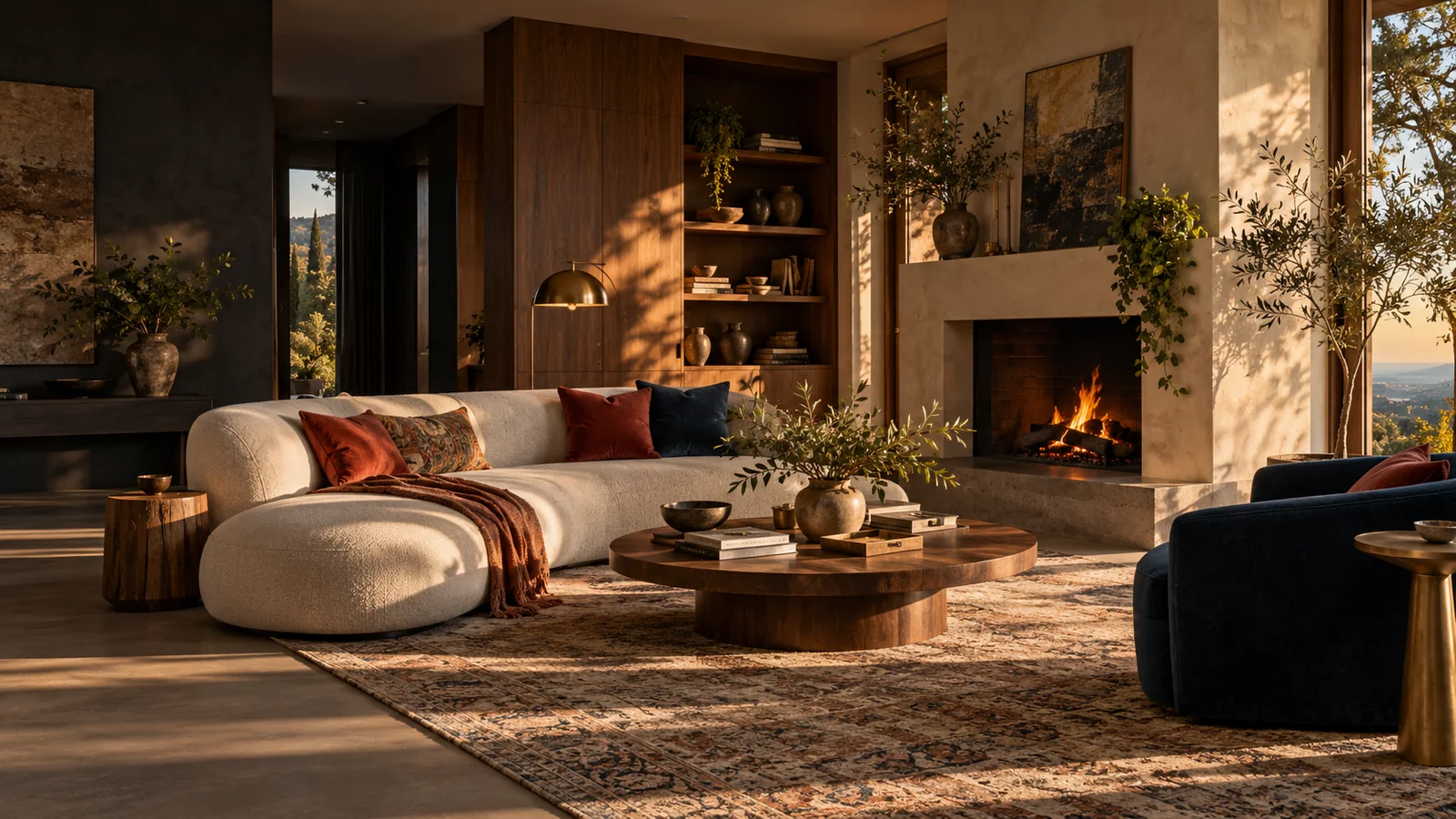
When you see a living room that makes you want to move in immediately, do not begin by hunting for the exact sofa.
Decode the room first.
What is the largest visual object?
A dark sofa?
A cream sectional?
A dramatic rug?
A fireplace?
That is the anchor.
What made you feel something?
Often it is not the furniture.
It may be the warm pool of light in the corner.
The low evening glow.
The deep color on the wall.
The heavy curtains.
What appears more than once?
Cream in the rug and curtains?
Black in the mirror frame and coffee-table legs?
Olive in the cushions and artwork?
That repetition creates connection.
Is the architecture boxy while the furniture introduces curves?
Maybe you are responding to the round mirror, oval table, and globe lamp without realizing it.
Look at the surfaces.
Wool.
Linen.
Wood.
Velvet.
Stone.
Woven fabric.
Ceramic.
Texture is often doing more emotional work than the color.
This is the part worth copying.
Maybe you already own the dark sofa.
Your rug is fine.
Your walls are fine.
What you are missing is one warm lamp and a little texture.
Now you are solving your room instead of trying to buy somebody else’s.
You are not limited to beige.
Cream, taupe, oatmeal, mushroom, rust, olive, brown, burgundy, muted red, charcoal, and deeper greens can all work.
The relationship between the colors matters more than finding one official “cozy” shade.
A dark sofa can feel warm when it sits beside softer fabric, warmer wood, and lower evening light.
It needs a rug that relates to the seating area.
A common arrangement places at least the front legs of the sofa and main chairs on the rug, but your furniture and room measurements should decide the final size.
Tape the dimensions onto your floor before ordering.
That five-minute test is far easier than wrestling a rolled rug back into return packaging.
Yes.
A sectional is not automatically too large just because the room is small.
Sometimes one sectional gives you the seating you need with less visual clutter than several separate chairs and tables. Measure the footprint and protect the main walking routes before deciding.
Make fewer things do more.
Use one rug to connect the seating.
Layer two or three useful light sources instead of filling surfaces with decorative objects.
Choose pillows and throws for texture.
Hide the things you use but do not need to display.
Leave some surfaces partly empty.
Cozy comes from layers.
Clutter comes when everything competes for attention.
Absolutely.
Start with the things you can take with you:
rugs, lamps, furniture placement, curtains where allowed, textiles, art, freestanding mirrors, plants, books, and decorative pieces.
Apartment Therapy’s small-rental examples repeatedly show that color, texture, lighting, and personal objects can change how a rental feels without rebuilding it.
For anything mounted to the wall, check your lease and use hanging hardware suited to the wall material and the item’s weight.
The best cozy apartment living room ideas do not leave you with a room that looks like somebody else’s saved photo.
They help you understand your own.
Maybe the sofa was never the problem.
Maybe the rug is too small.
Maybe the room is fine until 6 p.m., when one bright ceiling fixture turns everything flat.
Maybe you have enough decor and three things need to leave.
Maybe the missing piece is not something stylish at all.
Maybe it is the framed photograph sitting in a drawer because you have not decided where to hang it.
Start with the weakest layer.
Fix that.
Live with the room for a little while.
Then decide what it still needs.
Because a cozy apartment living room should not only look warm when you photograph it.
It should make you want to stay awhile when nobody is looking.
Explore original printables, find another story or save your next creative project.