
POPULAR AT FAMILY HAVEN
POPULAR AT FAMILY HAVEN
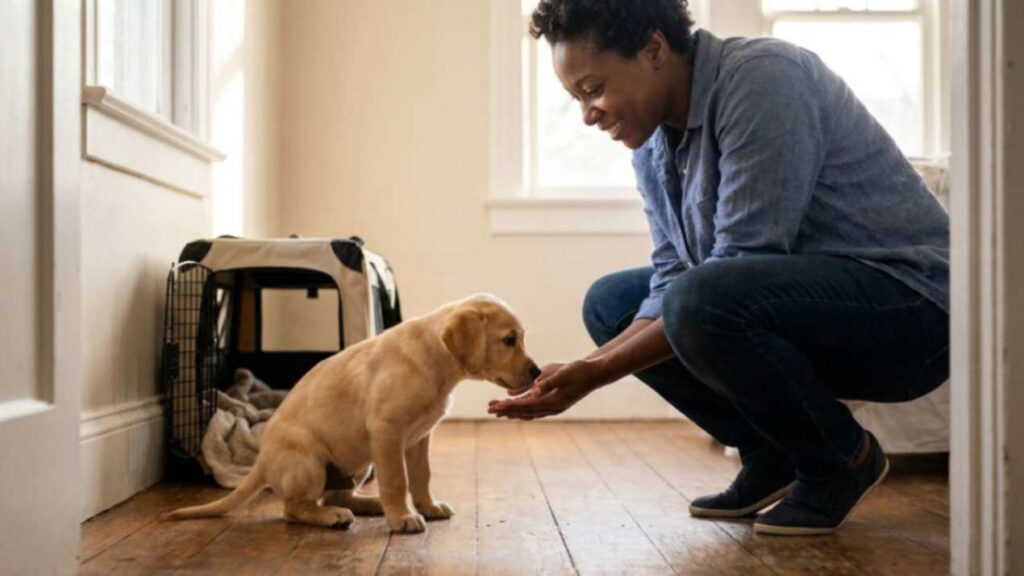
Puppy parenthood begins the moment you finally bring your puppy home.
Ten minutes later, somebody has peed on the floor, the new bed is being chewed instead of slept in, and the tiny creature you thought would spend the evening cuddling has decided your shoelaces are the greatest invention in human history.
Welcome to puppy parenthood.
Those first days can be ridiculously sweet and surprisingly tiring at the same time. You may love your puppy and still wonder why nobody mentioned the 2 a.m. toilet trips, needle-sharp teeth, constant supervision, or the fact that taking a shower now requires planning.
The good news? You do not need to solve all of puppyhood this week.
You need to know what matters first.
During your puppy’s first weeks at home, put most of your energy into:
Fancy tricks can wait.
Perfect leash walking can wait.
A puppy who understands where to sleep, where to pee, what to bite, and that you sometimes leave the room has already learned a lot.
When advice starts flying at you from every direction, come back to three things:
Safety. Routine. Relationship.
Your puppy has landed in a home they do not understand yet. They do not know that the rug is not a toilet, the phone charger is not food, or that bedtime means everyone would appreciate a little silence.
The first days are about helping them feel secure while preventing as much trouble as you reasonably can.
The current AAHA first-days puppy guidance recommends good supervision, positive reinforcement, patience, and helping puppies become comfortable with things such as a crate gradually rather than forcing them through fear. AAHA
That is a much better starting point than trying to turn an eight-week-old puppy into a finished dog before next Tuesday.
Keep day one smaller than you think it needs to be.
Your puppy does not need a grand house tour, eight visitors, three training lessons, a bath, a trip to the pet store, and a neighborhood meet-and-greet.
That sounds exhausting because it is.
Choose one part of the house where you can supervise easily.
That might be:
If a pen would make supervision easier, these foldable puppy playpen options are a simple Amazon US starting point.
Do not give your puppy the entire house on day one.
More freedom sounds kind.
More freedom also gives a baby dog seventeen new places to pee while you are trying to find your coffee.
Take your puppy to the same toilet area often, especially after:
Then reward the successful toilet trip right after it happens.
Do not wait until you are back inside five minutes later. By then your puppy may think the reward was for walking through the door and looking adorable.
The AKC early puppy guide puts toilet training, safe confinement, chewing, alone-time practice, and early social experiences ahead of trying to teach a long list of formal commands. American Kennel Club
Clean it.
Look at what happened.
Did you wait too long? Did play go on longer than expected? Did the puppy disappear behind the sofa for suspiciously quiet reasons?
Then adjust.
For cleanup, an enzymatic pet cleaner can help with urine and odor rather than simply covering the smell.
An accident is not your puppy being stubborn.
It is information.
The first night is often where puppy parenthood becomes real.
Your puppy may have gone from sleeping beside littermates to sleeping in a strange house with strange sounds and strange people who keep saying their name.
Some puppies settle quickly.
Some absolutely do not.
A crate or safe sleeping space near your bed can make the first nights easier because you can hear when your puppy wakes and may need to toilet.
If you use a crate, help the puppy build a good association with it during the day too.
Food, calm rest, a chew, and short relaxed periods inside make much more sense than putting the puppy in at bedtime and expecting them to understand the assignment immediately.
First ask why.
Do they need the toilet?
Are they frightened?
Are they uncomfortable?
Did they just wake?
A young puppy crying in a new house is not running an emotional blackmail operation.
Keep nighttime toilet trips quiet and boring.
Outside.
Toilet.
Soft praise.
Back to bed.
No 3 a.m. garden party.
A useful puppy routine is a rhythm, not a minute-by-minute spreadsheet.
Your puppy did not read the spreadsheet anyway.
Try thinking in repeating blocks:
| What just happened? | What probably comes next? | What you do |
|---|---|---|
| Puppy wakes | Toilet | Go out promptly |
| Successful toilet trip | Food, play, or short training | Supervise |
| Meal or lively play | Toilet again | Give another chance |
| Puppy gets wild, mouthy, or droopy | Rest | Lower the excitement |
| Puppy wakes from nap | Toilet | Start the cycle again |
| Evening winds down | Toilet and calm time | Prepare for sleep |
No.
Predictability helps, but exact timing changes with age, health, feeding, sleep, breed, activity, and the individual puppy.
A useful routine says, “After this, we usually do that.”
It does not mean panicking because lunch happened at 12:17 instead of 12:00.
If your household already runs better with visual routines, a daily routine chart for kids can also help families make puppy jobs visible instead of asking, “Wait, who took her out last?”
A puppy who suddenly turns into a furry piranha in the evening may not need another hour of excitement.
They may need sleep.
Give your puppy quiet opportunities to settle during the day instead of trying to entertain them from breakfast until bedtime.
And yes, when the puppy sleeps, you are allowed to sit down.
You do not need to stand over the pen whispering, “Look how peacefully she’s breathing.”
Go eat your lunch.
Start with the lessons that make normal life easier.
Show them where to go and make successful trips worth repeating.
Say it when something good is about to happen.
You want your puppy to hear their name and think, “Oh, I should pay attention,” not, “Apparently I am in trouble again.”
Instead of spending all day saying no, keep legal chewing options nearby.
If your puppy grabs your slipper, trade the slipper for something better.
You can browse puppy chew toy options if you need a few age-appropriate choices.
Walk out of sight for a few seconds while your puppy is settled safely.
Come back.
Repeat later.
Build slowly.
A puppy who has never spent ten comfortable seconds without you cannot be expected to feel fine when you suddenly leave for two hours.
Puppies bite.
Those teeth are tiny. Their confidence in using them is not.
Redirect to toys, pause rough play, and help your puppy learn that chomping people makes the fun stop.
Reward-based teaching matters here. The AVSAB humane training position recommends reward-based methods and advises against aversive training methods for dog training and behavior work. AVSAB
Socialization does not mean your puppy needs to greet every dog, child, bicycle, delivery driver, and pigeon within a five-mile radius.
It means helping your puppy learn that ordinary life is safe.
That can include:
This is where online advice can feel contradictory.
Early learning matters, but disease risk also matters.
Do not solve that by putting your puppy on the ground in every busy dog area.
Talk with your veterinarian about local disease risk and safe ways to expose your puppy to life while their vaccine series is underway. Controlled experiences can look quite different from walking through a heavily used dog park.
The goal is not:
“My puppy met 100 things.”
The goal is:
“My puppy learned that new things can happen without the world falling apart.”
Because puppy behavior is not always a neat little line from “bad” to “better.”
A puppy can have a lovely morning and transform into an ankle-seeking land shark at 7:42 p.m.
Before assuming your puppy needs more exercise, ask:
Then lower the temperature of the room.
Quiet chew.
Toilet trip.
Rest.
Not every burst of wild behavior needs another activity.
Puppies investigate with their mouths.
That makes normal household items suddenly much more interesting.
Keep an eye on:
The ASPCA pet poison guidance warns about foods such as grapes, raisins, onions, garlic, and products containing xylitol; its household guidance also flags several medicines and cleaning products. ASPCA
A home with kids needs one extra rule:
bags come off the floor.
Lunchboxes can contain food. Backpacks can contain gum, medicines, snacks, or other things your puppy would happily investigate first and regret later.
If your kitchen already feels short on safe storage, these small kitchen storage ideas may help you get puppy food, treats, and unsafe household items off the easy-reach level.
Puppy supplies spread.
One towel becomes five. One leash becomes three. Toys reproduce overnight. Nobody knows why there are poop bags in four different rooms.
Create one main puppy station.
Keep the things you use together:
A little organization can save a lot of wandering around the house holding a wet puppy while asking where somebody put the towel.
These small laundry room ideas can help if your laundry area doubles as puppy-cleanup central, while the linen closet organization ideas are useful if towels, bedding, and grooming supplies need one proper home.
Children and puppies can be wonderful together.
They can also wind each other up until the living room feels like somebody accidentally opened a tiny zoo.
Set simple rules for both sides.
Children should know:
Give children jobs that match their age.
A younger child might refill the water bowl with help.
An older child may help measure food, brush the puppy, or join short training sessions.
If you are already teaching children responsibility at home, these life skills activities for kids give you more ways to build age-appropriate household responsibility without making the puppy the child’s entire job.
Your puppy is not the only learner.
If one person says the puppy is allowed on the sofa, another says no, and a third quietly lets them up when nobody is looking, congratulations: the puppy has already found management.
Decide the basics together:
This matters even more when one person starts doing nearly everything.
Recent puppy-owner discussions repeatedly mention exhaustion, disrupted sleep, biting, loss of normal routines, and family members feeling pushed aside during those first weeks. Those stories are personal experiences rather than veterinary evidence, but they are a useful reminder that caring for the humans is part of making puppy parenthood sustainable too. Reddit
If your household needs a five-minute laugh after a rough puppy day, these relatable family memes and funny animal memes are a perfectly reasonable break.
This is one of the most useful distinctions a new puppy owner can learn.
| What you notice | What to do first |
|---|---|
| Occasional toilet accident | Tighten supervision and routine |
| Normal mouthing during play | Redirect and teach gentler play |
| Trouble settling after a busy period | Lower stimulation and offer rest |
| Mild uncertainty in a new place | Add distance and make the experience easier |
| Training is going nowhere | Ask a reward-based trainer for help |
| Persistent fear or escalating behavior | Speak with your vet and a qualified behavior professional |
| Repeated vomiting or severe diarrhea | Contact your veterinarian |
| Trouble breathing, collapse, seizure, or serious injury | Seek urgent veterinary help |
| Suspected poisoning | Contact a veterinarian or animal poison service promptly |
Do not let “puppies are hard” become the answer to every problem.
Sometimes you need better management.
Sometimes you need training help.
Sometimes you need a veterinarian.
Knowing the difference saves time and worry.
This may be the most relaxing part of the entire article.
You do not need to master all of this in month one:
Your first month has a simpler job.
Get the basics working.
| Before arrival | First day | First week | First month |
|---|---|---|---|
| Puppy-proof key areas | Keep things calm | Build a repeatable routine | Keep building safe independence |
| Prepare food and sleep space | Show the toilet area | Start gentle training | Continue social experiences |
| Gather vet records | Supervise closely | Practice short alone time | Expand skills slowly |
| Decide family rules | Let puppy rest | Confirm veterinary plan | Adjust routines that are not working |
| Choose essential supplies | Start toilet routine | Teach safe chewing | Get help early when stuck |
That is enough.
More than enough, actually.
Take your puppy out after waking, meals, active play, naps, and any time you notice their usual pre-toilet signs. Younger puppies need more frequent chances, so build your routine around what your puppy actually does rather than expecting one fixed schedule to suit every dog.
Check for toilet needs, discomfort, fear, or another real problem before deciding what the crying means. Help your puppy learn to settle gradually rather than assuming that ignoring every cry is the only way to teach independence.
Safe social experiences can begin early, but meeting unfamiliar dogs or using heavily trafficked dog areas carries different health risks while vaccinations are incomplete. Ask your veterinarian what is safe in your area and favor controlled contact with known healthy dogs when appropriate. American Kennel Club
Yes, the first weeks can disrupt sleep, work, family routines, and your normal freedom in ways that are hard to understand before the puppy arrives. Make the day smaller, share the workload where you can, and get practical help before exhaustion turns every small puppy problem into a giant one.
A month from now, some of the things worrying you today will already feel easier.
Not everything.
Your puppy may still steal a sock with the confidence of someone who pays the mortgage.
But you will know them better.
You will recognize the pre-potty pacing. You will know when the biting means “play with me” and when it means “I have been awake too long.” You will find the toys that actually work, the routine that fits your home, and the little signals that were invisible during week one.
That is puppy parenthood.
Not getting everything right immediately.
Learning the dog in front of you, helping them learn your world, and making the next good decision together.
Start there.
The rest can come later.
Explore original printables, find another story or save your next creative project.