
Modern Christian wall art does not have to look overly traditional, overly themed, or disconnected from the rest of your home. The best pieces make faith visible while still feeling natural beside the furniture, colors, textures, and objects you already love.
Christian art has never been limited to one visual language. The Library of Congress describes The Saint John’s Bible as a contemporary work that combines centuries-old calligraphy and illumination with modern artistic methods and technology.
That gives us a useful starting point: Christian art can change visually without losing the meaning behind it.
What makes Christian wall art feel modern instead of dated?
Modern Christian wall art usually feels intentional rather than heavily themed. Typography, negative space, color, symbolism, scale, framing, and materials all help determine whether a faith-based piece feels current in the room around it.
You do not need to remove crosses, Scripture, biblical imagery, or Christian symbolism to make the artwork modern. Instead, think about how those elements are presented.
A short Scripture in an airy serif font creates a very different feeling from a verse squeezed between several decorative fonts. An abstract composition inspired by a biblical story feels different from a literal illustration. A handmade plaster cross brings a different energy from a glossy printed sign.
If you already enjoy displaying Scripture, our Bible verse art ideas can help you explore ways to bring meaningful words into a family space without starting from scratch.
Here are eight Christian wall art styles that can feel fresh while keeping faith at the center.
What does minimalist Christian wall art look like?
Minimalist Christian art uses fewer visual elements so the message becomes the focus. Expect simple typography, restrained colors, generous empty space, fine line drawings, small symbols, and uncomplicated frames.
Minimal does not mean unfinished.
A strong minimalist piece pays close attention to letter spacing, line breaks, scale, and the relationship between the text and the space around it. A single short phrase such as “Be still” can have more visual impact when it is given room than when it competes with florals, borders, multiple typefaces, and extra decoration.
Black, cream, warm white, beige, muted brown, and charcoal work particularly well in this style because they are easy to combine with existing rooms.
Minimalist Christian artwork is especially useful when your furniture already has strong shapes, patterns, or colors. The artwork can add meaning without adding another layer of visual noise.
How can warm organic Christian wall art feel modern?
Warm organic Christian wall art combines faith with natural textures, soft colors, and materials that make a room feel relaxed. Think oatmeal linen, aged paper, warm wood, clay tones, olive green, handmade surfaces, and imperfect botanical forms.
This style works beautifully when you want Christian decor to feel like part of the home instead of something added afterward.
The artwork might feature a short Scripture over a textured background, a loose olive branch surrounding a small biblical phrase, or a simple cross painted in earthy tones.
Natural materials also have a long history in religious art. The V&A Museum documents devotional objects made from materials ranging from wood and painted pine to ivory, metal, glass, and wax. It also notes that private devotional art could become part of everyday life rather than remaining confined to formal worship spaces.
That idea still works in a modern home: meaningful objects do not have to look separate from everyday life.
If the rest of your room already leans soft and neutral, these neutral living rooms can help you see how restrained colors leave space for a more meaningful focal piece.
Can abstract Christian wall art still feel rooted in faith?
Yes. Christian art can communicate through symbolism, shape, color, light, movement, and visual metaphor without writing an entire Bible verse across the canvas.
This is one of the best options for someone who loves contemporary art but still wants the piece to carry spiritual meaning.
A wash of gold emerging from darkness might suggest light and hope. Flowing blue forms can recall water, renewal, or baptism. Seeds, pathways, fire, branches, crowns, wilderness, or fragmented shapes can reference biblical ideas without illustrating every detail literally.
The Bible art exhibition at the Library of Congress shows how contemporary sacred art can use abstract angels, butterfly wings, modern typography, cultural patterns, digital voiceprints, and nonillustrative compositions alongside biblical text.
That gives abstract Christian artwork room to be both meaningful and visually interesting.
The key is knowing what the symbolism means to you. A beautiful abstract piece becomes easier to live with when the story behind it matters beyond matching your sofa.
What is modern figurative Christian wall art?
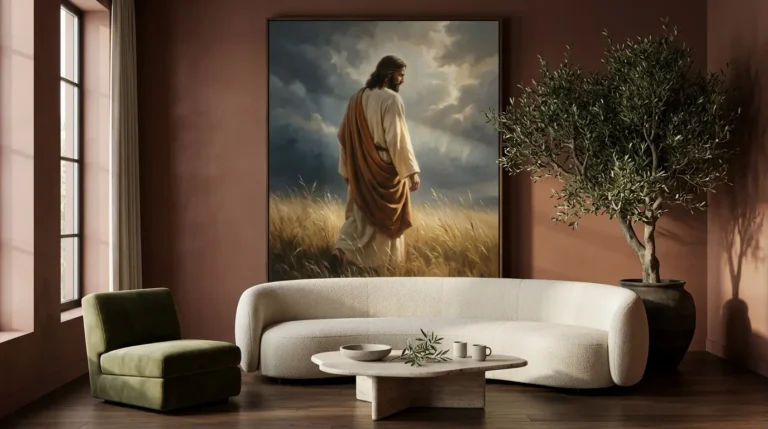
Modern figurative Christian art depicts people, prayer, biblical scenes, worship, Christ-centered imagery, or moments of faith using a contemporary visual style. It can feel much more personal than typography while avoiding the formal appearance of traditional church paintings.
The artwork might use loose brushwork, simplified silhouettes, graphic shapes, modern clothing, unusual perspectives, or a limited color palette.
This style already has precedent in contemporary sacred art. In The Saint John’s Bible, the Library of Congress documents biblical figures and stories interpreted with modern references, symbolic imagery, contemporary clothing, abstract forms, and cultural visual influences.
Because figurative artwork naturally attracts attention, let it breathe.
A large Christ-centered painting over a console may need nothing more than a lamp, a few books, and one simple object nearby. Covering the same wall with several competing religious pieces can weaken the impact of the one that matters most.
Can vintage Christian art work in a modern room?
Vintage Christian art can look beautiful in a modern room when the goal is contrast rather than turning the entire space into a period room. Traditional religious imagery can feel surprisingly fresh beside cleaner furniture, simple frames, and quieter colors.
Try treating the vintage piece as something collected rather than something that dictates every other decorating choice.
An aged biblical illustration in a thin black frame can work over a modern oak console. An antique-style sacred heart print can sit beside contemporary photography. An old hymn page can become one small element within a more varied gallery wall.
You do not need every era in the room to match.
Architectural Digest notes that modern rooms can take older-style paintings and traditional rooms can take modern art; mixing periods can create a more interesting result than making everything visually identical.
That principle can keep vintage Christian art from feeling like a theme.
What does botanical Christian wall art look like?
Botanical Christian art connects Scripture or Christian symbolism with flowers, leaves, vines, branches, seeds, gardens, and other natural forms. It can feel soft and decorative while still having a clear spiritual idea behind the imagery.
The most successful pieces connect the plant imagery to the message instead of adding flowers simply to fill empty corners.
Themes of growth, sowing, creation, flourishing, harvest, wilderness, and vines all lend themselves naturally to this style.
Botanical artwork can also move in several directions. A delicate line-drawn branch can feel minimalist. Moody painted flowers can feel vintage. Loose wildflowers can suit cottage-inspired rooms, while oversized leaf shapes can push the same idea toward contemporary design.
The Library of Congress exhibition even documents plants, butterflies, and other natural imagery incorporated into contemporary biblical illumination, showing how nature can operate as both decoration and symbolism within sacred artwork.
How does textural Christian wall art make a room feel more personal?
Textural Christian art adds a physical quality that flat prints cannot always create. Painted canvas, carved wood, plaster relief, handmade paper, embroidery, woven pieces, dimensional crosses, and visible brushwork can make faith decor feel collected and tactile.
That does not mean handmade work is automatically better than printable artwork.
A framed print may be easier to resize, switch seasonally, or use in several rooms. A handmade piece can add depth where a room contains too many flat surfaces.
You can combine both.
For example, one textured statement piece can sit beside two inexpensive framed prints. Our affordable wall decor ideas are useful if you want the wall to feel finished without making every single piece an investment.
Texture works best when it has room to be noticed. If the artwork includes heavy plaster, carving, fabric, or thick brushwork, keep nearby accessories a little simpler.
How do you build a modern Christian gallery wall?
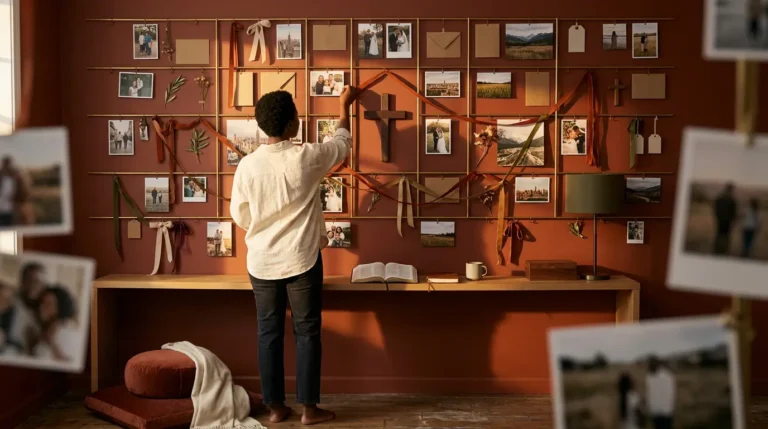
A modern Christian gallery wall feels intentional when the pieces share a visual connection without becoming a matching set. Color, frame finish, theme, spacing, or repeated shapes can provide unity while individual pieces remain different.
Not every item needs to contain Scripture.
You could combine a small Bible verse print, an abstract faith-inspired painting, a family photograph, botanical art, a cross, and an ordinary landscape. The Christian pieces establish meaning, while the personal and decorative pieces make the display feel like a home rather than a showroom.
The AD gallery guide recommends balancing visual weight while mixing different media, scales, and styles around a larger story.
Another Architectural Digest gallery guide recommends finding a common thread while still mixing periods, mediums, colors, sizes, and unexpected objects.
That approach works especially well for faith-centered homes because your wall can tell a fuller story about what your family values.
For a more focused devotional space, these prayer room ideas can help you think beyond artwork alone.
How do you choose the right Christian wall art style?
Start with the room you already have. Look at its colors, furniture, materials, mood, available wall space, and existing artwork before deciding what should go on the wall.
Your Christian artwork can either continue that visual language or become one deliberate contrast.
| If your room feels… | Try this Christian art style | Look for… |
|---|---|---|
| Clean and simple | Minimal typography | Negative space, short phrases, simple frames |
| Warm and natural | Organic modern | Earth tones, wood, linen, softened forms |
| Artistic and contemporary | Abstract faith art | Symbolism, color, movement, layered shapes |
| Quiet but expressive | Modern figurative | One strong focal image |
| Collected | Vintage Christian | Historic imagery with modern framing |
| Soft and nature-led | Botanical faith art | Vines, flowers, leaves, natural motifs |
| Handmade | Textural Christian art | Canvas, plaster, embroidery, carved elements |
| Personal and layered | Faith gallery wall | Mixed art, photographs, Scripture, objects |
If you are decorating a shared home, our Christian couple decor ideas can also help you think about how faith and personal style can exist together.
How large should Christian wall art be?
Artwork should relate to the wall and furniture around it rather than feeling like a small object floating in empty space. Before buying or printing anything, measure the available wall and consider the whole arrangement from a few feet away.
This matters especially over beds, sofas, consoles, and dining furniture.
One larger piece often creates a calmer result than several tiny frames trying to fill the same wall. If you prefer smaller work, grouping it into a deliberate gallery arrangement can give it enough visual presence.
Size is not only about inches. Dark artwork, thick frames, bold colors, and detailed imagery can feel visually heavier than a pale minimalist print of the same dimensions.
How high should Christian wall art hang?
Eye level is a useful starting point, but the room should make the final decision. Furniture height, ceilings, artwork dimensions, and nearby pieces can all change where the art looks balanced.
The 2026 AD hanging guide gives 57 inches from the floor to the center of the frame as a general starting point while also recommending adjustments for the specific room.
Above furniture, visually connect the art to what sits below it. If the piece feels as though it is floating near the ceiling, lowering it may make the whole arrangement feel more intentional.
The best Christian wall art should still feel like your home
Modern Christian wall art does not require choosing between meaningful and beautiful.
Your faith can show up through a quiet line of Scripture, an abstract piece full of symbolism, a contemporary biblical figure, vintage devotional art, botanical imagery, handmade texture, or a collected gallery wall.
The strongest choice is usually the one you would still want to live with even after the decorating trend changes.
Choose artwork because the message matters, then give that message a visual style that belongs naturally in your home.
Frequently Asked Questions
What is the most popular modern Christian wall art style?
Minimal typography, neutral Scripture art, abstract Christian artwork, botanicals, and warm organic designs appear repeatedly across current Christian decor collections. Rather than choosing solely by popularity, pick a style that works with the colors, materials, and mood already present in your room.
Does Christian wall art have to include a Bible verse?
No. Christian art can communicate through biblical scenes, crosses, symbolism, abstract interpretation, devotional imagery, typography, nature, or other visual references connected to faith.
Can you mix Christian wall art with regular artwork?
Yes. Mixing Christian pieces with family photographs, landscapes, abstract artwork, botanical prints, and collected objects can make a room feel more personal and less themed.
Where is the best place to hang Christian wall art?
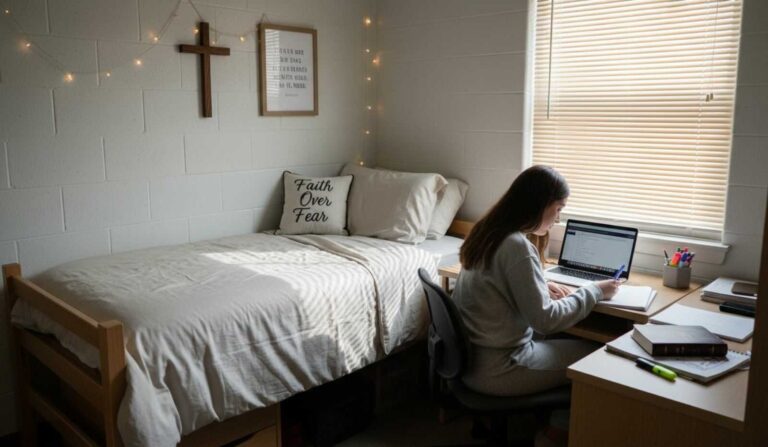
Hang it where the message can become part of everyday life, such as a living room, bedroom, entryway, office, nursery, hallway, or prayer space. The best location depends on the piece’s size, purpose, and how prominently you want it to be seen.