
POPULAR AT FAMILY HAVEN
POPULAR AT FAMILY HAVEN
Small bedrooms rarely have a not enough baskets problem.
They usually have a wrong furniture, wrong place, too much stuff, or no clear home for everyday things problem.
That distinction matters because some small bedroom storage ideas solve clutter by adding even more objects to an already tight room.
A rack appears beside the dresser. Baskets go under the window. Shelves climb the wall. An over-door organizer arrives. Suddenly you have technically created more storage and somehow made the bedroom feel smaller.
The better goal is not to store the maximum possible amount.
It is to make the room easier to reset.
Your jeans have one place. Shoes have one place. Laundry has one place. The spare duvet is not competing with the T-shirts you reach for every morning.
Architectural Digest’s current small bedroom storage advice makes a similar case for hidden, vertical, and double-duty storage instead of treating bins as the whole solution.
So before we add anything, let’s figure out what is actually taking over your room.
Walk into the room and ignore the furniture for a minute.
What keeps ending up somewhere it does not belong?
| What Keeps Piling Up? | Fix This Zone First | Think Twice Before Adding |
|---|---|---|
| Clothes | Closet + dresser | Another open garment rack |
| Shoes | Closet floor or shallow cabinet | Several shoe racks around the room |
| Bedding | Under bed or upper shelf | Giving prime drawers to spare blankets |
| Books | Narrow vertical storage | Deep bookcase for paperbacks |
| Daily clutter | Nightstand drawers | More trays on top |
| Laundry | One defined hamper | Multiple baskets in different corners |
| Bags | Hooks or one closet zone | Chair used as permanent bag storage |
| Accessories | Drawer, wall cabinet, shallow organizer | More tabletop storage |
| No closet | Wardrobe + dresser plan | A collection of exposed racks |
Quick tip: If five categories are overflowing at once, do not buy five organizers. Start with the category creating the most daily frustration.
That is usually clothes, laundry, or whatever is covering the chair.
Storage furniture is not useful if you have to turn sideways every morning to get past it.
Before ordering:
A piece can technically fit against a wall and still make the room annoying.
This is the same path first principle I use in these small-space furniture ideas: keep the main bed comfortable, then make secondary storage slimmer, shallower, or vertical before sacrificing movement.
Now we can make the storage work for the room instead of making the room work around the storage.
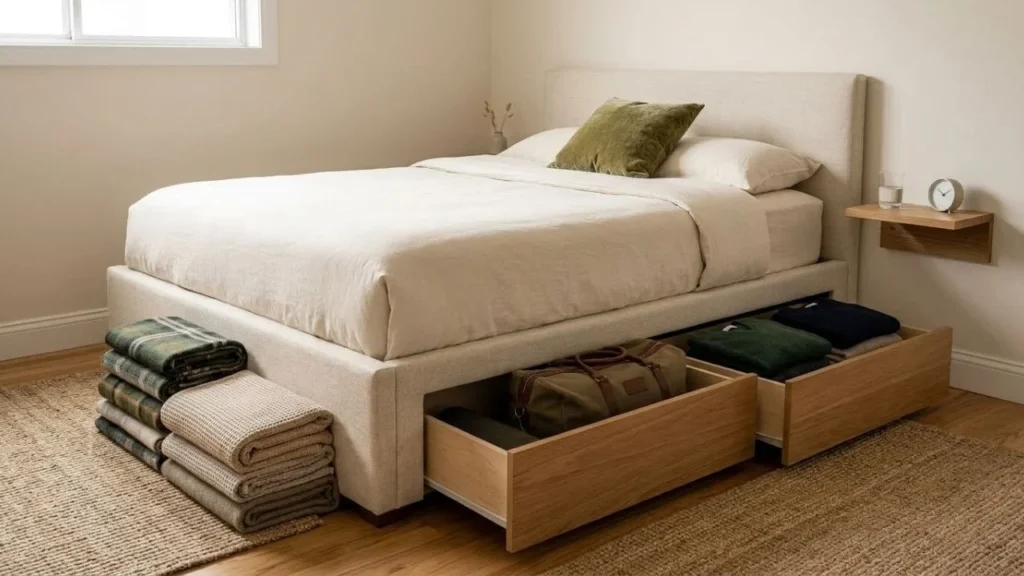
Under-bed space is one of the strongest small bedroom storage ideas because it uses floor area you already gave to the bed.
Architectural Digest’s current under-bed storage guide recommends it for less-used categories such as spare bedding and out-of-season clothing, but accessibility matters just as much as capacity.
Before buying a container, measure:
That last one is easy to miss.
If your bed sits against a wall, storage that opens equally from both sides is not equally useful to you.
Good candidates include:
Avoid putting daily-use items under there if retrieving them involves kneeling on the floor before work.
The storage is hidden.
Your irritation will not be.
Do not automatically buy risers.
Check whether your frame and manufacturer allow them and whether extra height would feel stable and comfortable.
Sometimes changing the container is easier than changing the bed.
A soft, low-profile zip bag may fit where a rigid box will not.
A storage bed can be worth the footprint when the bedroom lacks a linen closet or useful under-bed clearance.
It can work well for:
But the opening method matters.
A drawer built into the side of the bed is useless if:
A lift-up bed avoids side clearance, but check the maker’s instructions, mechanism, mattress limits, and safe operation.
Do not choose the storage style from the product photograph.
Choose it from the way your room is laid out.
If you need more drawers but have limited wall width, look upward.
A taller dresser can give you similar clothing capacity while using less horizontal wall.
Architectural Digest’s current small-bedroom guide specifically recommends tall dressers as a way to use vertical space when the floor footprint is limited.
Before buying one, check:
Tall dressers and wardrobes need appropriate stability.
The U.S. Consumer Product Safety Commission recommends anchoring furniture to reduce tip-over risk, especially in homes where children may climb or pull on drawers. furniture anchoring guidance
This is one area where “I’ll do it later” is not my favorite plan.
If your nightstand has no drawer, the surface has to carry every tiny bedside object.
Then the bed is surrounded by:
A small nightstand with one or two drawers can hide the things that need to stay close.
Keep the top for what you need during the night.
That may be only:
The calmer surface makes the whole side of the bed feel less crowded.
A floating nightstand does not create dramatically more storage.
Its strength is different.
It gives you a landing place while leaving more floor visible underneath.
The Spruce’s recent small bedroom design advice specifically recommends floating nightstands as a visually lighter alternative to bulkier bedside furniture.
This works especially well when:
If wall mounting is not allowed, do not turn “floating nightstand” into “argument with landlord.”
A tiny freestanding table or bedside caddy may solve the same need.
Sometimes storage improves because you remove something rather than add something.
A plug-in or hardwired wall light can free the nightstand from a lamp base.
That gives the surface back to:
and may let you choose a smaller nightstand altogether.
For renters, plug-in wall lights can be a lower-commitment option when the installation method suits the wall and lease.
The goal is not decorating the wall with another object.
It is freeing the furniture below it.
Hooks behind the door are useful when they prevent a chair pile.
They are less useful when the door becomes a second closet.
I would use them for a short list:
Not every piece of clothing worn since Tuesday.
Once hooks are loaded:
If not, you did not create storage.
You created a padded doorstop.
Shoes need surprisingly little depth when they are stored at an angle or vertically.
That makes a slim cabinet useful on a wall that could never hold a normal dresser.
Good locations can include:
Before buying, measure the deepest shoes you own.
Boots, high-tops, and larger sizes may not fit the same way flats and sneakers do.
Your bedroom does not need to host your complete footwear archive.
Move:
to another appropriate area if you have one.
Prime bedroom space should serve current life first.
The highest closet shelf is perfect for things you need occasionally and terrible for things you need every morning.
Good upper-shelf categories include:
Keep everyday jeans, underwear, bags, and work clothes lower.
A box containing one scarf, tax paperwork, two pillowcases, a charger, and a swimsuit is not organized.
It is a delayed surprise.
Label by real category.
“Winter accessories” is useful.
“Miscellaneous” is a warning label pretending to be a storage system.
Closet shelves can hold a surprising amount.
The problem is that sweater stacks do not respect borders.
Shelf dividers can create lanes for:
This makes the shelf easier to reset because each stack has an obvious boundary.
I prefer this to adding a container around every folded item.
Sometimes the shelf is already the container.
It just needs lanes.
A room without a closet needs a plan, not six substitute closets.
House Beautiful’s current no-closet storage ideas emphasizes multifunctional and space-conscious storage for bedrooms without built-ins.
If you own enough hanging clothing to need substantial storage, one enclosed wardrobe can feel calmer than:
Closed doors remove a lot of visual information.
That matters in a bedroom where the bed already occupies most of what you see.
Look for a wall where it will not interfere with:
If the room is narrow, depth may matter more than width.
An open rack can work if:
Apartment Therapy’s no-closet bedroom ideas includes garment racks, wardrobes, hooks, and under-bed storage as different answers depending on the room and wardrobe.
You do not have to force one storage style to handle everything.
If your bedroom is also your office, the desk can quietly become a second clutter zone.
Use the wall above it for things connected to the desk:
Do not use the desk wall as an excuse to store unrelated bedroom overflow.
The point of zoning is that the object should make sense where it lives.
Use open shelving for items you can keep visually orderly.
Use closed storage for:
Not everything deserves an audience.
A bench at the foot of the bed looks useful.
Sometimes it is.
Sometimes it creates an obstacle so you can store one blanket.
I would consider one if it gives you at least two benefits:
Skip it if it makes you:
The best furniture is not the furniture with the most features.
It is the furniture you can use without resenting where it stands.
If the gap beside the bed is almost nonexistent, do you actually need furniture there?
A bedside caddy can hold:
without taking floor space.
It will not replace a drawer unit if you need real storage.
But for a tiny room, it can solve the bedside essentials problem without creating another furniture problem.
This is especially useful in:
Seasonal editing is part of good small bedroom storage ideas.
It is not a failure of organization.
If you live somewhere with distinct seasons, your daily closet does not need:
Move lower-use seasonal pieces to:
Then switch them back when the season changes.
Pinterest’s current 2026 organization reporting shows searches for “wardrobe reset” rising, which fits this behavior: people are looking for smaller, repeatable resets rather than one giant annual cleanout.
The reader does not need the statistic to rotate a sweater.
The useful part is realizing you do not need all four seasons in prime reach.
Laundry without a home creates its own floor plan.
Chair.
Bed corner.
Floor.
Exercise bike that has quietly changed careers.
Pick one hamper location.
Choose the hamper from the gap, not the other way around.
A narrow space may suit a tall slim hamper.
A wider closet bottom may suit a shorter basket.
If your clothes regularly land on one particular chair, put the hamper closer to where you undress.
Storage works better when the right action is the easy action.
A beautiful hamper across the room cannot compete with the floor beside your feet.
Books are rarely deep enough to justify an enormous bookcase in a tiny bedroom.
A narrow vertical shelf can hold:
while using less wall width.
Keep:
Elsewhere, if possible:
Your bedroom library does not need to demonstrate that you have read books.
It needs to hold the books you use.
A dresser covered in tiny objects makes the entire piece look cluttered even when the drawers are perfectly organized.
Consider:
Put the solution close to where you get dressed.
The best organizer is the one you can put things back into without performing a ceremony first.
A mirror with hidden storage can make sense for:
especially when the room lacks dresser-top space.
But do not buy a large storage mirror just because “two-in-one furniture” sounds efficient.
Ask:
Two functions are useful only when you needed both.
Decorative pillows become a storage category every night.
If you remove five pillows before getting into bed, where do they go?
If the answer is:
the floor,
they are participating in the storage problem.
Keep the pillows that make the bed comfortable and look finished.
Edit the ones that need a nightly relocation program.
This is a tiny change.
It can remove a surprisingly large pile from a small room.
If the closet door has enough clearance, the back can hold things that otherwise waste drawers.
Possibilities include:
Avoid loading the door until it becomes difficult to move.
A door should still behave like a door.
A calmer visual rhythm can help a small bedroom feel less busy.
That does not mean throwing out functional containers because one is gray and another is cream.
If you need new bins, choosing related:
can make open storage feel more intentional.
But function wins.
One sturdy odd-colored box that fits the shelf perfectly is more useful than the matching basket that wastes four inches of space on every side.
This may be the most useful of all the small bedroom storage ideas.
Do not fill every shelf to the edge.
Do not pack every drawer until it has to be pushed shut.
Do not turn every vertical surface into storage.
Better Homes & Gardens recently highlighted an organizer-used “80/20” approach that deliberately leaves some capacity open so storage stays easier to use and can absorb normal changes.
You do not need to measure exactly 20 percent.
The principle is what matters.
Leave somewhere for:
A bedroom with zero spare capacity begins creating temporary piles almost immediately.
Empty space has a job.
Use under-bed space for things where low frequency + bulk makes sense.
| Good Under-Bed Items | Better Somewhere Easier to Reach |
|---|---|
| Spare bedding | Daily underwear |
| Seasonal clothes | Work clothes |
| Extra blankets | Everyday shoes |
| Occasional shoes | Daily medication |
| Travel bags | Phone chargers you use nightly |
| Keepsakes | Current paperwork |
| Guest linens | Anything you forget exists |
Choose based on what you store.
Soft bags work well for:
They can fit lower spaces and flex around textiles.
Rigid bins work better when:
Measure first.
The container that is one inch too tall has no storage capacity at all under your bed.
Do not build a pretend closet from unrelated pieces one at a time.
Create a simple clothing system.
You need somewhere for:
One possible combination is:
Another might be:
An open garment rail works best when it holds a manageable amount.
If everything you own is on display, the clothing becomes a wall pattern.
Keep daily or current-season pieces visible.
Move less-used clothing elsewhere when possible.
Depth becomes your main number.
A shallow wardrobe may be more useful than a wide dresser.
Wall hooks can hold tomorrow’s outfit.
Under-bed storage can take the seasonal category.
You do not have to recreate a walk-in closet.
You need a working wardrobe.
This question can save more space than another storage purchase.
Look around for things that live in the bedroom only because nobody chose another home for them.
Possible candidates:
If another room has a better logical home, move the category.
Do not spend money building bedroom furniture for things that never needed to live beside your bed.
| Your Main Problem | Start Here |
|---|---|
| Not enough clothing storage | Tall dresser + closet edit |
| No closet | Wardrobe + dresser |
| Too much bedding | Under-bed storage |
| Shoes everywhere | Shallow shoe storage |
| Messy nightstand | Drawer or caddy |
| Laundry piles | One correctly placed hamper |
| Too many books | Narrow vertical shelf |
| Small accessories | Drawer or wall organizer |
| Room feels visually busy | More closed storage |
| Furniture blocks walking | Remove or replace deepest piece |
| Too much seasonal stuff | Rotate it out |
| Constant new piles | Leave spare capacity |
| Worth More Thought or Money | Easier Place to Save |
|---|---|
| Dresser that fits the wall and drawer clearance | Matching organizer sets |
| Stable wardrobe in a no-closet room | Extra garment racks |
| Storage bed if you truly need bulk capacity | Decorative storage bench |
| Smooth drawers you use daily | Decorative baskets |
| Strong wall storage where appropriate | Shelves added just to fill a wall |
| Good hamper in the right location | Multiple laundry baskets |
| Proper furniture anchoring | Trend-led storage accessories |
Storage purchases should solve repeated friction.
If the problem happens once every six months, it probably does not deserve a new piece of furniture.
You end up with the same amount of stuff plus new containers.
Sort first.
Then measure.
Then buy only what the remaining category needs.
Open shelves look light when they are mostly empty.
Once they hold fifteen bottles, six bags, books, cables, folded clothes, and a hair dryer, they look like fifteen bottles, six bags, books, cables, folded clothes, and a hair dryer.
Use closed storage for visually noisy categories.
Daily items deserve easy-reach drawers.
The spare duvet does not need the drawer directly beside your hand every morning.
Think:
daily = easiest
weekly = nearby
seasonal = less convenient
Before adding a second dresser, check:
The answer may already be in the room.
That dresser fits beautifully until the bottom drawer hits the bed.
That wardrobe fits beautifully until its door hits the nightstand.
Measure the furniture while open, not only while closed.
Vertical storage is useful.
A bedroom covered on all four sides with shelving can still feel crowded.
Keep at least one area visually quieter.
Your eyes need somewhere to stop working.
If putting away socks requires opening a box, moving a basket, lifting a lid, and reaching behind another container, the socks are going back on the chair.
Good organization respects laziness a little.
The easiest sensible home usually wins.
Use the space for lower-frequency bulky items such as spare bedding, seasonal clothes, extra blankets, occasional shoes, or luggage.
Keep daily-use categories somewhere easier to reach.
Use hidden and vertical capacity first.
Under-bed storage, tall dressers, floating bedside pieces, closed wardrobes, closet shelves, and door storage can increase capacity without automatically adding another deep floor unit.
It can be in a room short on wall width.
You still need to compare depth, drawer clearance, usable capacity, reach, window position, and furniture stability.
Build a three-part system for hanging clothes, folded clothes, and shoes.
One wardrobe plus a tall dresser often feels calmer than several exposed racks, though an edited open rail can work in a very tight room.
Yes, in moderation.
It works best for orderly categories such as books or a small display. Closed storage is usually calmer for clothing, cables, beauty items, and miscellaneous everyday objects.
Start with things you can move:
You do not need built-ins to make a small room work.
Consider one if you need substantial hidden storage and the opening method works with your layout.
Do not buy side drawers that cannot open or a lift mechanism that does not suit your mattress and setup.
Keep current shoes easiest to reach.
Use a closet floor, shallow shoe cabinet, or under-bed shoe storage for less-used pairs. Move seasonal or occasional footwear elsewhere if you have a better spot.
Reduce the number of visible storage systems.
A room with one wardrobe, one dresser, and one hamper often feels calmer than a room with racks, cubes, baskets, hooks, rolling carts, and shelves all visible at once.
Start with something that consumes useful space but does not improve daily life.
That could be:
You do not have to declutter the entire room before making progress.
One wrong piece can create a surprising amount of room.
The best small bedroom storage ideas make your bedroom easier to put back together at the end of the day.
That is the test.
Your clothes have somewhere obvious to go.
The spare bedding is out of the daily-use zone.
The shoes are not lining the wall.
The nightstand has room for tonight instead of holding three months of tiny objects.
And you can still walk around the bed.
Start with the category that bothers you most.
Give it one proper home.
Then live with the change before buying the next organizer.
Your bedroom does not need to store the maximum amount physically possible.
It needs enough space for your things, your routines, and you.
Explore original printables, find another story or save your next creative project.