
POPULAR AT FAMILY HAVEN
POPULAR AT FAMILY HAVEN
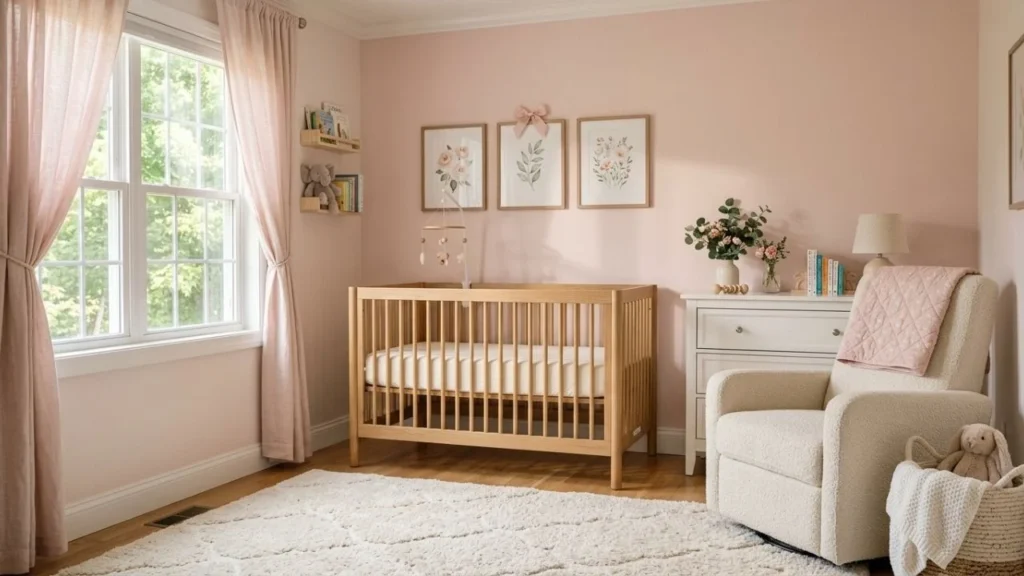
Pink nursery ideas start with one consistent pink palette and the furniture you plan to keep, so the room feels calm and can grow with your child.
You can save twenty beautiful nurseries and still have absolutely no idea which pink to put on your own wall.
That is the annoying part about inspiration.
The rooms look lovely.
Your screenshots multiply.
And somehow you are standing in the paint aisle wondering why blush now comes in approximately 400 emotional states.
The best pink nursery ideas make that decision easier. They do not ask you to buy a matching pink version of everything. They help you decide where the color belongs, what should stay neutral, what deserves more of the budget, and what will still make sense when the crib is no longer the center of the room.
I would start with one question:
How do you want the room to feel when you walk into it?
Not what theme.
Not what Pinterest board.
The feeling.
Soft?
Warm?
Traditional?
Playful?
A little vintage?
Clean and quiet?
That answer will help you choose far more confidently than starting with a basket full of pink accessories.
You do not need a full design plan before buying one picture frame.
You do need a few decisions.
Look at your:
Then choose the pink.
If your furniture is warm oak, a blush with a little warmth may sit more comfortably beside it than a cool blue-pink.
If the dresser is dark walnut, dusty rose or a deeper muted pink may hold its own better.
If almost everything is white, you have more freedom, but I would still introduce wood, woven texture, taupe, or another grounded finish so the room does not feel flat.
A pink that looks barely there at 11 a.m. can look much stronger after sunset.
Paint a sample on at least two walls.
Then check it:
Nursery Design Studio’s current color guidance also notes that dusty pinks can shift noticeably between sunny and shaded walls.
A pink basket does not need a ten-year career plan.
A dresser might.
Current parent-shopping behaviour also points toward more interest in versatile furniture that can continue working outside the nursery. Babylist reports that parents are increasingly choosing standard dressers and bookcases instead of baby-only versions to get more use from what they buy.
If you are deciding where to put the money, their are useful.
You can make the room beautiful without filling the baby’s sleep space with decorative bedding.
AAP guidance recommends a firm, flat sleep surface with a fitted sheet and no loose blankets, pillows, stuffed toys, or other soft objects in the infant sleep area.
If you want the full explanation, read the .
Put the pretty quilt on the chair.
That way you still get the color without asking the crib to double as a styling shelf.
You do not need to chase every 2026 nursery trend.
Four directions are worth borrowing because they can be interpreted in small, sensible ways.
Babylist’s 2026 nursery coverage points to color-led rooms, traditional patterns, scalloped forms, and a more selective vintage look rather than rooms built around one literal theme.
Their gives a good visual overview.
| Current Direction | How I Would Use It | What I Would Skip |
|---|---|---|
| Color leads the room | Pick one pink family and repeat it lightly | Buying every object in identical pink |
| Traditional patterns | Small florals, gingham, checks, soft stripes | Mixing four strong patterns at once |
| Scallops and curves | One mirror, shelf edge, rug, or basket | Scalloped everything |
| Collected vintage | One or two pieces with character | Making the nursery look like a costume set |
These trends should give you options.
They should not give you another shopping list.
If you want pink without a room that feels sugary, this is where I would begin.
Use blush on the wall, then bring in:
Wood gives pale pink enough visual weight to feel connected to the rest of the home.
If the wood is golden or honey-toned, look at warmer pinks with peach, beige, or clay undertones.
If the wood is deeper walnut, dusty rose can work beautifully.
Little Crown Interiors recently used soft blush wallpaper, neutrals, and light wood furniture in a nursery where the large wall pattern was kept to one feature wall.
Their is useful if you want to see how restrained pink and wood can feel together.
I would use this if: you want something feminine but still connected to a warm neutral home.
I would skip: a pink crib, pink dresser, pink chair, and pink rug all in the same room. The wall is already doing the color work.
A two-color wall gives pink a clear boundary.
That can be especially helpful if covering all four walls feels like too much.
Use dusty rose on the lower half, warm cream above it, then let the furniture sit across both.
The pink feels intentional instead of scattered.
You also get more freedom with the decor because the wall treatment has already given the room personality.
If your room has lower ceilings, I would keep the top section lighter.
It gives the upper part of the room more breathing room.
For broader pink nursery combinations, these show warmer pinks paired with neutrals, wood, wallpaper, and adaptable finishes.
Floral nursery wallpaper is not disappearing.
The version that feels easier to live with now is softer.
Think:
Nursery Design Studio’s current nursery coverage is also moving toward smaller florals, faded stripes, and mini gingham instead of oversized wall treatments dominating the entire room.
If you have one clean, uninterrupted wall, that is usually the easiest place.
A wall broken up by:
may make a detailed print feel busier than you expected.
Measure the wall.
Then order a sample.
Do not choose from your phone screen and hope your lighting agrees.
Project Nursery currently has blush, dusty rose, delicate floral, and deeper rose patterns in its collection.
Save-this tip: tape the wallpaper sample beside the crib or dresser wood. You are choosing the relationship between those materials, not the wallpaper in isolation.
Scallops are showing up on:
I like this trend.
I do not like it enough to scallop the entire room.
Pick one.
Maybe two.
A scalloped mirror above a dresser can be enough.
Or a woven hamper with a curved edge beside an otherwise simple wall.
A trend feels much easier to enjoy when removing it later does not involve repainting half the room.
That is the kind of trend decision I would make with a nursery.
Cute now.
Not a renovation later.
If blush and white feel too soft for you, add brown.
A deep brown dresser or walnut crib can make pink feel richer and less nursery-specific.
Try:
dusty pink + chocolate brown + cream
or:
blush + walnut + mushroom
It introduces visual weight.
The pink stops carrying the entire palette.
You can then keep other pieces quieter.
I would use:
Do not introduce brown, black, brass, green, blue, pink, and terracotta simply because each one looks lovely on its own.
At some point the nursery needs to know which family it belongs to.
This is one of the pink nursery ideas I like most right now because it gives the room character without requiring a literal theme.
Pinterest’s 2026 parenting data shows renewed interest in vintage children’s rooms and nostalgia-led childhood design, while current nursery reporting is also pointing toward a more selective vintage look.
You might use:
The Bump’s are useful if you want to compare how current designers are moving away from bland all-neutral rooms.
One old-looking dresser can be enough.
The crib, rug, lamp, mirror, and art do not all need an elaborate backstory.
You want collected.
Not historical reenactment.
Blush and sage are useful together because one gives you warmth and the other gives your eyes somewhere cooler to rest.
I would try:
Or reverse it:
If pink is the main color, use sage as the support.
If sage is the wall color, bring pink in more lightly.
Two colors fighting for first place can make a small nursery feel busy quickly.
Take one photo of all your samples together.
Paint.
Wood.
Rug.
Curtain.
Wallpaper.
If one item suddenly looks as though it walked in from another room, you will spot it much faster in that photo.
You do not have to make the architecture pink.
Paint one furniture piece.
A dusty rose or clay-pink dresser can carry plenty of color against:
You own the dresser.
You can take it with you.
The wall can stay exactly as the lease prefers it.
If the dresser is pink, I would use a:
One piece gets the attention.
The others support it.
Gingham and soft stripes fit the return to more traditional nursery patterns without needing a whole themed room.
You could use them on:
If your wallpaper already has gingham, I would keep the curtains mostly plain.
If the chair has a strong stripe, let the rug calm down.
Current nursery design coverage is also showing traditional patterns such as gingham, checks, and soft stripes alongside the return of color-led rooms.
For more restrained pattern examples, the is worth reading.
Pattern needs somewhere to stop.
That is usually where the room starts looking more considered.
If pink walls feel predictable, move the color.
Try:
This can work well when:
Unless you deliberately want a strong room, I would stay away from a ceiling pink that feels dramatically darker than everything below it.
You still want to look up and see part of the room.
Not a lid.
This section of the nursery will matter more than a surprising number of decorative details.
Put the chair where you can actually use it.
Then check:
Use pink on the:
You do not need everything in the corner to match.
If you want one compact light-and-sound device rather than another decorative lamp, the Amazon.com USA is one current option.
The checked listing is the white Hatch Rest 2nd Gen, which combines a night light and sound machine and includes time-to-rise functions that can remain relevant past the newborn stage.
I would treat it as a functional item.
Not an excuse to turn the nightstand into a technology display.
Pretty curtains and useful room darkening can coexist.
I would use the blackout layer for function and the curtain for color.
Try:
cordless blackout shade + dusty blush curtain
or:
cordless blackout shade + cream curtain with pink trim
CPSC recommends cordless window coverings in homes with young children and advises keeping cribs, beds, furniture, and toys away from window covering cords.
Their explains the reasoning clearly.
For renters or anyone avoiding drilled brackets, this checked is one current LazBlinds option.
The verified Amazon page is for a 36-by-72-inch black shade made from polyester. It is listed as cordless, no-drill, trimmable to width, and 100% blackout.
The checked color is black, so I would only use that exact version if a dark window line works with your room or will sit quietly behind the curtain.
Measure first.
Window products are not a “close enough” purchase.
The rug does not have to be pink.
Sometimes the better choice is a rug that contains some pink plus the other room colors.
For example:
A patterned rug can explain why all the other colors are in the room.
Suddenly the blush wall, brown dresser, sage art, and cream chair look related.
Choose something you will not mind looking at when the room becomes:
And yes, think about cleaning.
That beautiful pale rug will eventually meet real life.
Real life tends to arrive carrying something sticky.
You need somewhere for diapers today.
You will need somewhere for toys later.
Then books.
Then clothes.
Then an inexplicable collection of objects your child insists are treasures.
This is where flexible furniture earns its place.
A standard dresser can work as nursery storage now and bedroom furniture later.
Babylist’s current also reflects this move toward more versatile furniture.
Try:
When you tire of the pink, the dresser survives.
Dressers and other climbable furniture should be secured according to the manufacturer’s instructions. CPSC recommends anchoring furniture such as dressers and bookcases to help prevent tip-overs.
Their gives the practical steps.
Then return to the much more enjoyable question:
Which basket looks best?
You do not need “princess,” “ballet,” “butterfly,” or “garden” repeated on every object.
A wall can feel personal without becoming a theme wall.
Try a small group of:
The art does not all need pink backgrounds.
Maybe one print has dusty rose.
Another has cream and brown.
A third has sage.
A blush frame or mat can connect them.
You can replace one picture later without redesigning the entire room.
The Bump’s 2026 nursery coverage also points toward more personal spaces rather than relying solely on generic neutral rooms or rigid motifs.
Your nursery should look like it belongs to your family.
Not like it arrived fully assembled in aisle seven.
Small-room pink nursery ideas work best when you stop trying to fit the large-room version into half the square footage.
Do less.
But make each choice count.
I would start with:
That is enough.
You do not have to choose the palest pink available.
But I would test:
Vertical shelves and wall storage can help, but do not fill every available wall simply because floor space is tight.
Visual clutter still takes up room, even when it is not touching the floor.
Pehr’s include useful ideas for using soft color, storage, and limited square footage more thoughtfully.
This might be the idea that saves you the most money later.
Before buying something expensive, ask:
Will this still make sense when the crib is gone?
Babylist’s 2026 nursery-saving guidance recommends prioritizing, choosing where to spend, and using flexible furniture rather than assuming every piece needs to come from the baby section.
Their is useful if your inspiration board has begun developing expensive tastes.
Stand in the doorway.
Ignore the crib for a moment.
Would the wall color still look good with:
If yes, you have given yourself room to change the nursery without starting from zero.
That is a much better use of a trend.
If seventeen choices have now created seventeen new tabs in your brain, use this.
| If You Want… | Start With… | Add… | Keep Quiet… |
|---|---|---|---|
| Soft and airy | Blush + cream | Light oak | Heavy pattern |
| Warm and grounded | Dusty rose + walnut | Mushroom + brass | Bright white |
| Traditional | Small floral or gingham | Scallop + wood | Novelty decor |
| Modern | Clay pink + cream | Black or brown detail | Ruffles everywhere |
| Nature-led | Blush + sage | Oak + botanical art | Extra pink accessories |
| Vintage | Dusty pink | Brass + older-looking dresser | Matching furniture set |
| Small-room | Pale pink or one accent wall | Wall storage + light wood | Too many tiny objects |
| Renter-friendly | Neutral walls | Pink dresser, rug, art, curtain | Permanent wall work |
A nursery budget disappears quickly when every pretty object starts presenting itself as necessary.
It is not.
| Spend More Thought Here | Save Here |
|---|---|
| Crib and mattress | Decorative crib styling |
| Comfortable chair | Extra cushions |
| Useful dresser | Nursery-only storage |
| Safe window covering | Extra decorative layers |
| Rug you can live with | Tiny floor accessories |
| Main lighting | Novelty lights |
| Furniture installation | More shelf decor |
| Pieces that last | Trend-led accessories |
Ask:
Will I use this every day?
If yes, think about it longer.
If you will glance at it from the doorway twice a week, it probably does not need to consume a heroic percentage of the budget.
Do not.
Related shades are usually more forgiving than an entire room trying to match one blush swatch perfectly.
Use one dominant pink and one supporting variation.
Put the wood, paint, wallpaper, and rug samples beside each other.
A pink that looked beautiful alone can suddenly look purple beside one oak finish and peach beside another.
Love scallops?
Try the mirror before the built-in wall.
Love gingham?
Try wallpaper or a lampshade before committing every upholstered surface.
You may discover after the baby arrives that you need:
far more than you needed that fifth framed print.
Leave room to learn.
Keep the actual infant sleep space clear according to safe-sleep guidance.
The room can hold the decorative layers instead.
That low shelf filled with pretty breakable objects will eventually become incredibly interesting to a mobile child.
Think one stage ahead.
Cream, warm white, walnut, oak, chocolate brown, sage, taupe, muted blue, and soft gray can all work.
The better question is which one works with your pink.
A warm blush behaves differently from a cool pale pink.
Blush is lighter and tends to sit easily beside cream and pale wood.
Dusty rose has more depth and often works well with walnut, brown, taupe, muted green, and vintage-looking pieces.
No.
You can use:
The room can read as pink without covering every surface.
Yes, but current nursery design coverage is leaning toward smaller-scale florals, washed botanicals, softer repeating patterns, and accent-wall applications rather than only oversized florals.
Use pink beside something with more visual weight.
Try:
And keep the largest furniture flexible.
Yes.
Use a cleaner palette such as:
clay pink + cream + dark brown
Then choose simple furniture shapes and fewer decorative pieces.
Keep the biggest purchases less age-specific.
Let the pink show up on things that can change without replacing the whole room.
There is no single best shade.
Start by testing lighter blushes, peachy pinks, warm off-pinks, or one deeper accent wall.
The room’s natural light matters more than a paint name on a screen.
Yes.
Use:
You can create a clear color story without painting every wall.
Yes.
Blush and sage are especially easy to combine because sage cools the palette while pink brings warmth.
Keep one of them dominant.
Yes, and I would strongly consider it if you want the room to feel warmer and less sugary.
Dusty rose with walnut or chocolate brown can continue working well as the room matures.
Take a photo from the doorway.
If your eye sees pink first and then the room, you may have enough.
If every major object is pink, remove one pink layer and see if the room suddenly feels calmer.
You can always add it back.
The best pink nursery ideas are not the ones with the most pink.
They are the ones where the pink feels as though it belongs there.
Maybe that means blush walls beside oak.
Maybe it is one dusty-rose dresser in an otherwise cream room.
Maybe the whole nursery is neutral except for a faded floral wall that you fell in love with.
You do not need all seventeen ideas.
You need the two or three that solve your room.
Start with the furniture you expect to keep.
Choose the pink beside it.
Add one pattern or special detail.
Then give yourself permission to stop.
Your baby’s nursery does not need to look as though a styling team finished it five minutes before you walked in.
It needs to feel good when you are sitting there months later, tired, holding your baby, and still happy you chose the room this way.
Still choosing the room’s direction? Explore our nursery ideas and follow Family Haven Studio on Pinterest to save more home inspiration as you plan.
Explore original printables, find another story or save your next creative project.