

POPULAR AT FAMILY HAVEN
POPULAR AT FAMILY HAVEN
A small kitchen can feel packed even when you technically have enough cabinets. The problem is often how that space is being used.
Start with these moves:
You do not need to try all 17 ideas. Fix the two or three areas that make your kitchen harder to use every day.
You know the cabinet.
You open it carefully because one wrong move sends a pot lid sliding toward your foot.
Then there is the counter that somehow holds the toaster, coffee maker, fruit bowl, mail and the reusable grocery bag nobody has put away yet.
A small kitchen does not need to be spotless to work well. It does need enough breathing room for you to cook without moving six things first.
That is what these small kitchen storage hacks are meant to do.
Not make your kitchen look staged.
Not sell you thirty matching containers.
Give you usable space back.
One mistake can make a small kitchen even harder to use: buying storage before figuring out what is taking up the room.
An organizer does not automatically create space.
Sometimes it simply gives clutter a nicer container.
Martha Stewart’s expert-backed small kitchen storage guide starts with taking inventory, removing unused pieces and moving items that do not need prime kitchen space. That is a sensible first move.
Stand in your kitchen and ask:
Then measure before buying anything.
| Problem | Storage move to try | What you may get back |
|---|---|---|
| Empty space above plates | Shelf riser | Extra cabinet level |
| Deep cabinet | Pull-out bin | Usable back section |
| Piled baking trays | Upright divider | Shelf width |
| Loose pot lids | Lid rack | Pan cabinet room |
| Packed counter | Appliance rotation | Prep space |
| Narrow unused gap | Slim cart | Pantry overflow space |
| No pantry | Freestanding storage | Cabinet room |
Check:
A storage product can be lovely and still be useless if it stops the cabinet door from closing.
Cabinets usually hold the biggest storage opportunity because we tend to think only about the shelf itself.
Look above it, behind it and on the door too.
Do not empty every cabinet at once unless you enjoy eating dinner beside a mountain of mixing bowls.
Pick one.
Take everything out and sort it into four groups:
Look closely at duplicates.
How many travel mugs does your household actually use?
Do you need four vegetable peelers?
Is a giant roasting pan used twice a year taking the easiest shelf in the kitchen?
Move occasional items to a higher shelf, nearby closet or another suitable storage area.
Do not turn this into a full-house decluttering weekend.
One cabinet that opens without something falling out is progress.
If you like practical organization that works in tight rooms, our small laundry organization guide uses the same idea: make the awkward inches work harder instead of assuming you need a bigger room.
Open an upper cabinet.
Look at the plates.
Now look at all the empty air above them.
That space is already yours.
A shelf riser lets you divide a tall cabinet opening into two shorter zones.
Use one for:
The Kitchn’s current tiny-kitchen storage ideas also points to shelf risers as a simple way to use cabinet height that normally sits empty.
If you want a ready-made option, a stackable cabinet shelf set can create separate levels without changing the cabinet itself.
Before buying anything, check the organizers you already own.
A sturdy freestanding shelf from another room may fit.
Just make sure it is stable, washable and sized for the cabinet.
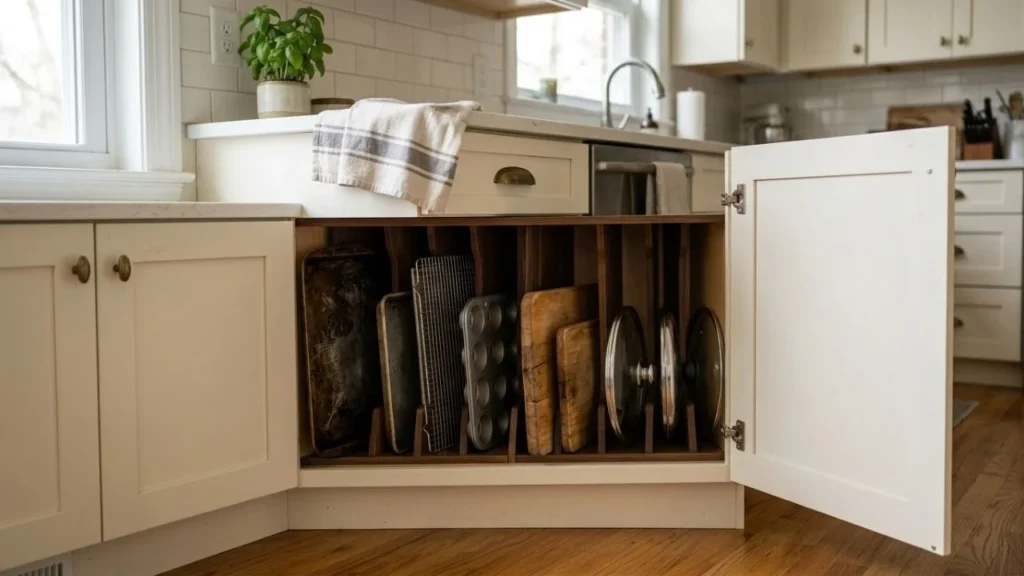
A pile of baking sheets looks innocent until you need the one at the bottom.
Then everything comes out.
Store flat kitchen pieces like files instead.
This works well for:
The point is simple.
You should be able to pull out one item without touching the other five.
A adjustable bakeware rack is one ready-made option if loose vertical dividers do not work in your cabinet.
Try a sturdy file sorter you already own if:
No one checking your kitchen cabinet will issue a fine because the organizer started life in an office.
Pot lids are small until you try storing six of them.
Keeping every lid on top of its pot may sound logical, but it often wastes vertical space.
Store the pots together and the lids upright beside them.
Good places include:
A adjustable lid organizer can work when you want each lid to have a separate slot.
Do not move lids to another part of the kitchen simply because an organizer fits there.
Storage should shorten your routine.
If the lids end up six feet from the pans you use them with, you solved one problem and added another.
Deep cabinets are often full at the front and forgotten at the back.
A bag of rice goes in.
A jar goes in front of it.
Then another.
Three months later, you buy more rice because the first bag has joined a witness protection program behind the pasta sauce.
Use handled bins or shallow baskets as makeshift drawers.
Group things by purpose:
Pull out the whole group when you need it.
A row of tiny containers can waste space between them.
Start with one or two larger bins.
Use smaller containers only when they solve a real problem.
The inside of a cabinet door is often blank storage space.
It works best for thin or lightweight items.
Try it for:
Close the cabinet slowly while holding the organizer where you want it.
Look for:
You need enough room for the organizer and everything behind it.
A turntable can help in deep cabinets where bottles form two or three rows.
It works well for:
Instead of reaching around the bottle in front, rotate the tray.
Choose a cabinet where items have similar heights.
A short jar hiding behind a tall oil bottle is still hard to see, even when both are sitting on a turntable.
Drawers get messy because they make it easy to toss something in and close them.
That feels fine until you need the can opener.
If the drawer contains:
you do not have a kitchen drawer.
You have a small indoor garage sale.
Give the drawer one main purpose.
For example:
Cooking tools
or
Food storage
or
Cutlery
A basic divider may be enough.
Food containers can swallow a drawer.
Start by matching every container with a lid.
If either half is missing, decide if the remaining piece still has a use.
Then:
If lunch gets packed every morning, do not hide lunch containers behind holiday baking supplies.
Your storage should follow the life happening in the kitchen.
Some of the best small kitchen storage hacks do not add another cabinet.
They use places that are already there.
That slim gap beside a cabinet or refrigerator may have enough room for a narrow cart.
This can work for:
A rolling cart is useful because you can pull it forward instead of reaching into a dark gap.
Apartment Therapy’s no-renovation storage ideas includes the same broader principle: you can add useful kitchen storage without installing new cabinetry.
Do not block:
If the gap only works by wedging storage against an appliance, leave it alone.
If your refrigerator has an exposed magnetic side, it can hold lightweight storage.
This can move spices or small supplies out of a cabinet.
A set of magnetic fridge spice racks is one option for an exposed magnetic surface.
Use the area for items you reach for often, not everything you can physically stick to the fridge.
Too much hanging storage can make a small kitchen feel crowded.
Not every refrigerator panel works with magnets.
Check before buying a magnetic organizer.
When drawers and counters are full, the wall can take a few everyday tools.
Useful wall storage includes:
Keep your most-used items there.
Do not hang the contents of three cabinets across the backsplash.
The room still needs some visual rest.
Step 1: Pick the items.
Choose two to four things that keep stealing useful drawer or counter space.
Step 2: Find a safe spot.
Stay clear of cooking heat, open flames and heavy splash zones.
Step 3: Clean the surface.
Follow the hook maker’s surface-prep instructions.
Step 4: Space the hooks.
Leave enough room to remove one item without knocking down the others.
Step 5: Respect the weight limit.
A removable hook holding an oven mitt is one thing. A heavy cast-iron pan is another.
A small kitchen counter cannot be the pantry, appliance garage, mail desk, coffee bar and food-prep area at the same time.
Something has to move.
Look at every appliance living on the counter.
Ask:
How often do I use this?
A useful rule:
| How often you use it | Where it may belong |
|---|---|
| Daily | Counter or easiest cabinet |
| A few times a week | Easy cabinet or cart |
| Occasionally | Lower-priority cabinet |
| Rarely | Another suitable storage area |
Your coffee maker may deserve its spot.
The stand mixer used once every six weeks may not.
This is one of the small kitchen storage hacks that costs nothing and can give you an immediate patch of working counter.
You should not have to drag the toaster from a basement shelf every morning in the name of minimalism.
Daily ease matters more than an empty photograph.
Organizing only by item type can make everyday routines harder.
Try organizing one area around what you actually do.
Keep nearby:
Keep together:
Keep:
close enough that baking does not require walking around the whole kitchen.
The best storage location is often the place where the item gets used.
A kitchen without a pantry does not have to store every food item inside its cabinets.
A narrow cabinet, small shelving unit or nearby cupboard can hold:
If there is no suitable spot inside the kitchen, look just beyond it.
A dining-area cabinet may work better than forcing food into an already packed upper cupboard.
This is a good place to borrow the same small-room thinking used in our reading nook ideas: a small home often works better when overlooked corners are given one clear purpose.
A row of matching pantry containers can look lovely.
It can also become an expensive Sunday afternoon spent transferring food from one perfectly usable package into another one.
Decant when the new container:
Good candidates may include:
Leave food alone when its original package already fits the space and works well.
You do not need twenty containers at once.
Start with the two packages causing the biggest storage problem.
If that helps, keep going slowly.
There is no point freeing up counter space if it becomes the new home of receipts, cereal boxes and tomorrow’s school forms by Friday.
Choose one section of counter that permanently stays available for work.
Even a modest stretch can give you room to:
Nothing permanently lives there.
Not the mail.
Not the grocery bag you are “going to put away later.”
Not the appliance you use twice a month.
This is the payoff from the other small kitchen storage hacks.
You do not need empty counters everywhere.
You need enough open space to use the kitchen without beginning each task by clearing yesterday away.
If you are staring around the kitchen thinking, “Okay, but where do I start?”, use the problem you feel most often.
| If this keeps happening | Start here |
|---|---|
| Things fall from cabinets | Declutter + upright storage |
| You cannot reach the back | Pull-out bins |
| Plates waste cabinet height | Shelf riser |
| Lids make a mess | Vertical lid rack |
| Counter has no prep room | Appliance test |
| No pantry exists | Freestanding storage |
| Drawers are packed | Single-purpose drawer |
| Rental limits changes | Removable or freestanding storage |
| Snacks spread everywhere | Routine-based zone |
Do one.
Live with it for a week.
Then decide if the kitchen still needs another fix.
Renters do not have to sit around waiting for a future kitchen with better cabinets.
Look first at storage you can remove and take with you:
Check your lease before drilling into cabinetry or walls.
Keep the original hardware and instructions for anything you temporarily change.
Moving day is not the time to discover that the cabinet-door screws disappeared two apartments ago.
A small kitchen still has to work after breakfast.
Children will leave water bottles out.
Someone will put the cereal back in the wrong spot.
A pet may decide the newly cleared lower shelf looks interesting.
That does not mean the organization failed.
Make the reset easier.
Keep:
A real kitchen gets messy.
Good storage makes the mess easier to put back.
Start by removing items you do not use, then give the easiest-to-reach space to things used most often. After that, use cabinet height, doors, deep shelves and walls before adding large storage furniture.
Use freestanding shelves, narrow rolling carts, wall storage, removable hooks and furniture just outside the kitchen. A dining cabinet or nearby closet can take less-used pantry items and free kitchen cabinets for everyday cooking.
Create one pantry zone instead of scattering food across every cabinet. A narrow shelving unit, freestanding cabinet, cart or nearby cupboard can hold dry goods. Grouping foods by routine can make a small pantry substitute easier to use.
Give daily appliances fixed homes and move less-used machines elsewhere. Create one permanent prep section where nothing is stored. If the same objects keep returning to the counter, make their proper storage easier to reach.
Upper cabinets work well for lighter items such as dishes, mugs, dry food and items used often enough to keep within easy reach. Heavy cookware usually makes more sense lower down so you are not lifting it overhead.
They can be useful when a cabinet has a lot of unused height above short items. Measure first. If your shelves are already closely spaced, a riser may simply make the cabinet harder to use.
Start with removal and rearranging before shopping. Use baskets you already own, stand flat items upright, move rare-use appliances, group foods by routine and clear one counter section. Spend money only where an organizer solves a problem you can name.
Treat a deep shelf more like a drawer. Put related items into handled bins so you can pull the contents forward instead of reaching around things at the front.
You do not need all 17 small kitchen storage hacks.
You may need one shelf riser.
One cleared cabinet.
One place for the lids.
One appliance moved off the counter.
That is enough to start.
A small kitchen will still get messy. Someone will leave a mug beside the sink. A snack packet will end up in the wrong bin. Dinner will create dishes.
The goal is not to keep the kitchen ready for photographs.
It is to make putting things back simple enough that your home can recover from normal life.
Start with the spot that irritates you most.
When that one works better, move to the next.
Comments are closed.
Explore original printables, find another story or save your next creative project.



[…] your kitchen already feels short on safe storage, these small kitchen storage ideas may help you get puppy food, treats, and unsafe household items off the easy-reach […]
[…] your counters already feel packed before Christmas arrives, sort that problem first. A few small kitchen storage changes can give you room to decorate without sacrificing the space you need every […]
[…] make pasta. If your cabinets and counters are already fighting for space, these small kitchen storage […]