
POPULAR AT FAMILY HAVEN
POPULAR AT FAMILY HAVEN
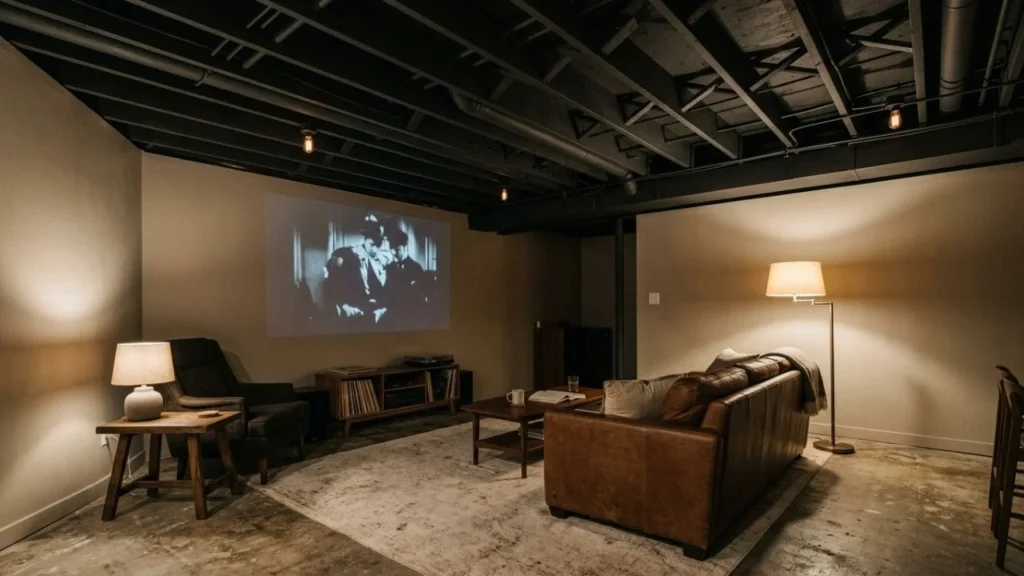
Unfinished basement ideas on a budget start with better lighting, less clutter and a useful furniture layout before you plan a complete renovation.
This post contains Amazon.com links. Family Haven Studio may earn a commission from qualifying purchases at no added cost to you.
There is a particular kind of basement that is not terrible enough to renovate immediately, but not inviting enough to use either.
You walk downstairs for the holiday decorations and look around at all that square footage.
Concrete floor. Exposed ceiling. One lamp doing the work of six. A sofa that came downstairs because nobody knew what else to do with it.
And you think, We could actually use this space.
Then your brain starts adding drywall, flooring, contractors, furniture, ceiling work, paint, storage, and a budget you definitely did not plan for.
That is where these unfinished basement ideas on a budget come in.
You are not trying to fool anyone into thinking the basement is fully renovated. You are making it cleaner, warmer, easier to use, and more connected to the rest of your home.
That is a much more realistic goal.
And it can look good.
A basement can have ten unfinished details, but usually only two or three are making the whole room feel unpleasant.
Maybe the concrete floor makes everything feel cold.
Maybe the exposed basement ceiling is visually busy.
Maybe storage has swallowed half the room.
Maybe the furniture is pushed against every wall like it is waiting for a school dance to start.
Fix the loudest problem first.
| If the basement feels… | Start here | Do not rush to buy… |
|---|---|---|
| Dark and gloomy | Better lighting + lighter surfaces | More small decor |
| Cold and echoey | Rug + curtains + textiles | Artwork |
| Cluttered | One storage zone | Decorative baskets for every corner |
| Random | Furniture layout + zones | Matching furniture |
| Bare | One focal point + textiles | Decor for every wall |
| Uncomfortable | Seating + floor comfort | Trendy accessories |
| Too expensive to fix | Use-what-you-own plan | Permanent upgrades |
Good-enough rule: If moving the furniture, adding two lamps, and putting down a rug solves 70% of what bothers you, stop there for a few weeks.
Live with it.
You may discover that the room needs far less money than you thought.
The difference between “unfinished” and “forgotten” is usually not expensive material.
It is repetition.
Repeat a color.
Repeat a wood tone.
Repeat the same storage bin.
Give each area one clear job.
Leave some empty space.
Once the eye understands what belongs together, concrete and exposed joists stop feeling like proof that the room is incomplete.
They become the background.
Do not begin with decor.
Begin with a sentence:
“We need this basement to be our ______.”
Family hangout?
Playroom?
Workout area?
Laundry and storage space?
Movie room?
Office?
You can add secondary zones later, but one main purpose keeps the room from becoming a collection of random leftovers.
Stand at the bottom of the stairs and ask:
If movie nights matter most, the seating area deserves the biggest chunk of space.
If your kids need somewhere to play, protect open floor area before adding furniture.
If storage is the real need, build the room around access and organization rather than pretending storage bins do not exist.
Tip: A basement does not need seven functions simply because it has room for seven.
One giant unfinished basement can feel more awkward than three smaller areas.
You can create those areas without framing a single wall.
Use:
A large rug can mark the family room.
Interlocking tiles can mark the workout area.
A curtain can soften the storage side.
A table and focused lamp can mark a hobby corner.
Now the basement has a layout instead of a collection of objects.
For more ways to make a room work harder without replacing everything, Family Haven Studio’s budget DIY ideas are useful when you want to reuse furniture and materials first.
You do not need to cover every foundation wall.
Start with the walls that dominate the main living zone.
A lighter wall can bounce around the limited daylight you have and make furniture stand out from the raw background.
Warm white is an easy starting point, but it is not your only option.
Try:
If the upstairs rooms already use warm neutrals, carry one of those tones downstairs. The basement will feel more connected to the rest of the house.
Family Haven Studio’s cozy paint colors can help you narrow a warm palette without making the basement feel heavy.
Watch for: choosing a deep wall color in a basement with little daylight and then trying to fix the darkness with more lamps.
A painted concrete floor can look clean and simple without pretending to be hardwood.
That matters when the alternative is spending money on flooring you plan to rip out during a future renovation.
If your existing concrete is sound and suited to the finish you choose, treating the slab itself can make sense for a basement workshop, play area, hobby room, laundry zone, or casual family room.
The exact list depends on the floor coating you choose, but you may need:
Remove dust, grime, and anything that could interfere with the finish.
Small surface flaws may need prep before coating. If a crack or moisture issue looks bigger than cosmetic wear, get it checked instead of hiding it.
Concrete coatings can have specific prep, ventilation, drying, and curing instructions.
Do not drag the sofa and rug back five minutes after the floor feels dry to the touch.
Give the finish the curing time it asks for.
Good-enough option: If the concrete is dry, sound, and simply looks dirty, a serious clean may be all you need right now.
That costs a lot less than turning Saturday into a flooring project you did not actually want.
You do not need to cover every inch of concrete.
That is one of the easiest ways to keep unfinished basement ideas on a budget from turning into a surprise flooring bill.
Use softer flooring where bodies actually touch the floor.
A children’s play zone may benefit from interlocking foam tiles.
A workout corner may need padded flooring.
A family seating zone may only need a large rug.
The storage side can stay concrete.
That is not unfinished thinking.
That is spending money where it changes daily life.
Tiny rugs can make a large basement feel even more chopped up.
For your main seating area, use one rug large enough to connect the furniture.
At minimum, the front legs of the main seating pieces should visually join the rug when the room size and rug allow it.
That gives the furniture a reason to be where it is.
If you are still figuring out size and style, browsing area rug options can help you compare common shapes and dimensions before committing.
If children snack downstairs, plan for it.
If a dog sleeps there, plan for that too.
If people walk straight into the basement from outside, the cream shag rug that needs emotional support after every footprint may not be your best friend.
Choose washable, low-pile, patterned, or forgiving materials when they make sense for your household.
Homes are not spotless 24/7.
Your rug choice should know that.
An exposed basement ceiling can look busy because every joist, pipe, duct, and wire reads as a separate line.
One consistent ceiling color can calm that down.
Light ceilings can make a low basement feel more open.
Dark ceilings can visually recede and work well when you want a moodier movie or lounge area.
There is no universal “black is better” answer.
Look at:
This Old House has a useful breakdown of basement ceiling options if you want to compare exposed ceilings with other approaches before spending money.
Down-to-earth note: Your exposed ceiling may still look like an exposed ceiling after paint.
That is okay.
The goal is calmer, cleaner, and more intentional, not “nobody will ever know there are joists up there.”
One harsh ceiling fixture can make a basement feel like a storage room even after you decorate it.
Add light at different heights.
Try:
You want enough light to live down there without every bulb blasting at full power.
A floor lamp beside the sofa instantly makes the space feel more residential because the light is happening where people are.
Tip: Warm lighting near the seating zone and brighter task lighting near laundry, hobbies, or exercise can help one basement support different uses.
Some basement areas are never going to be cute.
The furnace does not care about your aesthetic.
Neither does the stack of holiday bins.
Instead of forcing everything into the same visual field, use curtains to create a softer boundary where it is appropriate and safe to do so.
You can separate:
Neutral blackout curtain panels can also help visually block busier storage areas when the setup suits your room.
Keep anything that needs servicing easy to reach.
The curtain should hide clutter from your sofa, not hide something a technician needs to find.
Storage looks messiest when it leaks into the whole room.
Choose one wall or section and let it do the heavy lifting.
Then group similar things together.
For example:
| Zone | Store here |
|---|---|
| Seasonal | Holiday bins, wreaths, wrapping supplies |
| Kids | Outgrown clothes, toy rotation, school keepsakes |
| Household | Paper goods, cleaning backups, tools |
| Sports | Balls, skates, helmets, exercise items |
| Memory | Photos, keepsakes, family boxes |
You do not need matching containers for every single item.
If buying new bins is not in the budget, group the containers you already own by size or color.
Put the least attractive ones lower.
That alone can make the storage wall feel calmer.
The basement is a good place to stop pretending every room requires a matching furniture set.
That older sofa may be perfectly comfortable.
The armchair from the guest room may still have years left in it.
The trick is connecting them.
Repeat two or three things:
If the sofa fabric is the problem but the furniture itself is fine, a washable couch cover can be a cheaper experiment than replacing the whole thing.
That is the “good enough” principle in action.
Fix the part that bothers you.
Keep the part that still works.
An unfinished wall is not always a disadvantage.
Sometimes it is a free projector wall.
Keep the setup simple:
That can be enough.
You do not need fake cinema signs, a popcorn machine, neon lighting, movie posters on every wall, and six recliners unless your family actually wants that.
If a mounted television is part of the plan, Family Haven Studio’s TV wall ideas can help you think through the visual setup around it.
Real-life win: A casual basement movie area is also one of the few rooms where nobody cares that the throw blanket stayed crumpled after Friday night.
A basement playroom should work while children are playing, not only after every toy has been put away.
Keep open floor space.
Add storage children can reach.
Use surfaces that can survive crayons, snacks, blocks, and the occasional mystery sticky spot.
A simple setup might include:
Do not fill every wall with decor.
Children need room more than the room needs accessories.
Ask, “Can they put this room back together without me?”
If the answer is no because every toy has its own labeled acrylic container on a shelf six feet high, the system may be working harder than the family.
Your unfinished basement home gym does not need to look like a fitness studio.
Give the equipment a boundary and leave enough room to move safely.
You might use:
A real unfinished-basement gym shared by a family used defined flooring, reused mirrors, wall hooks, and a dedicated equipment zone rather than renovating the whole basement.
That is the kind of budget thinking worth copying.
Use the expensive item you already own.
Spend around it, not against it.
The raw basement can actually be useful here.
A hobby area does not need delicate finishes.
Give yourself a sturdy work surface for:
Store the supplies near the table.
Add task lighting.
Leave enough open tabletop space to actually do the activity.
Tip: Do not turn the entire table into storage and then wonder why nobody uses it.
An unfinished basement laundry room often needs organization more than decoration.
Start with what makes laundry irritating.
No folding surface?
Poor light?
Detergent scattered everywhere?
Baskets blocking the walkway?
Then fix that one problem.
Try:
Apartment Therapy shows how an unfinished basement laundry area became more pleasant through storage, a work surface, framed family photos, and DIY changes instead of treating the room as a purely utilitarian corner. basement laundry makeover
You still have to do laundry.
At least the room does not have to punish you for it.
Basement floors fill up fast.
Look at the walls before adding another cabinet.
Depending on your wall type and what you need to store, vertical storage could include:
This is especially useful near a home gym, hobby area, or laundry zone.
Bob Vila’s unfinished basement projects include ideas for working with exposed joists and unfinished surfaces without hiding all of them.
Watch for: mounting heavy storage without knowing what the wall or fastener can safely hold.
This is one of the easiest ways to make random furniture look related.
Pick one element and repeat it.
Maybe:
You do not need every item to match.
You need enough repetition for the eye to understand the room.
Three black accents spread across a seating area can connect furniture that came from three different rooms.
That costs much less than buying a “basement furniture collection.”
Concrete, exposed wood, metal ducts, and open ceilings create hard surfaces.
Softness balances them.
Use:
You do not need all six.
Choose the ones that solve something.
If the basement echoes, textiles can make it feel less stark.
If the concrete feels cold, start with the rug.
If the wall looks bare, curtains may do more than another small picture frame.
This is where a cozy unfinished basement begins to feel like somewhere you would sit on purpose.
Do not decorate every unfinished wall.
Pick one area that gets the attention.
That could be:
Then let the other walls breathe.
Step 1: Trace the frames.
Place each frame on paper, trace it, then cut the shape out.
Step 2: Tape the templates up.
Arrange the paper pieces on the wall before making holes.
Step 3: Move them around.
This is the part people skip, then spend the afternoon patching drywall.
Step 4: Mark the hanging points.
Use the template positions to work out where each frame belongs.
Step 5: Hang the real pieces.
Remove the paper as you work.
Ten extra minutes planning can save a wall full of “I thought it would look good there” holes.
This may be the most useful idea in the entire list.
You do not have to complete the basement in one financial hit.
After living with the room, you may still want permanent flooring, finished walls, or a new ceiling.
Or you may realize the basement already does what your family needed it to do.
That is why unfinished basement ideas on a budget work best when you stop measuring success against a full renovation.
You do not need the same solution as the house in the photo you saved.
| Level | What to focus on | Examples |
|---|---|---|
| Use What You Have | Layout and organization | Move furniture, group storage, reuse lamps, rearrange artwork |
| Low-Cost Update | Comfort and visual order | Paint, rug, curtains, storage bins, pillow covers |
| Spend Where It Counts | One long-term improvement | Better lighting, durable floor zone, storage system, quality seating |
Start at the top.
You can always spend more later.
It is much harder to un-buy a basement full of things that never solved the original problem.
Start with cleaning, decluttering, furniture placement, and lighting.
Those four changes affect the whole room and may cost little or nothing if you reuse what you already have.
Then add one large soft element, such as a rug or curtain, if the basement still feels cold.
Buy the thing that fixes the problem you feel most.
If the room is dark, buy lighting before wall decor.
If the floor is uncomfortable, work on the floor before buying cushions.
If clutter is the issue, deal with storage before styling shelves.
Use visual consistency instead of trying to hide every raw surface.
Paint selected walls, unify the ceiling color if appropriate, define zones, repeat finishes, add warm lighting, use larger textiles, and keep clutter contained.
The basement can still show concrete and exposed structure while feeling planned.
No.
If a wall does not bother you and is not part of the main living zone, leaving it alone can save money and keep future access simple.
A cozy unfinished basement needs softness and better light before it needs decorative objects.
Start with:
The room may still have too much hard surface, weak lighting, or furniture spread too far apart.
Pull the seating closer together and look at what the room feels like from where people actually sit.
Common budget-friendly approaches include area rugs and removable floor tiles in appropriate areas.
A workout or play zone may need padding while storage areas can remain concrete.
Do not assume the entire basement needs one flooring treatment.
Do not use a rug to hide a damp floor.
Make sure the floor condition suits the material and setup you plan to use.
Choose based on the room.
White or another pale color can help a low, darker basement feel more open.
Black can visually quiet pipes and joists and suit a movie area or basement with enough light.
It can make the ceiling feel lower in some rooms, especially when the basement already lacks light.
Test the overall palette instead of choosing from a photo alone.
Use rugs, furniture placement, shelving, curtains, and changes in lighting.
The point is to signal that one activity stops and another begins.
A curtain or furniture arrangement is usually easier to change later than a permanent wall.
That matters if today’s basement playroom may become tomorrow’s home office.
Yes, if the space suits that use and feels comfortable enough for your household.
Start with seating, lighting, floor comfort, storage, and a clear layout before spending money on decorative extras.
No.
Repeat a few colors, finishes, and textiles so older pieces feel related.
Matching is optional.
Connection is what makes the room look intentional.
A good basement does not have to look untouched.
It can have toys on the floor.
The throw can be crooked.
Your old sofa can stay.
There can be storage behind a curtain and exposed joists above your head.
The point of these unfinished basement ideas on a budget is not to create a showroom beneath your house.
It is to give the square footage you already own a purpose.
Start with the part of the basement that bothers you most.
Fix that.
Then ask what still feels wrong.
One useful change at a time is usually a better plan than waiting for the day you can afford to do everything perfectly.
Explore original printables, find another story or save your next creative project.