
POPULAR AT FAMILY HAVEN
POPULAR AT FAMILY HAVEN
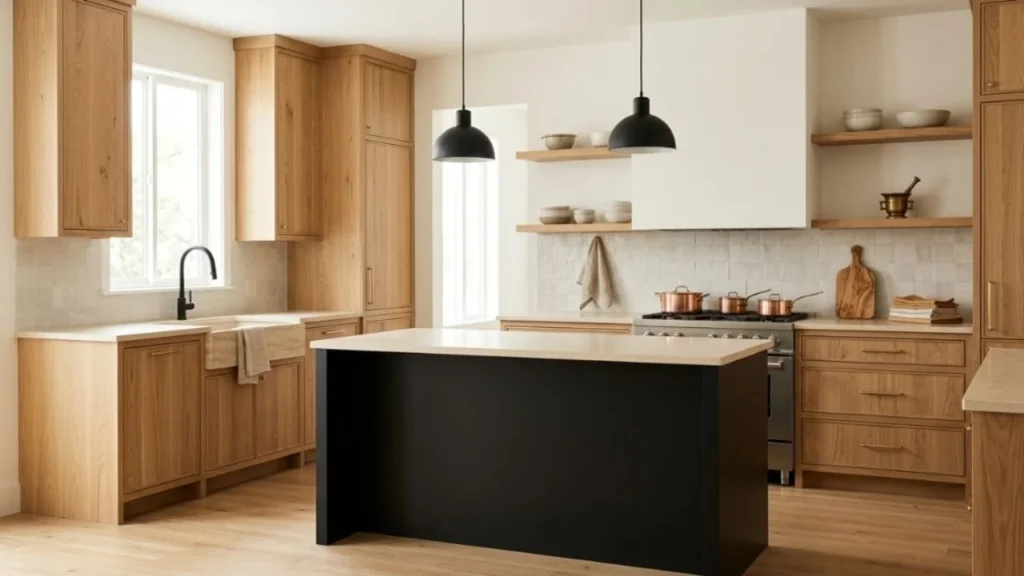
You save a kitchen photo with pale oak cabinets, a black island, and creamy stone and think, “That is it.”
Then the samples arrive.
The oak looks warmer in your room. The black island feels bigger than it did on your phone. The floor suddenly has an orange cast you never noticed, and those neat little black handles almost disappear on the wide drawers.
That is the real work behind a white oak and black kitchen.
The pairing itself is simple. The room starts to feel right when the wood, black, stone, floor, metal, and light know which one is supposed to lead.
This guide walks you through that decision in plain language, then gives you 20 ideas you can adapt to the kitchen you actually have.
White oak brings grain, warmth, and natural variation. Black gives the eye a clear edge, so the pale wood does not blur into the floor, walls, and countertops.
That is why the same pairing can feel soft in one home and much bolder in another.
White oak can add:
For more examples of wood mixed with stone, darker cabinetry, and softer finishes, these wood kitchen ideas are worth browsing.
Black is most useful when it has a clear purpose.
It can define:
Choose the biggest black feature first.
If the island is black, the faucet and hardware may only need to repeat the color quietly. If the counters are black, you may not also need a black hood, black upper cabinets, and a black pantry wall.
There is no useful percentage that works in every kitchen.
Natural light, room size, ceiling height, flooring, appliances, and the amount of oak already visible all change how heavy black feels.
| Your kitchen | Let this lead | Good places for black | Watch carefully |
|---|---|---|---|
| Small and dim | White oak + light stone | Hardware, faucet, one light | Black upper cabinets |
| Small and sunny | White oak | Island base or one counter | Too many dark blocks |
| Medium | Oak + warm neutral | Island, hood, hardware | Black on every fixture |
| Large and bright | Oak + one larger black zone | Island, pantry wall, counters | Tiny black accents with no anchor |
| Open plan | White oak | Island and lighting | Finishes that fight nearby furniture |
| North-facing | Pale oak + warm white | Controlled dark details | Cool grey beside the wood |
Cabinet fronts, the island, flooring, countertops, and backsplash control the room far more than small accessories.
If three of those surfaces are already dark, another large black feature may make the kitchen feel heavy.
Change the biggest dark surface you can still change.
Lightening an island, countertop, or tall cabinet bank will affect the room more than swapping a faucet or stool.
Do the opposite.
Give black one clear job, such as the island or range area, instead of scattering tiny dark accents across the kitchen.
Keep the perimeter cabinetry in white oak and let the island become the main dark feature.
This works because the black has a clear boundary. The oak still controls most of the room, while the island gives the center enough definition.
Repeat black once or twice outside the island.
A faucet, pendant, or cabinet pull may be enough.
Stand at the room entrance before choosing the finish.
If the island fills most of your first view, deep black will feel much stronger than it does on a floor plan.
Black countertops create a strong horizontal line against pale oak.
This works well when you like clean cabinet shapes and want the countertop to become one of the room’s stronger features.
Pair the dark counter with:
For compatible granite, quartz, or other suitable surfaces, a granite countertop cleaner (paid link) is one care product you can compare with the instructions from your countertop maker.
Look at the whole lower half of the kitchen.
Black counters, dark floors, and a black island can become heavy together even when each material looks good on its own.
This is one of the easiest ways to add black without covering much of the wood.
Simple matte black cabinet pulls (paid link) can give slab or Shaker-style doors more definition while leaving the grain visible.
Do not choose a pull from one enlarged product photo.
Cut paper strips to the lengths you are considering, tape them to the doors and drawers, then stand back.
Longer pulls often feel better proportioned on wide fronts.
You do not need the same handle length everywhere. Keep the shape consistent and change the length when the cabinet size calls for it.
The island does not have to be black on every side.
Use black on the working fronts and white oak on an end panel or seating side.
The wood softens the side people see from the dining or living area.
You still get the strong black island from the kitchen side without showing one dark block from every angle.
Try it on:
Keep the added oak close to the main cabinet tone so the pieces feel related.
A black hood can give the cooking wall a clear center without turning the whole wall dark.
Keep the surrounding cabinets in white oak and let the backsplash stay quieter.
A large boxed hood can look balanced above a wide range and oversized on a short wall.
Judge the whole wall, not just the hood by itself.
Repeat a little black through:
That stops the hood from looking stranded above a pale kitchen.
Black pendants are useful when you want contrast above the island but do not want another dark cabinet wall.
They also help link a black island to the upper half of the room.
White oak already brings natural lines and movement.
A simpler pendant can give your eye a calmer place to rest.
In an open-plan home, the pendants are visible from more than the kitchen.
Check their size from the sofa, dining table, and main doorway too.
Cream, warm white, beige, or gently veined stone can soften the jump between pale oak and deep black.
This works well when the cabinetry already gives you enough contrast.
If the oak grain is active and the island is dark, the backsplash does not need a loud pattern too.
For a clear overview of door styles, cabinet materials, layout choices, and what to think about before ordering, this kitchen cabinet guide is useful.
Using one material for the worktop and backsplash cuts down the number of finishes sitting beside the oak.
That can make a mixed-material kitchen easier to read.
Try:
Use stronger veining when the cabinetry is calmer.
If the white oak already has a lively grain, a quieter stone can stop the two patterns from competing.
A full wall of black upper cabinets can feel dense.
Replacing one section with white oak shelves gives the dark wall a break and repeats the wood elsewhere.
Good choices include:
Leave space around them.
An open shelf can go from calm to emergency grocery storage in one rushed Tuesday, so give everyday clutter somewhere else to live.
Black-framed glass gives you dark lines without adding another solid black block.
It works well for a drinks cabinet, glassware section, or one display area at the end of a cabinet run.
Glass doors still show the contents.
Use them where you actually want to see the dishes or glasses, then let solid doors hide the less attractive parts of normal kitchen life.
A small interior light can help the glassware show after dark.
Keep it soft enough that the cabinet does not become a bright box at the end of the room.
White oak is not one flat beige surface.
Some boards look straighter and calmer, while others show more movement.
In simple terms, rift-cut or rift-sawn oak is chosen when a straighter, more even grain is wanted.
That cleaner grain can sit nicely beside flat black surfaces and stronger stone.
Vertical grain can make tall doors feel taller.
Horizontal grain can make a long drawer run or island feel wider.
The main goal is consistency.
Neighboring panels changing direction for no clear reason can make an expensive cabinet wall look less settled.
A tiny wood chip cannot tell you how an entire cabinet wall will look.
Ask for a larger door or panel and, when possible, more than one representative piece.
Ask about:
Do not expect every finished door to copy it exactly.
Natural wood varies, so the better question is how the variation will be arranged across a full cabinet run.
Fluted white oak adds texture without introducing another color.
Use it on the seating side or one end of a black island when a plain slab panel feels too flat.
Texture works because smoother surfaces sit beside it.
If the island, pantry, cabinet doors, and wall panels all use the same fluting, the detail can start making the room feel busy.
A stark cool white can make warm oak look more yellow than it did in the showroom.
Warm white, cream, mushroom, and soft stone shades usually create an easier transition between oak and black.
For another current kitchen-focused look at warm neutrals, natural wood, and darker accents, this kitchen colour guide gives useful examples.
Check your samples:
Do not blame the cabinet sample immediately.
Move it beside a warmer wall color and your real countertop. A cool white or cool grey nearby can make the warm wood look stronger by comparison.
A black and wood kitchen does not require every metal finish to be black.
A smaller amount of warmer metal can soften the scheme.
Try champagne bronze cabinet pulls (paid link) against your real oak and black samples before deciding which metal should appear most often.
Let one finish show up more often.
Use the second on fewer pieces, such as the faucet, pendants, or one cabinet section.
Yes.
The mix usually feels calmer when one clearly leads instead of every fixture changing finish.
If a black island or countertop feels like too much, let the sink area carry a smaller amount of dark color.
A matte black kitchen faucet (paid link) gives you a clean black line against pale stone and oak without changing a large surface.
Check:
You use the faucet every day, so practical fit matters more than getting one more black item into the room.
A compact room can use black without letting dark color take over eye level.
Keep most upper cabinets in white oak or another pale finish and use black in smaller places.
Try:
If long pulls make a compact cabinet run look too busy, matte black cabinet knobs (paid link) give you another scale to compare.
Keep the larger dark surfaces lower when possible.
Oak uppers, warm pale walls, and a light backsplash can keep eye level softer.
A large kitchen can make tiny dark accents look scattered.
Instead of adding black in ten little places, let one larger area carry it.
A black pantry wall makes sense when it marks pantry storage.
A black island feels natural because the island already stands apart from the perimeter cabinetry.
Your floor does not need to be the same shade as the cabinets.
An almost-match can look more awkward than a clear but related difference.
Look at:
For examples of designers using more than one oak tone without making the woods fight each other, this mixed wood tones is a useful visual read.
Treat it as the first fixed sample.
Every cabinet, counter, wall color, and metal choice has to work with the floor you already own.
Once the cabinets, countertop, backsplash, floor, and main metals look right together, stop adding permanent finishes.
Now bring in the pieces that make the room feel lived in.
Try:
For softer seasonal changes that keep the worktops useful, these Family Haven Studio fall kitchen decor ideas can take over from here.
A polished white oak and black kitchen still needs room for breakfast, grocery bags, lunch bottles, and the mysterious drawer containing three lids that fit absolutely nothing.
The fixed design should make daily life easier, not make you afraid to leave a toaster on the counter.
The countertop can make the contrast stronger or calm it down.
Choose it after you know how much black already exists in the cabinetry.
| Countertop | Overall effect | Works well when | Watch for |
|---|---|---|---|
| Matte black | Strong and clean | Most cabinetry is oak | Can darken a small room |
| Warm white | Light and calm | Island is already black | Avoid icy undertones |
| Cream quartzite | Natural and soft | You want warmer contrast | Check the real slab |
| Quiet marble | Gentle movement | Cabinet fronts are simple | Learn the care needs |
| Pale beige | Soft transition | Black is used in smaller areas | Too much beige can feel flat |
| Charcoal | Deeper and moodier | Room is large and bright | Can add weight low in the room |
No.
A black island can have a pale stone top, while white oak cabinets can carry a dark countertop.
Remove one large dark layer before changing the small details.
The island, countertop, or floor will affect the room much more than a cabinet knob.
The backsplash sits directly between large cabinet surfaces, so it has more influence than its size suggests.
It often works best as the quieter bridge between oak and black.
This works well when a black island or dark counter already has enough weight.
Cream softens the change from pale wood to black and sits easily beside warm metal.
This can work when the existing floor contains grey.
Compare it directly with the oak so the wall color does not make the wood look more yellow than expected.
Soft veining can bring movement without fighting the grain.
Choose which one should lead.
If both demand attention, the kitchen can feel restless even when each sample looks beautiful by itself.
Matte black gives the clearest connection to a black island or countertop.
Champagne bronze, brass, bronze, and some nickel finishes can also work when black already has a larger job elsewhere.
Knobs can keep smaller cabinet doors visually light.
Pulls often feel better on drawers and tall doors where you have more width to work with.
If you plan to install hardware yourself, a cabinet hardware jig (paid link) can help repeat the same hole position across doors and drawers.
Confirm the actual cabinet size and the handle’s hole spacing first.
A template can repeat a measurement. It cannot fix a measurement that started out wrong.
Lighting changes how both oak and black look after sunset.
A warm wood sample that looks soft at noon can look flat under one harsh ceiling light.
Think about:
under cabinet lights (paid link) can add light in a spot where a rechargeable fixture suits the room.
For a full renovation, plan permanent task lighting with the electrical work instead of relying on portable lights everywhere.
Put the cabinet sample beside the countertop and switch on the lights you expect to use in the evening.
The kitchen still needs to look good while you are making dinner on a dark November evening.
Use black as a clean line, not the entire personality of the room.
Softer materials can keep the combination from turning into rows of hard dark edges.
Try:
A rounded stool back, curved pendant, bowl, or softer countertop edge can break up long straight cabinet lines.
No.
A black island may already be enough. The chair legs, shelves, faucet, appliances, window frame, and every light do not all need to become black too.
Do not keep adding accessories to fix a problem caused by the large surfaces.
Work backward through the room and find the piece that is upsetting the balance.
| If the room feels… | Likely reason | Try this first |
|---|---|---|
| Too dark | Too much black on large surfaces | Lighten one major dark area |
| Too beige | No clear contrast | Give black one larger job |
| Too yellow | Cool white or grey beside warm oak | Test warmer surrounding colors |
| Too busy | Oak, stone, tile, and hardware all compete | Quiet one patterned surface |
| Too flat | Everything is pale and smooth | Add one black anchor or more visible grain |
| Too industrial | Too much dark metal | Add wood, linen, stone, or warm metal |
| Too rustic | Wood dominates every surface | Add cleaner black lines |
| Too small | Dark finishes sit at eye level | Lighten uppers and backsplash |
Change the largest unfinished decision.
Do not try to fix an island that feels too heavy with a lighter soap dispenser.
Start with the easier layers.
Wall paint, lighting, stools, hardware, and decor can change the balance without replacing cabinetry or stone.
Before you approve the expensive pieces, look at the room as one complete palette.
Black hardware is a smaller and easier part to replace than cabinetry, flooring, or stone.
If you like the contrast, it is a lower-commitment place to use black while keeping the expensive surfaces more flexible.
Yes, if the island does not dominate the room and there is enough light around it.
In a dim kitchen, a softer charcoal or smaller black feature may feel easier than a deep black block in the center.
No.
Aim for tones that look related rather than identical, and compare the undertones so one surface does not pull orange while another reads grey or pink.
Warm white, cream, mushroom, soft beige, and warm greige are useful starting points.
Test the paint beside your exact cabinet and countertop because the surrounding colors can change how the oak appears.
Slab doors put more attention on the grain and suit a cleaner modern look.
Simple Shaker doors work well when you want a little more frame detail without hiding the natural wood.
Yes.
Choose one metal to lead and repeat the second in fewer places so the mix feels controlled.
The saved photo can show you the feeling you want.
Your floor, daylight, room size, cabinet layout, and everyday routines still get the final vote.
A white oak and black kitchen works when the oak gives the room warmth, black has a clear job, and the quieter materials between them give both enough room.
Before you order anything permanent, put the cabinet sample, counter, backsplash, flooring, wall color, and hardware together in the actual room.
Then remove the piece that seems to be fighting hardest for attention.
That last edit can be more useful than adding one more finish.
Explore original printables, find another story or save your next creative project.