
POPULAR AT FAMILY HAVEN
POPULAR AT FAMILY HAVEN
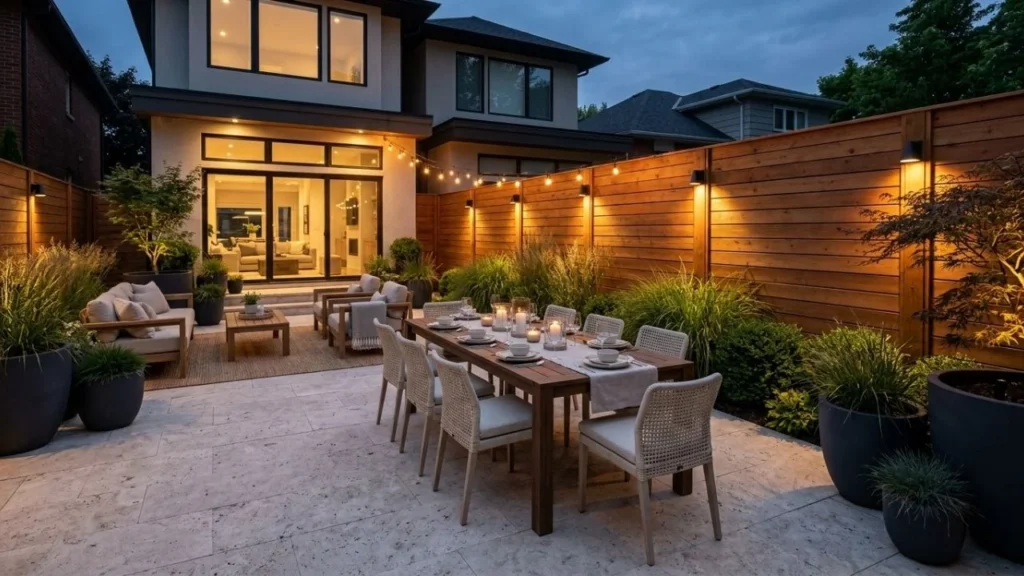
A fence can disappear into the dark the second the sun goes down. Then one little row of warm lights comes on and suddenly the backyard has edges again.
That is what good fence lighting ideas should do. They should help you see the gate, soften a long wall of wood or vinyl, make the seating area feel warmer, and give the yard a little life after dinner without shining into your neighbor’s bedroom.
The trick is not adding the most lights. It is putting the right light in the right spot.
A six-foot privacy fence behind a dining table needs something different from a side gate, a chain-link boundary, or a shaded fence beside the trash cans. Start with the part of the yard you actually use at night, then work outward.
Fence lighting usually has one of four jobs: help people move safely, mark a gate or boundary, light plants and texture, or make a sitting area feel good after dark.
Once you know the job, the fixture gets much easier to choose.
| You want to… | Start with… | Skip… |
|---|---|---|
| Mark a long fence | Small repeated downlights | Bright lights on every post |
| Light a gate | Motion or focused wall light | Decorative fairy lights alone |
| Warm a dining zone | String lights or lanterns | Cold white floodlights |
| Show off wood texture | Low ground lights | Light aimed at eye level |
| Light a shaded fence | Low-voltage fixtures | Solar panels with poor sun |
| Keep things subtle | Warm shielded lights | Bare bright bulbs everywhere |
For outdoor electrical products, use fixtures made for the conditions where they will sit and follow the maker’s directions. UL’s outdoor fixture safety guide explains the difference between line-voltage, low-voltage, and solar outdoor luminaires, including wet-location requirements for line-voltage fixtures.
If you use an extension cord outdoors, use one meant for outdoor use. CPSC warns that indoor cords are not made for outdoor temperature, moisture, and mechanical stresses. outdoor extension cord guidance
For permanent line-voltage work, use a qualified electrician when the job goes beyond simple plug-in or solar lighting.
Warm, downward-directed light also creates less glare and keeps more of the light where you need it. The National Park Service’s outdoor lighting principles recommend targeted, shielded, lower-level light plus timers or motion controls where useful.
You do not need a light on every post to make a long fence feel finished.
Try a small downlight every second post first. That gives you a repeating rhythm of soft pools on the boards and ground without turning the fence into a runway.
This looks especially good on cedar, stained pine, white vinyl, and simple horizontal fencing. Warm light lets the wood grain or panel lines show without making the backyard feel harsh.
work well for this kind of quiet fence lighting. Bob Vila’s current test describes the set as small, warm-white solar fixtures that cast a soft downward glow.
If the fence gets only a little direct sun, test one section before buying enough for the whole property line.
Post-cap lights look neat because the fixture becomes part of the fence instead of hanging on the face of it.
But putting one on every post can get busy fast.
Use them on the gate posts, the corners, the posts around the patio, or every second or third post. That gives the fence a finished outline while letting darkness stay part of the backyard.
Dynaming solar post caps fit common square wood and vinyl post sizes and offer a steady-light setting plus a flame-style LED effect. Bob Vila’s 2026 test says the tested six-pack fit 4-by-4, 5-by-5, and 6-by-6 wood or vinyl posts.
Measure the actual top of the post before ordering.
A cap that is close to the right size is still the wrong size. Fence posts have a talent for making a quarter inch feel personal.
If tiny modern deck lights feel too plain, use a fence-mounted fixture with an Edison-style bulb shape.
This works well around a patio, outdoor dining table, or small lounge area where you want the fence to feel more like part of the room.
Keep the fixtures at a comfortable height and space them far enough apart that each one gets its own little pool of light. You want a repeated glow, not a row of bright dots fighting for attention.
sit on the face of the fence and use a small Edison-style light inside black housing. Bob Vila’s current test praised the warm light and noted that the fixtures sit flush against the fence.
Pair them with warm wood, black planters, cream outdoor cushions, or terracotta pots.
The fence starts feeling less like a boundary and more like the back wall of your outdoor room.
String lights are an easy answer when the fence already borders the place where you sit.
Instead of stretching them across the entire yard, run them along the fence line. You still get the warm bulb look, but the sky above the patio stays open.
use shatter-resistant Edison-style bulbs and a separate solar panel, so the lights can follow the fence while the panel sits where it can get better sun. The current tested version is 27 feet with 12 bulbs.
Let the strand dip gently between strong attachment points rather than pulling it ruler-straight.
Keep the sag fairly consistent from section to section.
One loose dip looks relaxed. Five completely different dips look like the lights got tired halfway through installation.
A plain fence behind a bench or small sofa can become the prettiest part of the yard at night.
Hang fine fairy lights in loose vertical drops or a soft curtain behind the seating area. Keep them inside one defined section rather than covering the entire fence.
come in long flexible strands that can be shaped around lattice, trellis panels, or a small seating backdrop. Bob Vila’s tested version uses 33-foot strands and carries an IP65 rating.
Use the lights with simple outdoor cushions and one or two planters.
You do not need signs, wall art, three lanterns, and another strand across the top too.
The little lights are already doing enough.
Lanterns give a fence more shape during the day and a softer pool of light at night.
Use two beside an outdoor dining zone, one near a garden bench, or a small group spaced across a short fence section.
include wall-mount hardware and glass lantern bodies, which suits a more classic or cottage-style yard. Bob Vila lists the tested model at 15 lumens with an IP65 rating.
Place them where nobody will brush against them while walking past.
Hang one lantern above a planter and another a few feet away near the seating area.
That slight unevenness feels more relaxed than turning the fence into a perfectly measured hotel corridor.
The side gate is not the place for mood lighting alone.
You want to see the latch, the ground, the step, the dog lead, and whatever somebody left beside the recycling bin.
A gives a brighter burst of light when movement is detected, making it better suited to a working part of the yard than a tiny decorative light. Bob Vila’s test lists a 120-degree sensing angle and 400-lumen output for the tested version.
Aim the fixture toward the gate area and ground, not straight across the neighbor’s yard.
If the gate is used every evening, test the sensor position from both directions before fixing the light permanently.
Nothing says “welcome home” like waving your arms at a fence in the dark because the sensor cannot see you.
Some corners need more than a little glow.
A wide-angle motion light can help near a shed, rear gate, utility area, or the darkest section of the fence where you need to see clearly for a short time.
offer a wider sensing area and multiple operating modes. Bob Vila’s test lists a 120-degree sensing angle and 500-lumen output for the tested model.
This is not the fixture I would put beside the dinner table. It is better where function matters more than atmosphere.
If one corner gets a brighter motion light, let nearby decorative lights stay softer.
You do not need the entire backyard jumping to full brightness every time a cat walks past.
A textured wood fence can look beautiful when the light starts at the ground and brushes across the boards.
Place low-voltage spotlights in the planting bed a short distance from the fence, then angle them toward the boards rather than straight into the sky.
are designed for 12-volt landscape systems and give you a stronger fence wash when a small solar fixture is not enough. The current Amazon page lists the tested configuration as an eight-pack with warm-white 12-watt fixtures.
Use fewer lights than you think you need at first.
Three carefully placed beams can look better than ten bright cones overlapping each other.
For permanent low-voltage systems, plan the transformer, cable route, connections, and local requirements before installation.
Deck and step lights can work beautifully on fence posts because they are small and direct light down instead of throwing it across the yard.
Use them along a path, between the patio and gate, or beside a narrow walkway where you want the ground easier to see.
use black die-cast aluminum housings and integrated 12-volt LEDs. The current Amazon listing identifies the set as UL-listed outdoor railing, post, step, and accent lights.
They look especially clean on dark stained wood or black fencing.
This is also a smart direction for a fence that does not get enough sun for reliable solar charging.
You trade the easy solar setup for a more consistent wired system.
If you do not want fixtures attached to the fence at all, hide the lights lower down.
Well lights placed in a planting bed can send light up the fence while keeping the hardware closer to the ground.
use a top shield that helps control the beam and reduce direct glare. The current Amazon listing describes them as 12-to-24-volt, 3000K in-ground fixtures with die-cast aluminum bodies.
Use them to pick out sections of stone, wood grain, climbing plants, or one feature panel.
Do not aim every fixture straight upward.
A little texture is lovely. A row of beams firing into the night sky is a different project.
You can use the same fairy-light strand in a completely different way by dropping it vertically.
Start at the top rail, let the strand fall toward the ground, bring it back up at the next post, and repeat through a short section.
are flexible enough for this kind of loose pattern.
This works best behind a table, bench, or plant display where the lights have a reason to become more decorative.
Keep the drops away from gates and high-traffic paths.
No one wants to discover your lighting idea by wearing it.
Long privacy fences can get repetitive.
Instead of fixing identical lights to every post, place a small light on every second post or use pairs around the areas you actually use.
suit this quieter pattern because the fixture stays small and close to the fence. Bob Vila’s tested 16-light set produced a soft warm light rather than a bright beam.
The dark spaces between each pool of light make the lit sections more noticeable.
This approach also lets you start with fewer fixtures, live with the setup for a week, then add more only where the yard still feels too dark.
More lights are easy to add later.
Taking twenty unnecessary lights back off the fence is a much less cheerful afternoon.
Color-changing fence lights can be fun for birthdays, summer dinners, holidays, or game nights.
For normal evenings, keep them on a warm or simple setting so the yard still feels relaxed.
include warm-white and color-changing modes, making them useful when you want one fence section to change personality without installing a separate system. Bob Vila’s 2026 test lists the set at 10 lumens per fixture with an IP55 rating.
Put them around the patio or entertainment zone rather than across every boundary.
Choose the color you want to live with most of the time.
Then save the louder colors for the nights that actually call for them.
Your fence does not need to host a party every Tuesday.
Black fencing can disappear beautifully at night, which makes a little warm light stand out even more.
Use small face-mounted lights at wide intervals and let most of the fence stay dark.
work here because the black housing blends into a dark fence during the day while the warm bulb becomes the visible detail after sunset.
Add pale grasses, cream planters, or light gravel near the base if you want the glow to show more clearly.
This is one of those fence lighting ideas where restraint does most of the work.
The darkness is part of the look.
If the fence behind your table or outdoor sofa is where everyone gathers, smart string lights give you more control than a basic on-off strand.
include dimmable warm white plus app-controlled color scenes. The current Amazon listing is for a 144-foot set with 45 outdoor-rated bulbs.
Run the lights along one section of fence or slightly above it on secure outdoor-rated supports.
Do not feel obliged to continue the strand around the whole yard.
Lighting the social area tells people where the evening is happening.
The dark fence behind the garden can stay dark and mind its own business.
A full fence treatment is not always needed.
Choose the panel directly behind the dining table and make that one area feel finished with two or three warm downlights.
are small enough to repeat across a single panel without making the setup feel heavy.
Add a tall planter at each end of the section and keep the rest of the fence plain.
This is a good choice for renters or anyone who wants a smaller weekend project.
It also gives the patio a clear focal wall without spending money on lights you will barely notice from the table.
Chain-link fencing can hold a light strand neatly along the top rail, but a moving gate changes the plan.
Do not run a loose powered strand across the gate opening where people can catch it or where the moving gate can damage the cable.
Use along the fixed fence section, stop before the gate, then start another separate section on the other side if needed.
A solar setup can make that split easier because each section does not have to form one continuous powered run.
If you want lights over the gate itself, a separate overhead structure such as an arbor gives the lights somewhere fixed to go.
The gate still gets to be a gate. Everybody wins.
Solar makes installation easy, but a long fence in mixed shade can end up with some lights bright and others barely hanging on by bedtime.
A planned low-voltage run is worth considering when you want more consistent light across a long boundary.
comes as a larger multi-light low-voltage set that can be spaced through a long garden or fence line. The current Amazon listing is for ten 12-watt warm-white fixtures with connectors.
The system still needs the right transformer, cable, connections, and layout for the run.
For a permanent setup, get help from a landscape-lighting professional or electrician if you are not comfortable planning the electrical side.
The goal is a smooth row of useful light, not an annual backyard hunt for the one connection that decided to stop cooperating.
A solar light can only work with the sun it receives.
If the fence sits under mature trees, beside a tall house, or on a deeply shaded property line, stop trying to make a sunny-yard product solve a shaded-yard problem.
are a better fit when you want small post-mounted downlights without depending on individual solar panels.
This is also useful for north-facing or heavily planted fence sections where the solar panel would struggle to get a long period of direct light.
Before running cable, decide the number of lights you truly need.
The nice part about a shaded fence is that a little warm light already looks dramatic against it.
In a small yard, overhead strings can sometimes make the space feel busy because the lights cross the entire view.
Try keeping the lighting on the perimeter instead.
Use a handful of near the base of the fence and aim them at plants, corners, or selected boards.
That leaves the middle of the yard visually open while still giving you enough light around the edges to enjoy the space after sunset.
Pair the fence lighting with one lamp or lantern near the seating area instead of adding another ceiling of bulbs overhead.
Small backyards do not need less personality.
They just need fewer things competing for the same sightline.
The nicest fence lighting often looks quieter than you expect.
Use warm light, aim it down or toward the surface you actually want to see, keep brightness low where people sit, and put brighter motion light only where you need it for a gate or working area.
are a useful example of small fixtures that direct light toward a post, step, or lower surface rather than sending a bare bulb across the yard.
Timers and motion settings can also keep outdoor lights off when nobody needs them.
That matters for your own night view, for neighbors, and for wildlife moving through the area. The U.S. Fish & Wildlife Service’s bird friendly lighting guidance recommends targeted, lower-level, downward-directed nighttime lighting.
A peaceful backyard should still feel like nighttime.
These fence lighting ideas get easier once you match the power source to the fence.
Solar is easiest when the fence gets reliable sun and you want a simple DIY installation.
Low-voltage lighting makes more sense when the fence stays shaded, the run is long, or you want steadier light through the evening.
| Choose solar when… | Choose low voltage when… |
|---|---|
| The fence gets strong sun | The fence stays shaded |
| You want no cable run | You want steadier output |
| You are lighting a short section | You have a long fence |
| Decorative glow is enough | You need more planned light |
| You may move the lights later | You want a permanent system |
Recent backyard discussions show the same tradeoff. Solar owners like the easy setup, while people with older or shaded solar lights often start looking at low-voltage systems when output becomes uneven.
Do not choose by price alone.
Choose by the fence you actually have.
There is no single height that works for every fixture.
A post-cap light belongs on the post. A small downlight should sit high enough to spread light across the fence or ground without shining directly into seated eyes.
A motion light near a gate may sit higher so the sensor can see the approach.
Stand where people sit and walk before drilling anything.
If you can see a bare bright LED straight ahead, change the angle or position.
The person using the patio matters more than the symmetry on your measuring tape.
Start wider than you think.
Install a few temporary test lights or mark the planned positions, then look at the fence after dark.
Decorative fence lighting does not need perfect, continuous brightness. Dark gaps can make each pool of light look softer and help the yard keep its nighttime feel.
Near gates and steps, put light where someone needs to see.
Along the decorative part of the fence, let the spacing breathe.
Yes, but check the fixture, fastener method, fence maker guidance, and post size before drilling.
Solar cap lights can be a neat choice when they fit the actual post. Face-mounted lights also work when the fence and hardware are suited to the installation.
If you do not want holes, look for a non-permanent mounting method made for outdoor use and suitable for the fixture weight.
Do not copy a mounting trick from a wood fence and assume it belongs on vinyl.
Different fence, different job.
Yes, but lightweight strands are usually easier than trying to mount heavy decorative fixtures to the mesh.
Follow the top rail, keep cables secure, and stop before a moving gate rather than letting a strand hang across the opening.
For a gate area that needs brighter light, use a separate fixed light on a post, wall, or nearby structure.
That keeps the moving parts free and the walking route clear.
A fence is close to eye level in a lot of yards.
Bright exposed lights can create glare fast, especially when the seating area faces the fence.
A pretty solar fixture is still solar.
Check the sun before committing to twenty of them.
Repetition can look good, but it can also turn a calm yard into a dotted line.
Start with fewer fixtures.
You still see the fixture at noon.
Choose a shape and finish that looks good on the fence even when the light is off.
Aim and shield the light so it stays where you need it.
Your fence project should not become somebody else’s bedroom problem.
Small downlights, post caps, lanterns, string lights, and low-voltage landscape lights can all work.
Choose by the job first. A gate needs clearer light, while a dining area can use a softer decorative glow.
They can be a good fit on sunny fence sections where easy installation matters more than strong, perfectly even light all night.
For deep shade or a long fence where steady output matters, low-voltage lighting may be the better route.
Warm white usually feels softer around patios, wood fences, plants, and seating.
Cool blue-white light can feel harsher, especially when the fixture is close to eye level.
Solar post caps, face-mounted solar lights, solar lanterns, and solar string lights give you a few no-wire options.
Place the solar panel where it gets enough sun and follow the maker’s mounting directions.
Use fewer fixtures, keep the spacing consistent, hide loose cords, repeat one finish, and avoid mixing unrelated light styles on one fence.
Warm light and a clean layout usually look better than a wall full of tiny bright fixtures.
Use focused light on the fixed post or nearby structure so the latch and ground are easy to see.
Keep strands and cables away from the moving gate and walking opening.
The best fence lighting ideas make the backyard easier to use and nicer to sit in without turning the fence into the brightest thing on the property.
Start with one section you care about most. Light the gate, soften the fence behind the table, add a few warm post lights, or give a dark garden bed a gentle wash.
Then go outside after sunset and live with it for a few evenings before adding more.
A little darkness between the lights is not a mistake.
It is what makes the warm parts feel warm.
If you want the same softer feeling inside, these cozy home decor ideas can help you carry that warm lighting mood through the rest of the house.
For more room and decorating inspiration, browse our home decor ideas next.
Explore original printables, find another story or save your next creative project.